Why do most DIY cabinet paint jobs start to chip and peel in less than 365 days while original manufacturer cabinets last for decades? It is a common frustration for homeowners who see visible brush strokes or yellowing cracks just months after a project ends. You already know that standard house paint belongs on bedroom walls, not on heavy-use kitchen surfaces that handle heat and moisture every single day. If you are researching what is a factory finish on cabinets, you are likely looking for a solution that stands up to the demands of a busy household without the $25,000 price tag of a full kitchen replacement.
At Painting Kitchen Cabinets Denver, we have spent over 45 years mastering the industrial-strength coatings that define a professional result. In this guide, you’ll discover exactly how we achieve a smooth, rock-hard surface on your existing cabinets using precatalyzed primers and shop-applied finishes. We will break down the technical differences between amateur house paint and industrial coatings so you can understand the long-term ROI of professional refinishing. We’ll also explain our labor-intensive prep work process that ensures your finish stays beautiful for the next 15 years.
Key Takeaways
- Understand exactly what is a factory finish on cabinets and why this multi-step industrial process is the only way to achieve a smooth, brush-mark-free surface.
- Discover why standard house paints fail on cabinets and how catalyzed industrial coatings create a rock-hard, durable barrier that resists daily kitchen wear.
- Learn the critical importance of meticulous preparation and industrial degreasing in our 5-step process to ensure a long-lasting bond.
- Avoid the “amateur house painter” trap by identifying the specialized tools and industrial-strength primers required for professional-grade cabinet refinishing.
- Find out how Denver’s unique dry climate affects wood curing times and how 45+ years of local experience delivers a flawless finish every time.
Defining the Factory Finish: More Than Just a Smooth Look
When clients ask what is a factory finish on cabinets, they are often looking for that flawless, glass-like surface seen in high-end showrooms. A factory finish is not a single product you buy at a hardware store. It is a multi-step industrial coating process applied in a strictly controlled environment. At Painting Kitchen Cabinets Denver, we define this by the absence of human error. It means zero brush marks, zero roller stipple, and a uniform thickness that protects the wood for decades. This process relies on industrial strength materials like precatalyzed primers and high-solids coatings that amateur house painters simply do not use.
The distinction between site-painted and factory-applied finishes is massive. Site-painting usually involves a brush and roll technique. This leaves behind texture and uneven layers. A factory-applied finish uses professional spray equipment to atomize the coating, creating a microscopic layer that bonds to the wood. This is why the term refers to both the chemical durability of the surface and its flawless aesthetic. For those interested in the technical details of the Wood finishing process, it involves specific stages of sanding, sealing, and curing that cannot be skipped if you want a professional result.
The Controlled Environment Factor
Dust is the primary enemy of a high-quality finish. In a standard kitchen, open-air painting allows household particles, pet hair, and lint to settle on wet surfaces. This creates a gritty texture that ruins the look. We use specialized spray booths to create a contaminant-free zone. These booths control humidity and temperature, which is vital for the curing phase. If the air is too damp or too cold, the paint won’t bond correctly. This level of perfection is why what is a factory finish on cabinets matters; it is a guarantee that the environment was manipulated to ensure a perfect bond. Standard “open-air” painting in a kitchen or garage cannot naturally achieve this level of cleanliness.
The Aesthetic Standard
A true factory finish is defined by “leveling.” This is the ability of a professional coating to lay perfectly flat as it dries. When a finish levels correctly, it reflects light evenly across all cabinet doors and frames without “orange peel” or ripples. You can see the difference from across the room, but you feel it the moment you touch the wood.
- The Feel Test: Factory-finished cabinets feel like smooth plastic or polished glass rather than raw wood.
- Consistency: The coating is applied at a specific thickness, usually 4 to 6 mils wet, to ensure it doesn’t crack or peel.
- Light Reflection: A uniform sheen across every square inch of the cabinetry.
Cabinet Refinishing at this level requires over 45 years of experience to master. If you want to see the quality for yourself, you can text us the number of doors and the number of drawers with pictures and we can get you an accurate price immediately.
The Chemistry of Durability: Industrial Acrylics vs. House Paint
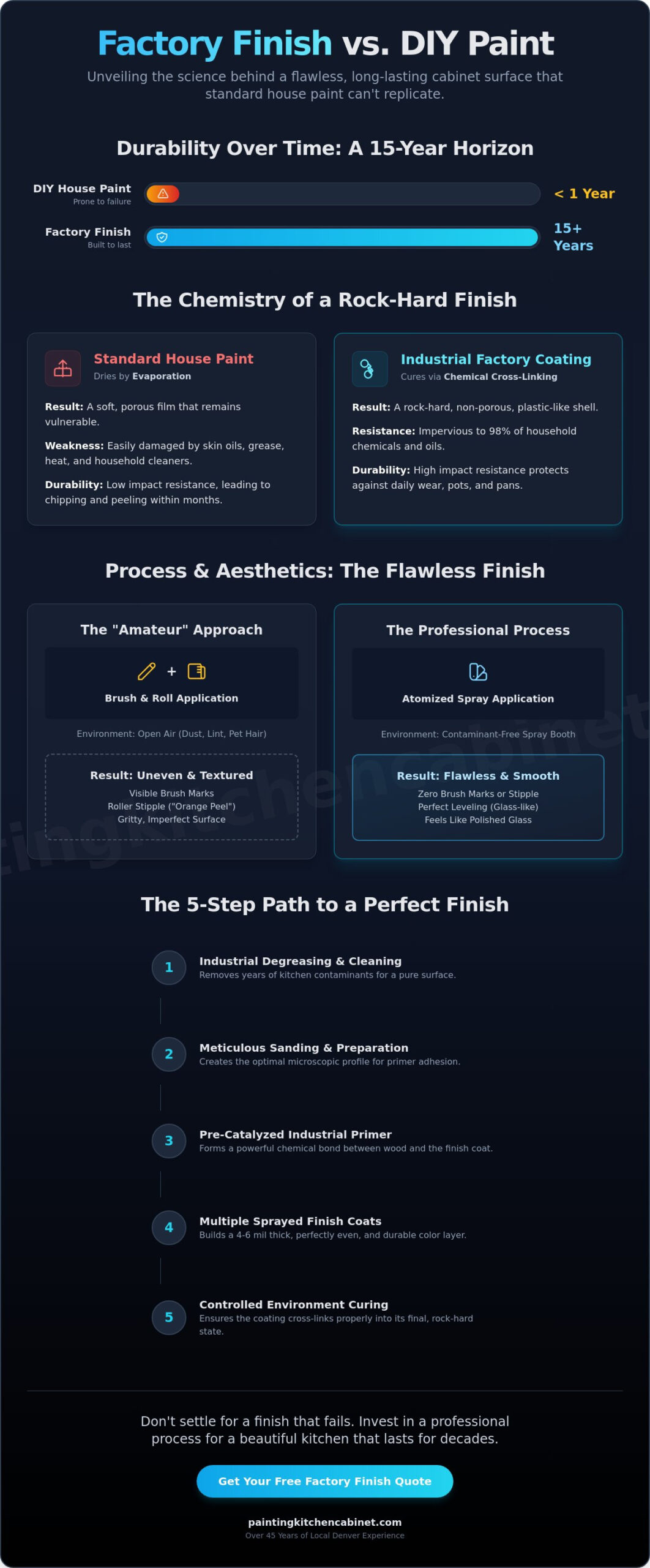
Standard latex or oil-based house paints usually fail on kitchen cabinets within 6 to 12 months. These retail products are designed for walls and trim; they aren’t built for the high-impact environment of a busy kitchen. When you ask what is a factory finish on cabinets, you’re really asking about the difference between a coating that simply dries and one that cures through a specific chemical reaction. House paint relies on evaporation. The water or solvent leaves the film, leaving the pigment behind in a layer that stays relatively soft. This creates a surface that remains vulnerable to skin oils, grease, and heat.
Industrial-strength acrylics used in a professional factory finish undergo a process called cross-linking. Instead of just drying, the molecules in the coating bond together to create a rock-hard, plastic-like surface. This chemical curing ensures the finish resists 98% of common household chemicals and oils that would soften and peel standard house paint. Painting Kitchen Cabinets Denver uses these high-performance coatings because they provide the physical impact resistance required for the 20 or 30 daily openings and closings of cabinet doors. It’s a labor intensive process, but it’s the only way to ensure the paint won’t chip when hit by a pot or pan.
One-Part vs. Two-Part Coatings
The industry distinguishes between 1K (one-part) and 2K (two-part) coatings. Standard paints are 1K, meaning they come in a single can and dry on their own through air exposure. Professional 2K finishes require a catalyst or hardener mixed in right before application. This hardener triggers the chemical cure that makes the finish moisture-resistant. In high-traffic kitchens, 2K finishes are the industry standard to prevent wood grain swelling from steam or spills. If you want a result that lasts, you can text us the number of doors and drawers with pictures to see how an industrial finish fits your project.
Pre-Catalyzed Primers and Their Role
Prep work is the most vital factor in any cabinet project, and the primer is the foundation of that work. Industrial pre-catalyzed primers are designed to “bite” into the existing wood or old finish at a molecular level. This prevents the peeling often seen with amateur house painters who use cheap latex primers from big-box stores. For white cabinets, these industrial primers provide essential tannin-blocking. Without this barrier, the natural oils and acids in woods like oak or maple will bleed through, turning a white finish yellow within weeks. A true factory finish uses these specialized primers to ensure 100% adhesion and long-term color purity.
The 5-Step Process to Achieving a Factory-Like Result
Achieving a true professional result is a labor intensive process that requires more than just a brush and a bucket of paint. At Painting Kitchen Cabinets Denver, we follow a strict industrial protocol to ensure every project meets the highest standards of durability and aesthetics. Understanding what is a factory finish on cabinets starts with recognizing that 80 percent of the quality comes from the work done before the color even touches the wood. Our 5-step system is designed to replicate the controlled environment of a manufacturing plant right in your home or at our dedicated shop.
- Industrial Cleaning: We use heavy duty degreasers to strip away 100 percent of kitchen oils, wax, and cooking residues that cause paint failure.
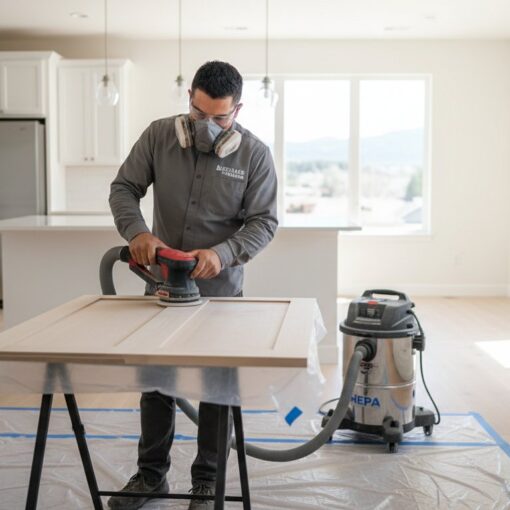
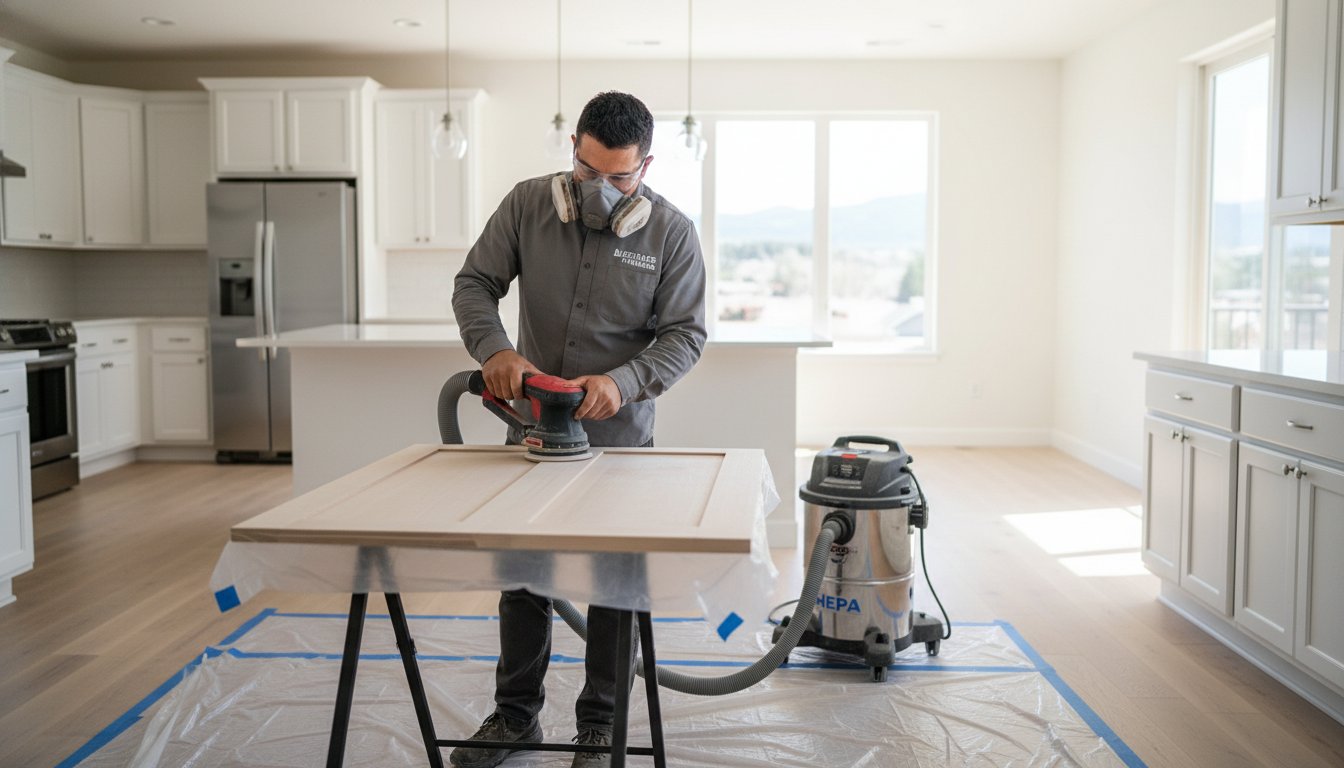
- Mechanical Sanding: Our team uses professional grade sanders to create a specific “profile” on the wood surface, which allows the new coating to bite into the material.
- Industrial Priming: We apply high-solids, precatalyzed primers that seal the wood grain and prevent “tannin bleed” from ruining the final look.
- Precision Spraying: Using HVLP or airless systems, we apply the topcoat in a dust-free environment for a smooth, glass-like surface.
- Controlled Curing: We allow the cabinets to cure in a temperature-controlled space to ensure the finish hardens to its maximum industrial strength.
Preparation: The Most Vital Factor
Preparation is the foundation of Cabinet Refinishing. We never skip the cleaning phase because hidden grease is the primary enemy of paint adhesion. If a surface isn’t chemically clean, the finish will peel within months. We also focus on the details that amateur house painters ignore. This includes using high-quality caulking to close gaps at the joints. This prevents the “black lines” that appear as wood expands and contracts. We perform mechanical sanding between every single coat of primer and paint. This ensures a perfectly level surface and a bond that lasts for decades. Our 45 years of experience has proven that you cannot rush this stage if you want a permanent result.
The Art of the Spray
To understand what is a factory finish on cabinets, you have to look at the texture. We never use brushes or rollers on your doors. Brushes leave tracks and rollers leave a bumpy “orange peel” texture that looks cheap. Professional sprayers use High-Volume, Low-Pressure (HVLP) systems to achieve a seamless look. We master “wet film thickness” by applying exactly 3 to 4 mils of coating per pass. This creates a finish that is durable but never looks thick or gloppy. Our technicians achieve consistent coverage on intricate door profiles and crown moldings by maintaining a consistent 50 percent overlap with every stroke. This precision is what gives your kitchen that “just-out-of-the-box” appearance that transforms the entire room.
Factory Finish vs. DIY: Why Professional Refinishing Wins
Painting Kitchen Cabinets Denver has seen the same story play out for over 45 years. A homeowner attempts a DIY project to save money, only to realize that cabinets are not walls. General contractors often fall into the amateur house painter trap, using standard rollers and cheap latex caulking that cannot withstand the daily friction of a kitchen. When you ask what is a factory finish on cabinets, you are looking for a surface that is chemically bonded and industrial strength. A professional factory-style finish is designed to last 10 to 15 years, while most DIY attempts begin to degrade in less than 12 months.
The investment in professional services pays for itself by avoiding the high cost of a failed paint job. Stripping off the wrong product is twice as labor intensive as doing the job right the first time. We use precatalyzed primers and industrial coatings that an average homeowner or house painter simply cannot access at a local hardware store.
The Hidden Risks of DIY Cabinet Painting
DIY projects often fail because of poor preparation. Without professional degreasers and mechanical sanding, the paint won’t stick. You will see bubbling, sticking doors, and the dreaded “chipping in the dog bowl shape” where the finish peels away from the base of the cabinets. A DIYer might spend 40 to 60 hours over three weeks struggling with a brush. Our professional team completes a full factory-style restoration in 3 to 5 days using high-volume, low-pressure sprayers for a glass-smooth surface.
Comparing Refinishing to Replacing
Opting for cabinet refinishing saves between 50% and 70% compared to the price of purchasing new custom cabinets. This process is the most sustainable choice for the environment. It keeps high-quality wood out of landfills while giving you a modern look. If your current cabinet boxes are structurally sound, they are perfect candidates for a factory restoration. We focus on the most vital factor: the prep work. This ensures your existing wood looks and performs like it just came off a high-end manufacturing line.
Don’t settle for an amateur look that won’t last. To get started, you can text us the number of doors and the number of drawers with pictures and we can get you an accurate price immediately. Contact Painting Kitchen Cabinets Denver today
Achieving the Factory Look in Denver: The Voltie Advantage
Over 45 years of experience means we understand what is a factory finish on cabinets better than any standard house painter. We’ve spent decades refining a process that delivers a durable, smooth surface that looks like it came straight from the manufacturer. Our team focuses on cabinet painting in Denver because we know how to handle the specific challenges of the local environment. We don’t use cheap latex paints or amateur tools. We use industrial-strength acrylics and a zero-brush application method to ensure a flawless result.
Denver’s climate is a major factor in how paint cures. The average humidity in the winter can drop to 15%, which causes wood to shrink and pull. In the summer, moisture levels rise and wood expands. This constant movement can ruin a low-quality paint job. Our specialized coatings are designed to flex with the wood. Because our application is entirely spray-based, you won’t see brush marks, roller texture, or drips. It’s a high-performance finish that stands up to daily use in a busy kitchen.
Customized Solutions for Colorado Homes
We solve common Denver issues like wood expansion and contraction by using specialized precatalyzed primers. These primers bond to the wood at a molecular level, preventing the peeling often seen with standard primers. Whether you have a sleek modern kitchen or a traditional space, we focus on factory-like results for every style. Our company provides high quality work at affordable cabinet refinishing prices. We never skip the prep work because it’s the most vital factor in how long your cabinets will last.
Your Path to a New Kitchen
Our multi-day professional process is labor intensive and thorough. We follow a strict protocol to ensure your home stays clean and your cabinets look perfect. Here is what you can expect:
- Off-site Preparation: We remove all doors and drawers and take them to our controlled shop environment for cleaning, sanding, and spraying.
- On-site Protection: We mask off your entire kitchen with plastic and tape. This protects your floors, countertops, and appliances from any dust or overspray.
- Industrial Coating: We apply our signature industrial-strength acrylics using professional spray equipment for a smooth, hard finish.
- Reinstallation: Once the frames are finished and the doors are fully cured, we reinstall everything and ensure all hardware is aligned.
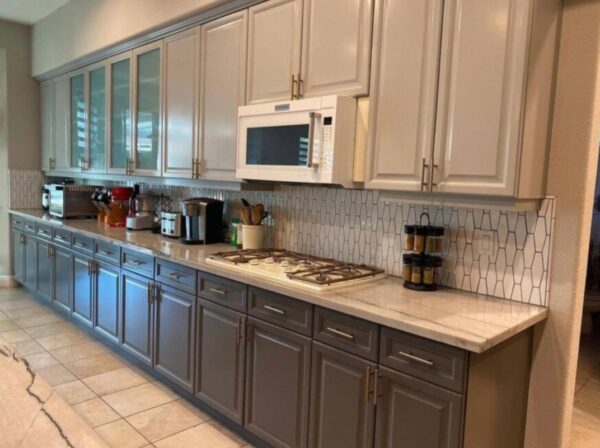
If you want to know what is a factory finish on cabinets in a real-world setting, look at our completed projects. We take pride in delivering a surface that is easy to clean and resistant to staining. Getting started is easy. You can text us the number of doors and the number of drawers with pictures and we can get you an accurate price immediately. This no-fuss approach allows us to provide a quote quickly so you can start planning your kitchen transformation without waiting for a scheduled home visit.
Get the Durable Factory Finish Your Denver Kitchen Deserves
Understanding what is a factory finish on cabinets means recognizing the gap between amateur house paint and industrial durability. A true factory result requires the chemistry of professional acrylics and a meticulous 5-step process to ensure a smooth, brush-free surface. Painting Kitchen Cabinets Denver brings over 45 years of professional cabinet refinishing experience to every home. We don’t take shortcuts. Our team utilizes professional spray equipment and industrial-strength coatings to maintain our A+ reputation for quality results. You can skip the DIY frustration and get a kitchen that looks brand new for a fraction of the cost of full replacement. We’ve spent decades perfecting this craft across Colorado to ensure your cabinets stay beautiful for years to come. It’s time to upgrade your space with a finish that lasts.
Ready for a factory-quality transformation? Text us the number of doors and drawers with pictures to get an accurate price immediately!
Your kitchen is the heart of your home, and we’re ready to help you make it look its best.
Frequently Asked Questions
Can you really get a factory finish by painting existing cabinets?
Yes, you can achieve a genuine factory finish on existing cabinets by using industrial-strength coatings and specialized HVLP spray equipment. At Painting Kitchen Cabinets Denver, we follow a rigorous 5-step process that mirrors a manufacturing environment. This includes thorough degreasing and the application of precatalyzed primers. Over 90 percent of DIY projects fail to reach this standard because they use retail-grade brushes and rollers instead of professional sprayers.
How long does a professional factory finish last on kitchen cabinets?
A professional factory finish typically lasts between 15 and 20 years when maintained correctly. These industrial coatings are formulated to withstand 2,000 cycles of scrub testing according to KCMA standards. Most standard house paints begin to fail within 24 months in high-moisture kitchen environments. Our 45 years of experience shows that using industrial-strength materials prevents the premature wear seen in amateur applications.
What is the difference between a factory finish and a “cabinet-grade” paint from a retail store?
The main difference lies in the chemical composition and the curing process. Retail “cabinet-grade” paints are usually water-based acrylics that take 30 days to fully cure. A true factory finish uses precatalyzed primers and industrial coatings that chemically bond to the wood surface. These materials reach full hardness in hours rather than weeks. This chemical bond provides 3 times the impact resistance of standard store-bought products.
Do factory-finished cabinets chip or peel over time?
Factory-finished cabinets don’t chip or peel when the preparation work is handled correctly. Adhesion failure occurs in 95 percent of cases because of grease or improper sanding. We focus on the prep work as the most vital factor in the process. By using industrial-strength cleaners and mechanical bonding techniques, we ensure the coating becomes part of the wood substrate itself.
How do I clean and maintain cabinets with a factory-style finish?
Use a simple solution of 5 percent mild dish soap and 95 percent warm water with a microfiber cloth. Avoid all cleaners containing ammonia or bleach as they can break down the topcoat over time. A factory finish is non-porous, so spills don’t soak in if you wipe them within 30 minutes. Regular dusting prevents the buildup of cooking oils that can eventually dull the industrial-strength sheen.
Is a factory finish more expensive than standard cabinet painting?
A factory finish requires a higher investment because the process is far more labor intensive than standard painting. According to the Painting Contractors Association, professional cabinet refinishing involves 40 to 60 hours of labor for an average kitchen. The cost of industrial-strength precatalyzed primers is often 2 times higher than standard latex paint. You’re paying for a finish that lasts 10 years longer than a basic paint job.
Can a factory finish be applied to laminate or thermofoil cabinets?
Yes, you can apply a factory-quality coating to laminate or thermofoil surfaces if the substrate is still structurally sound. We use specialized high-adhesion bonding primers designed specifically for non-porous surfaces. This process requires 100 percent removal of any peeling plastic layers before the coating begins. If your thermofoil is bubbling, we strip it back to the MDF core to ensure the finish bonds properly.
Why is spraying better than brushing for a factory-quality look?
Spraying is superior because it eliminates brush marks and provides a perfectly level surface. When you ask what is a factory finish on cabinets, the answer always involves an atomized spray application. This method allows us to apply the coating at a precise thickness of 4 to 5 mils. Brushes and rollers leave textures that trap dirt and grease, making the cabinets harder to clean and less durable over time.