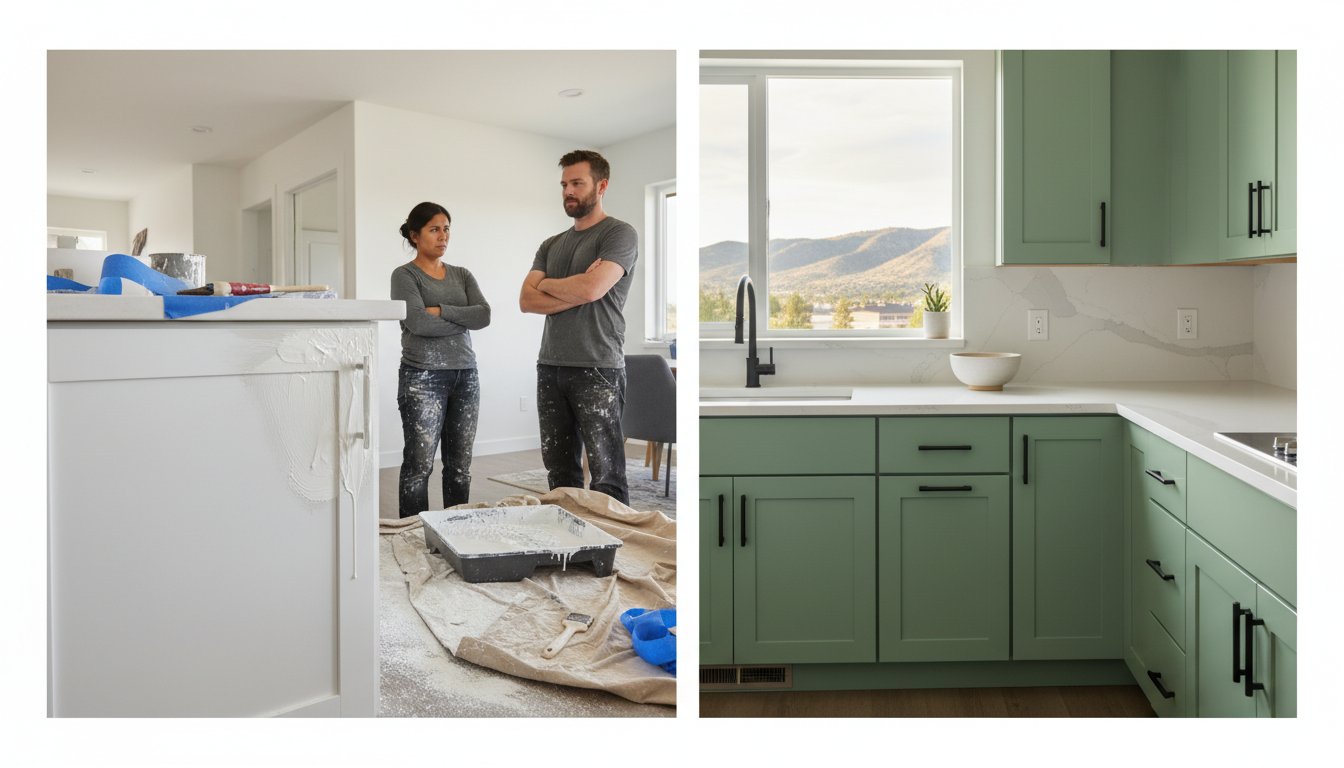
What if that weekend project you planned actually takes 80 hours of labor and leaves your kitchen unusable for three weeks? Many homeowners asking “should I paint my cabinets myself” are looking for a fresh look without the $20,000 average price tag of a full kitchen remodel. It’s frustrating to sort through conflicting online advice about prep work while worrying that your hard work will chip away and peel within six months.
You deserve a kitchen that looks brand new and stays that way for years. At Painting Kitchen Cabinets Denver, we have over 45 years of experience and know that a durable, factory finish requires more than just a hardware store brush. This article reveals the technical realities of DIY versus professional Cabinet Refinishing to help you decide which path protects your home investment. We will examine the industrial strength primers, the labor intensive sanding process, and why meticulous preparation is the most vital factor for success.
Key Takeaways
- Learn the truth about the “Pinterest trap” and why decorative store-bought paint often fails where industrial-strength factory finishes succeed.
- Discover why prep work is the most vital factor in a lasting finish and how invisible cooking oils can sabotage your entire project.
- Compare the technical gap between hand-brushing and professional sprayers to understand how to achieve a glass-smooth, durable surface.
- Before deciding should I paint my cabinets myself, calculate the “redo tax” and the hidden costs of professional-grade tools and equipment.
- Understand how 45 years of experience in the Colorado climate ensures a high-quality result that amateur methods simply cannot replicate.
The Reality of DIY Cabinet Painting: Pinterest vs. Your Kitchen
Many homeowners asking should I paint my cabinets myself are often misled by 60-second social media clips. These tutorials show the immediate transformation but rarely return to show the peeling and yellowing that happens 180 days later. There is a massive difference between decorative painting and a professional furniture finish. Kitchen cabinets are not walls. They are the hardest working surfaces in your home. They endure 110-degree heat from stovetops, constant grease splatter, and thousands of physical impacts every year. If the chemistry of your paint is wrong, the finish will fail quickly.
Professional cabinet refinishing involves a deep understanding of the wood finishing process, which includes specific steps for degreasing, mechanical sanding, and applying industrial-strength coatings. Amateur attempts often skip these labor-intensive steps. This leads to sticky doors that never fully cure and permanent texture issues that ruin the look of the wood. At Painting Kitchen Cabinets Denver, we have seen hundreds of DIY projects that ended in “painter’s regret” because the homeowner underestimated the technical requirements of the job.
The “Good Enough” Fallacy
A “good enough” job often costs you more in the long run. Real estate industry reports suggest that a poor kitchen renovation can decrease home value by 5 to 10 percent. Hand-brushed textures might look acceptable in a dimly lit garage, but high-output kitchen LEDs reveal every lap mark and brush stroke. Achieving a true factory-finish requires specialized spray equipment and a dust-free environment. Without these, you are left with a textured, amateur look that is impossible to clean and difficult to fix without a total strip and sand.
- Hand-brushed finishes trap grease and dirt in the brush tracks.
- Factory-spray finishes provide a smooth, non-porous surface.
- Incorrect primers lead to “tannin bleed,” where wood knots turn yellow through the white paint.
When DIY Might Actually Make Sense
If you are working on 30-year-old cabinet boxes in a laundry room or a basement utility area, a DIY approach might work. These are low-stakes environments with minimal traffic. You only need a basic kit to get started:
- High-quality sandpaper (120 to 220 grit).
- A heavy-duty degreaser like TSP.
- A high-quality synthetic bristle brush.
- A small foam roller for flat surfaces.
When you ask should I paint my cabinets myself for your primary kitchen, consider the 40 to 60 hours of labor required for a standard 20-opening kitchen. For most homeowners, the risk of a failed finish on a high-value asset isn’t worth the initial savings on labor.
The Technical Gap: Why Professional Spraying Beats Brushing
When you ask yourself, “should I paint my cabinets myself,” you’re really asking if a $20 brush and a gallon of store-bought paint can match a factory finish. The answer is almost always no. Professional results depend on the science of leveling. Industrial-strength acrylic coatings are designed to lay flat as they dry, but this only happens when applied through high-end spraying equipment. Our process at Painting Kitchen Cabinets Denver relies on over 45 years of experience to ensure every surface is glass-smooth. DIY applications lack the pressure and atomization required to prevent the orange-peel texture common with retail products.
Durability is the second half of the technical gap. Most kitchen cabinets endure 1,000 or more “touches” per year, along with exposure to grease and steam. We use precatalyzed primers that create a chemical bond with the wood. This is vital for preventing tannin bleed, where the natural oils in oak or cherry seep through and turn white paint yellow. Industrial coatings are tested against 24-hour exposure to harsh cleaners and moisture, whereas standard latex paint often softens or peels under the same conditions within 6 months.
The Problem with Brush and Roll Applications
Retail paints marketed as “self-leveling” rarely perform as advertised on vertical surfaces. Gravity pulls the paint down before it can flatten, resulting in visible sags and drips. DIYers also face the risk of “bridging.” This happens when thick paint fills in the decorative joints and seams of a door, making the cabinet look like it was dipped in plastic. This heavy application leads to “blocking,” a common failure where doors stick to the frames and pull the paint off when opened. Professional spraying avoids these issues by applying thin, even coats that preserve the sharp lines of your cabinetry.
Industrial Coatings vs. Amateur Latex
The chemistry of professional cabinet refinishing involves cross-linking resins. These resins create a molecular web as the coating cures, resulting in a finish that is significantly harder than house paint. While amateur latex paint can take up to 30 days to fully cure, industrial coatings are dry to the touch in 15 minutes and ready for assembly in hours. This speed isn’t just about convenience; it prevents dust and hair from landing in the wet finish, which is a constant battle for anyone wondering “should I paint my cabinets myself” in an open kitchen environment.
The 60-Hour Labor Trap: Why Prep Work is the #1 Cause of Failure
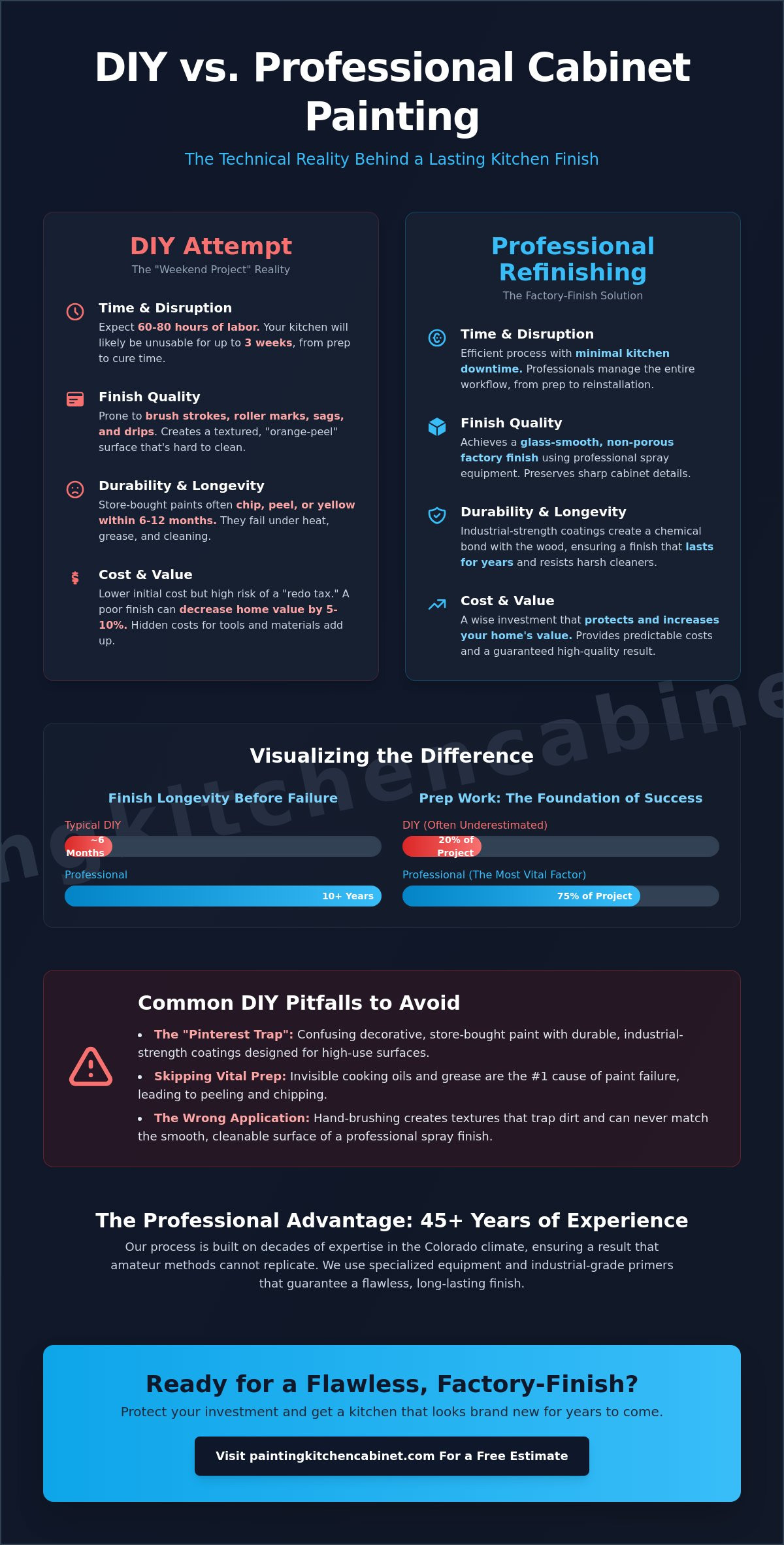
Most homeowners believe a kitchen transformation happens with a brush and a can of paint. That is a mistake. At Painting Kitchen Cabinets Denver, we know that 75% of a professional job is the labor that happens before the first coat of primer. If you are asking should I paint my cabinets myself, you must prepare for the 60-hour labor trap. This isn’t a weekend project; it is a grueling technical process that demands precision.
Deconstruction is the first hidden cost. You don’t just paint over hinges. You have to remove every door, drawer front, and piece of hardware. In an average kitchen, this means managing 50 to 100 individual pieces. If you don’t label them perfectly, your kitchen will never go back together correctly. Then comes the degreasing phase. Invisible cooking oils and skin oils are the enemy of paint adhesion. If you skip industrial strength cleaning, your new finish will peel off in sheets within six months. This is why professional Cabinet Refinishing requires such a heavy focus on preparation.
Mechanical abrasion is another non-negotiable step. You cannot simply “scuff” the surface and hope for the best. We also emphasize the importance of caulking cabinets to prevent dark gaps and cracks. Amateur house painters often use cheap latex caulking that fails. We use high-grade materials to ensure a seamless, factory finish that lasts for years.
The Meticulous Sanding Process
Sanding is where most DIY projects fail. We use a specific sequence of grits, usually starting with 120 grit to break the old seal and finishing with 220 grit for a glass-smooth surface. If you have maple, you sand differently than you do for oak. Managing dust in a residential environment is nearly impossible without professional HEPA extraction. Without it, fine white dust will settle in your vents, your furniture, and your lungs. You have to find the “sweet spot” between stripping the wood and providing enough tooth for the primer to bite.
Repairing Damage Before the First Coat
You can’t paint over problems and expect them to disappear. If you have oak cabinets, we fill the heavy grain to create a modern, smooth look. We also address cabinet repair near me issues like split stiles, loose panels, and water damage around the sink base. Masking is the final hurdle. You must protect your floors, counters, and appliances with professional-grade plastic and tape. When people ask should I paint my cabinets myself, they don’t realize they will spend 40 hours on prep before they ever see a hint of color.
Calculating the Real Cost: DIY Investment vs. Professional Value
When homeowners ask, “should I paint my cabinets myself,” they often focus only on the price of a few gallons of paint. This is a major oversight. Professional results require professional tools, and the cost of entry for a high-quality DIY job is higher than most people realize. To achieve a factory finish that lasts, you must invest in more than just a brush and a bucket. If you cut corners on equipment, the finish will fail within the first year.
The Tool Investment Reality
Professional results are impossible with cheap equipment. A $50 plastic sprayer from a local hardware store lacks the pressure and tip quality to atomize paint correctly. This results in “orange peel” texture or heavy runs that ruin the look of your doors. A professional-grade HVLP (High Volume Low Pressure) setup is necessary for a smooth surface. Beyond the sprayer, you must account for the following expenses:
- Safety Gear: High-quality respirators with organic vapor cartridges are mandatory. Breathing in atomized paint and primer particles causes long-term health issues.
- Ventilation: Proper fans and plastic containment systems are required to manage overspray and fumes.
- Consumables: You will spend between $200 and $400 on 220-grit sandpaper, tack cloths, high-quality masking tape, and floor protection before you even open a can of paint.
- Industrial Materials: Retail-grade latex paint is not meant for cabinets. You need industrial-strength precatalyzed primers and finishes that stand up to daily kitchen use.
There is also a “redo tax” to consider. We frequently receive calls from homeowners who attempted a DIY job and watched the paint peel off within months. Stripping off failed latex paint takes twice as much labor as starting with a fresh surface. You end up paying more for a professional to fix a botched job than you would have paid to have it done right the first time.
Kitchen Downtime Comparison
Time is your most valuable currency. A standard 30-door kitchen requires approximately 60 hours of intensive labor. For a DIYer working on weekends, this translates to 3 weeks of a non-functional kitchen. Living in a construction zone causes significant family stress. Dust from sanding gets into your pantry, and your counters are covered in plastic for twenty days. It is a grueling process that disrupts every meal.
A professional cabinet painting team completes this entire transformation in 3 to 5 days. We use a streamlined process that minimizes disruption and keeps your home clean. Beyond the time savings, a professional finish increases home appraisal value. Real estate data shows that a high-quality kitchen refresh can provide a return on investment of over 60 percent. An amateur job does the opposite; it signals to buyers that they will need to pay for a full renovation soon.
Professional Cabinet Painting in Denver: The Factory Finish Solution
Deciding should I paint my cabinets myself often comes down to the final result you want to see every morning. At Painting Kitchen Cabinets Denver, we’ve spent over 45 years perfecting a process that DIY methods and amateur house painters can’t match. The Colorado climate is exceptionally harsh on wood surfaces. Our extremely dry air and 40-degree temperature swings cause standard retail paints to crack and peel within 12 months. We understand these local variables and use materials specifically designed to withstand them.
Our “Spray Only” philosophy is a core company value. We don’t use brushes, and we don’t use rollers. Brushes leave stroke marks and rollers leave an orange-peel texture that traps dirt. We provide a smooth, durable finish that looks like it came straight from the manufacturer. Our local expertise in cabinet painting denver ensures your kitchen stands up to daily use and the unique Rocky Mountain environment.
Our Industrial Process
We use industrial-strength acrylics and precatalyzed primers that create a chemical bond with the wood. These aren’t the products you find at a big-box hardware store. Our coatings are durable, non-yellowing, and resistant to the oils and moisture found in a busy kitchen. The factory-like result is achieved through labor-intensive preparation. Prep work is the most vital factor in any job we take on. We follow a strict protocol for every project:
- Complete degreasing and cleaning of all surfaces.
- Meticulous sanding to ensure proper adhesion.
- Professional dust containment systems to protect your home.
- Precision masking of floors, appliances, and countertops.
We treat your kitchen like a controlled finishing shop, not a construction site. This commitment to clean work prevents dust nibs from ruining the final coat.
Taking the Next Step
Evaluating your own cabinets for refinishing potential is straightforward. If your cabinet boxes are structurally sound and you like the current layout, they are perfect candidates for a professional update. You don’t need to wait for a salesperson to visit your home for a basic estimate. We’ve simplified the quoting process for your convenience. You can text us the number of doors and the number of drawers with pictures and we can get you an accurate price immediately. This direct approach saves you time and provides the clarity you need to make a decision.
When you ask should I paint my cabinets myself, remember that your kitchen is the heart of your home and a major factor in its resale value. Your kitchen deserves a master craftsman who uses industrial tools and high-grade materials. This is a technical trade that requires decades of experience to master. Trust the experts who have been serving the Denver metro area for over four decades to deliver a finish that lasts.
Get the Durable Factory Finish Your Kitchen Deserves
Deciding should I paint my cabinets myself usually comes down to a choice between a 60 hour labor trap and a guaranteed professional result. DIY projects often fail because hardware store kits lack the industrial strength acrylic coatings required for a permanent, hard finish. At Painting Kitchen Cabinets Denver, we rely on 45 years of specialized experience to handle the intensive prep work that amateurs often skip. Our technical spraying process eliminates the brush marks and drips that ruin a kitchen’s aesthetic. We provide a non-yellowing, factory-like finish that resists the grease and heat of a busy Colorado home. You don’t have to risk your largest investment on a weekend experiment that might lead to peeling and failure. Trust the experts who have mastered the trade over four decades to get it right the first time.
Ready for a factory finish without the DIY headache? Text us your cabinet door and drawer count for an immediate quote!
Your dream kitchen is just a text away, and we are ready to make it a reality.
Frequently Asked Questions
Is it cheaper to paint cabinets yourself or hire someone?
It’s cheaper to paint cabinets yourself in terms of raw material costs, but the labor investment is massive. A standard kitchen requires 50 to 70 hours of work for a non-professional to complete correctly. You’ll spend roughly $300 on supplies, while professional services include industrial strength coatings you can’t buy at retail stores. Most homeowners find the time commitment outweighs the savings once they realize how labor intensive the process is.
What happens if I don’t sand my cabinets before painting?
Your paint will peel and chip within 12 months if you skip the sanding phase. Sanding creates a mechanical bond by scuffing the surface so the new coating has something to grab. Without this, the paint sits on top of the old finish instead of sticking. We see 95 percent of DIY failures caused by poor prep work. You must remove all grease and old clear coats to ensure the finish doesn’t fail.
How long does a DIY cabinet paint job actually last?
A DIY cabinet paint job typically lasts 2 to 4 years before it shows visible signs of wear and chipping. Professional finishes using precatalyzed primers and industrial coatings last 15 years or longer. When asking should I paint my cabinets myself, consider that amateur house painters use retail latex products. These aren’t designed for the constant contact and heavy cleaning kitchen cabinets endure every single day in a busy home.
Can you really get a factory finish with a brush and roller?
You cannot achieve a true factory finish using a brush and roller. Brushes leave visible tracks and rollers create a stipple texture that looks like an orange peel. A smooth, glass-like surface requires high-pressure spray equipment and a dust-free environment. Painting Kitchen Cabinets Denver uses industrial sprayers to ensure a level of durability and smoothness that hand tools simply cannot replicate on wood surfaces. The difference is immediately visible.
What is the best paint to use if I decide to DIY my cabinets?
The best paint for a DIY project is a waterborne alkyd or urethane enamel. These products level better than standard latex, but they still don’t match the hardness of professional precatalyzed lacquers. If you’re wondering should I paint my cabinets myself, remember that the quality of your finish depends on your primer. Use a high-quality bonding primer to prevent the paint from scratching off with a fingernail after it dries.
How much does a professional cabinet painting service cost in Denver?
According to 2024 data from HomeAdvisor, the average cost to paint kitchen cabinets ranges from $900 to $3,800 depending on the size of the kitchen. For an accurate quote in the local area, you can text Painting Kitchen Cabinets Denver the number of doors and the number of drawers with pictures. We can get you an accurate price immediately. This practical shortcut bypasses the guesswork of online estimates and gives you a real number.
Will painting my cabinets increase my home’s resale value?
Painting your cabinets can significantly boost your home’s value, with Zillow reporting that a kitchen refresh can yield a 65 percent return on investment. Modernizing a kitchen with a clean, factory finish makes the entire house look updated to potential buyers. It’s often the most cost-effective way to increase equity without a full $50,000 remodel. Most buyers prioritize the kitchen when making an offer, so the visual impact is vital.
What are the most common mistakes people make when painting cabinets themselves?
The most common mistakes are failing to degrease the wood and using cheap latex caulking. Kitchen cabinets collect 100 percent of the airborne grease from cooking, and if this isn’t removed with industrial cleaners, the paint won’t stick. Many DIYers also rush the drying time between coats. This leads to a tacky finish that attracts dust and hair, ruining the look of your Cabinet Refinishing project and requiring a complete strip and sand.