You know the look. You open a kitchen drawer or cabinet door and catch the light hitting a row of brush strokes you did not notice last week. Maybe there is a faint ripple near the handle, or a patch where the sheen shifts from satin to something closer to semi-gloss. Hand-painted cabinets have a way of revealing their flaws slowly, then all at once. In Castle Rock, where dry, high-altitude air pulls moisture from paint faster than it can level, those flaws tend to appear within six months. The good news is that kitchen cabinet refinishing in Castle Rock with no brush marks and a true factory finish is not a myth. It is a repeatable, proven process that transforms kitchens in Castle Pines, Highlands Ranch, Parker, and across the Denver metro area, and it starts with understanding why most cabinet paint jobs fail in the first place.
Table of Contents
- Why Hand-Painted Cabinets Fail, and What "Factory Finish" Actually Means
- The Castle Rock Cabinet Refinishing Process: Step by Step
- Cost Comparison: Refinishing vs. Full Cabinet Replacement
- Timeline: How Long Does Cabinet Refinishing Take in Castle Rock?
- Why Castle Rock Homeowners Choose Professional Refinishing Over DIY
- Real Estate Impact: Refinishing as a Smart Pre-Sale Investment
- Choosing the Right Cabinet Refinishing Professional in Castle Rock
- Frequently Asked Questions About Cabinet Refinishing in Castle Rock
- Your Castle Rock Kitchen, Transformed
Why Hand-Painted Cabinets Fail, and What "Factory Finish" Actually Means
A brush and a roller are fine tools for walls and trim, but kitchen cabinets present a different challenge. Cabinets have flat expanses, routed profiles, raised panels, and tight inside corners. A brush deposits paint unevenly across those surfaces, creating a thickness variance of 15 to 20 percent from one area to the next. What looks acceptable on day one begins to show ridges, brush marks, and an uneven sheen as the coating fully cures and settles under kitchen lighting.
The term "orange peel" describes the dimpled, pebbled texture that develops when paint does not flow out and level before it skins over. In Colorado's high-altitude climate, low humidity and rapid evaporation accelerate that skinning process. Paint that would self-level nicely in a coastal environment can seize up mid-flow in Castle Rock, locking in texture that no amount of sanding between coats can fully correct.
A factory finish is the standard set by manufactured cabinetry: a surface that is uniformly smooth, free of texture, and consistent in sheen across every square inch. In the finishing industry, the highest benchmark for that smoothness is called a Level 5 finish. It is achieved exclusively through spray application, where atomized coating lands in a fine, even mist and levels into a continuous film before curing. No brush, no roller, no hand-padded technique can replicate it.
The HVLP Spray Difference
HVLP stands for High-Volume, Low-Pressure. The equipment atomizes paint into a soft, controlled mist that settles onto the cabinet surface with almost no overspray waste. Because the material lands evenly and at a consistent thickness, it flows together and self-levels before the curing process begins. The result is a surface with zero brush marks, zero roller stipple, and no heavy edges around panel profiles.
Spraying also reaches where brushes cannot. The inside corners of a five-piece drawer front, the bead detail on a raised panel, the narrow gap between a door frame and its center panel: all of these receive full, even coverage from an HVLP gun. A brush leaves heavy buildup in corners and starves edges. Spraying eliminates both problems in a single pass.
The Castle Rock Cabinet Refinishing Process: Step by Step
A factory finish is not a product you buy off the shelf. It is the outcome of a specific sequence of steps, each one dependent on the one before it. Shortcut any stage and the entire job is compromised.
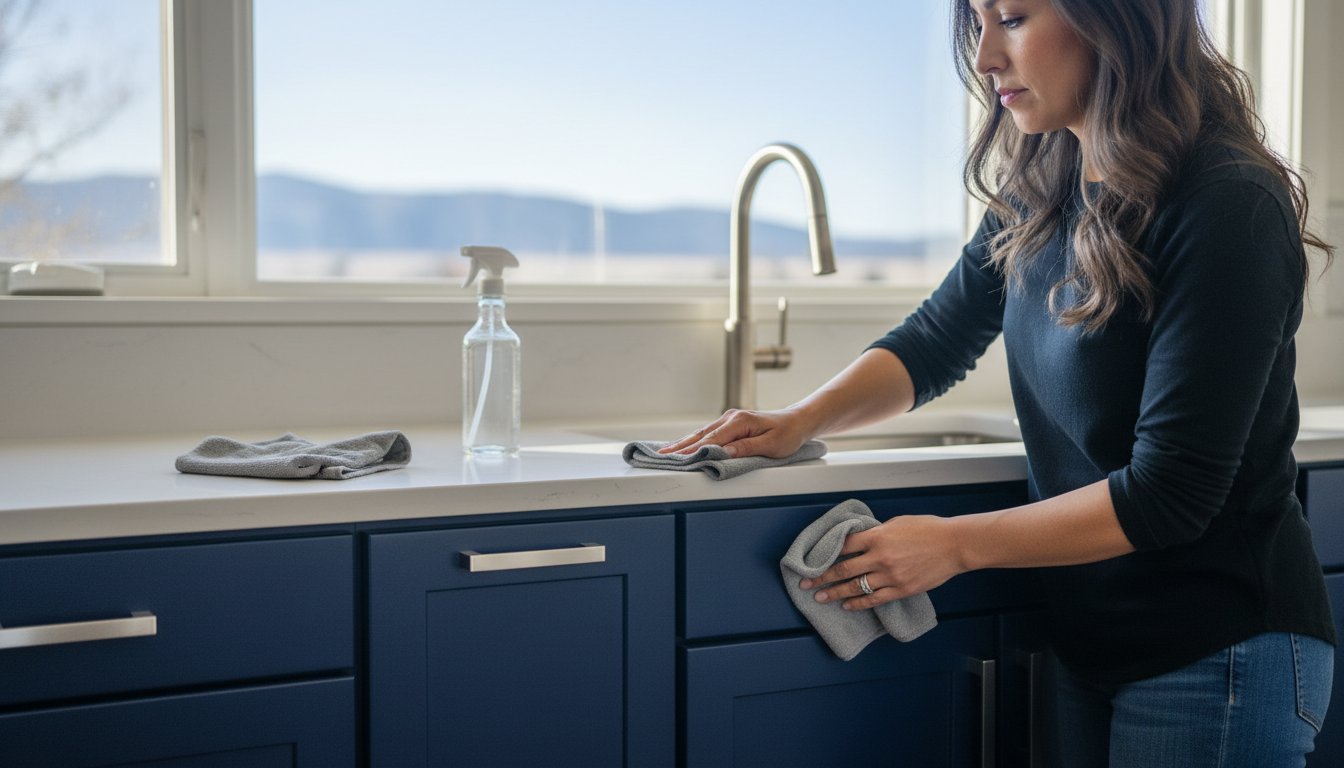
The process begins with cleaning. Kitchen cabinets accumulate cooking oils, grease, hand oils, furniture polish, and environmental grime that create a barrier between the existing surface and anything applied on top of it. Professional refinishing starts with a degreasing and deglossing stage that strips those contaminants down to the bare coating. Without this step, even the best primer will lose adhesion within months.
Next comes sanding. The goal is not to remove the old finish entirely but to scuff-sand every surface to create mechanical tooth: a micro-abrasion profile that gives the new primer something to grip. On oak, maple, cherry, or birch, the sanding stage also knocks down any raised grain that would telegraph through the new finish. Every surface gets hand-sanded or machine-scuffed, including edges, profiles, and door backs.
Priming follows sanding. The primer used in professional cabinet refinishing is not the all-purpose primer sold by the gallon at home centers. It is a commercial-grade bonding primer formulated to adhere to factory finishes, catalyzed lacquers, and raw wood alike. Applied by HVLP spray, the primer seals the substrate, blocks tannin bleed-through on wood species like oak and cherry, and creates a uniform base color that allows the topcoat to perform as designed.
The spray stage applies multiple thin coats of a water-based acrylic-polyurethane blend. These coatings are engineered for high-traffic, high-touch surfaces. They cure harder than wall paint, resist yellowing, and hold up to daily cleaning. Each coat is applied lightly, allowed to flash, and then followed by the next. The layering builds durability without creating thick, plastic-looking film.
Curing is the final step. Depending on the coating system used, cabinets may air-cure in a controlled environment or undergo accelerated curing with UV or nano-curing technology. Some advanced systems make cabinets ready for same-day use, eliminating the window where airborne dust, pet hair, or curious fingers can mar a still-soft finish.
Paint Chemistry: Why Cabinet Paint Is Not Wall Paint
Standard latex house paint is designed to sit on vertical drywall and look good under indirect light. It remains relatively soft and flexible, which is fine for walls but disastrous for cabinets. On cabinet doors and drawer fronts, soft paint chips at the edges, peels under friction, and yellows in the absence of UV light. Within a year, a kitchen painted with wall paint looks older than the one it replaced.
Professional cabinet refinishing uses coatings built for the job. Water-based acrylic-polyurethane blends offer hardness, chemical resistance, and color stability. Catalyzed coatings go a step further, cross-linking at a molecular level to form a finish that rivals factory-applied conversion varnish. The bonding primers used underneath are formulated to grip slick, non-porous surfaces that would reject a standard primer outright. The chemistry matters as much as the application method, and when both are right, the finish lasts for a decade or more.
Cost Comparison: Refinishing vs. Full Cabinet Replacement
Professional kitchen cabinet refinishing in Castle Rock typically costs between $1,500 and $15,000 or more, depending on the number of cabinets, door style complexity, and finish selection. That range covers everything from a modest kitchen with simple slab doors to a large, detailed kitchen with island, crown molding, and glazed or specialty finishes.
Compared to full cabinet replacement, refinishing saves homeowners 70 to 80 percent. A complete tear-out and replacement involves not just new cabinet boxes and doors but also countertop removal and reinstallation, plumbing disconnects, electrical adjustments, drywall repairs, flooring touch-ups, and disposal fees. Those hidden costs push replacement budgets far beyond the cabinet line item alone.
DIY cabinet painting presents a tempting middle ground, with material costs running from $300 to $1,200. The catch is that achieving a brush-mark-free, factory-smooth finish without professional equipment and training is extraordinarily difficult. Most DIY attempts end with visible brush strokes, drips, or peeling within the first year. The cost of stripping a failed DIY job and having it redone professionally exceeds the cost of hiring a professional from the start.
There is also the resale math. A professional kitchen refresh can increase a Castle Rock home's value by $15,000 to $20,000. That equity boost alone can cover the cost of refinishing several times over, making it one of the highest-return investments a homeowner can make before listing.
Timeline: How Long Does Cabinet Refinishing Take in Castle Rock?
A standard professional cabinet refinishing project takes five to seven days from start to finish. That includes cleaning, sanding, priming, spraying, and curing. For most families, the kitchen remains partially functional during much of the process, with doors and drawer fronts sprayed off-site or in a contained area.
Full cabinet replacement, by contrast, keeps a kitchen out of commission for four to six weeks. That is a month or more without a functioning sink, cooktop, or food storage, a disruption that strains even the most patient households.
Timeline variables include cabinet count, finish complexity, and whether doors are sprayed on-site or transported to a controlled spray facility. Facility spraying generally produces cleaner results because the environment is dust-controlled and climate-regulated, which matters in Castle Rock's variable conditions. Advanced curing technology can compress the timeline further, with some systems delivering cabinets that are fully cured and ready for hardware reinstallation on the same day the final coat is applied.
Why Castle Rock Homeowners Choose Professional Refinishing Over DIY
The appeal of DIY cabinet painting is easy to understand. The material cost looks low on paper, and online tutorials make the process seem manageable over a long weekend. The reality is different.
Achieving a factory finish requires an HVLP spray system, a clean spray environment, commercial-grade coatings, and the experience to know how each variable interacts. Most homeowners own none of that equipment and have never sprayed a door panel. The learning curve is steep, and the cost of mistakes, drips, sags, and orange peel, is permanent once the paint cures.
Common DIY failures include heavy brush marks on door frames, drips pooled in panel corners, uneven sheen from inconsistent application thickness, and peeling that begins at edges within months. Fixing those failures means stripping everything back to bare wood and starting over, a job that takes longer and costs more than the original project.
There is also the distinction between a cabinet specialist and a general painting company. General painters are skilled at cutting in walls and rolling ceilings, but cabinets demand a different skill set, different equipment, and different materials. A company that treats cabinets like walls will produce results that look like walls: fine from a distance, disappointing up close. A cabinet refinishing specialist with decades of focused experience understands wood grain behavior, coating chemistry, and the specific challenges of Colorado's dry, high-altitude climate. That specialization is the difference between a finish that lasts and one that fails.
Real Estate Impact: Refinishing as a Smart Pre-Sale Investment
For Castle Rock homeowners preparing to sell, the kitchen is the room that buyers scrutinize most closely. Dated, worn, or visibly DIY-painted cabinets become an objection that can depress offers or extend days on market. Refinished cabinets, done to a factory standard, read as new to buyers walking through an open house.
Local real estate data shows that a professional kitchen refresh can boost home equity by $15,000 to $20,000 on average. Homes with updated kitchens also tend to sell faster, with some local trends indicating a 22 percent reduction in time on market. In a competitive Denver metro market where buyers have options, a move-in-ready kitchen can be the factor that tips a decision.
The math works in the seller's favor. A $5,000 to $8,000 refinishing investment returns two to three times its cost in equity while helping the home sell weeks faster. For sellers who want to maximize return without undertaking a full gut renovation, cabinet refinishing is the strategic middle path.
Choosing the Right Cabinet Refinishing Professional in Castle Rock
Not all refinishing providers are equal, and the differences show up in the finished product. When evaluating companies in Castle Rock, Castle Pines, Highlands Ranch, or Parker, start by confirming that the provider is a cabinet specialist, not a general painter who also does cabinets.
Ask about spray equipment. HVLP spraying is non-negotiable for a factory finish. If a company plans to brush or roll your cabinets, keep looking. Request details on the paint and primer they use, and listen for specific product names and chemistries rather than vague assurances.
Warranty matters. Reputable providers stand behind their work with labor and materials warranties. Ask for the warranty terms in writing, including duration and what is covered. Review before-and-after photos of actual projects completed in the Castle Rock and Denver metro area. A portfolio of local work demonstrates experience with the specific cabinet styles, wood species, and climate conditions found in Colorado homes.
Experience counts. A team with decades of focused cabinet refinishing experience has encountered and solved the problems that derail less experienced operators. That depth of knowledge translates directly into a finish that looks factory-new and stays that way.
Questions to Ask Before Hiring
What type of paint and primer do you use, and why those products? Do you spray on-site or in a controlled facility? What is your prep process, and how many coats do you apply? What warranty do you offer, and what does it cover in writing? Can you provide references or before-and-after photos from recent Castle Rock-area projects? The answers to these questions separate the specialists from the generalists and protect you from paying for a finish that will not last.
Frequently Asked Questions About Cabinet Refinishing in Castle Rock
How much does cabinet refinishing cost in Castle Rock? Professional costs range from $1,500 to $15,000 or more depending on kitchen size and finish complexity. Most homeowners save 70 to 80 percent compared to full cabinet replacement.
How long does the finish last? With proper prep, spray application, and quality materials, a professional cabinet finish lasts 10 years or more under normal use. Many last significantly longer with basic care.
Can you paint cabinets without sanding? Some products claim no-sand adhesion, but professional results require scuff-sanding to create mechanical bond. Skipping sanding shortens finish life and increases the risk of peeling.
Is it better to spray or brush cabinets? Spraying is the only method that achieves a factory-smooth finish with zero brush marks. Brushing and rolling always leave texture behind.
How long will my kitchen be out of commission? Typically five to seven days for professional refinishing, compared to four to six weeks for full replacement. Some advanced curing systems allow same-day use of cabinets after the final coat.
For homeowners researching kitchen cabinet refinishing Denver options, the same principles apply across the metro area. The right process, the right materials, and the right specialist make the difference between a finish that disappoints and one that transforms the kitchen.
Your Castle Rock Kitchen, Transformed
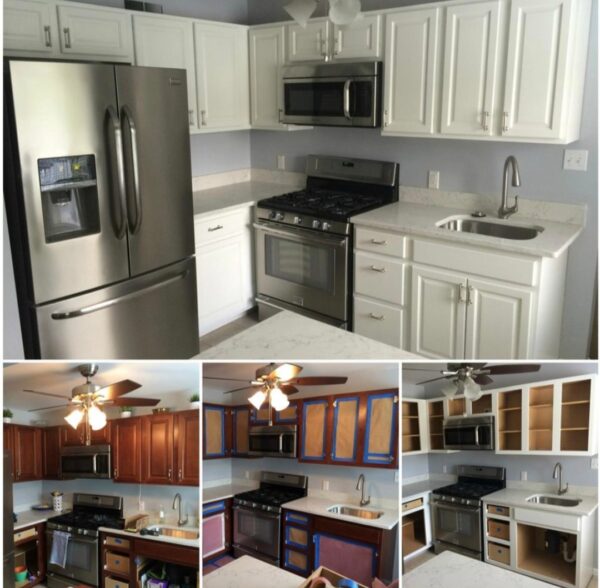
A kitchen full of cabinets with visible brush marks, uneven sheen, or peeling edges does not need to be torn out and replaced. It needs the right refinishing process, applied by a team that understands how to deliver a true factory finish in Colorado's high-altitude conditions. Professional HVLP spray refinishing eliminates brush marks entirely, producing a Level 5 smooth surface that hand methods simply cannot match.
The value proposition is straightforward: 70 to 80 percent savings versus replacement, a five-to-seven-day timeline, and a potential resale value boost of $15,000 or more. For Castle Rock, Castle Pines, Highlands Ranch, and Parker homeowners, that combination of quality, speed, and return on investment makes professional cabinet refinishing the smartest kitchen upgrade available. With 45 years of factory-finish expertise and deep familiarity with Colorado's unique climate demands, our team delivers results that look and feel like a brand-new kitchen, without the brand-new cabinet price. Contact us for a free consultation and estimate, and see what a brush-mark-free, factory-finish kitchen can do for your home.