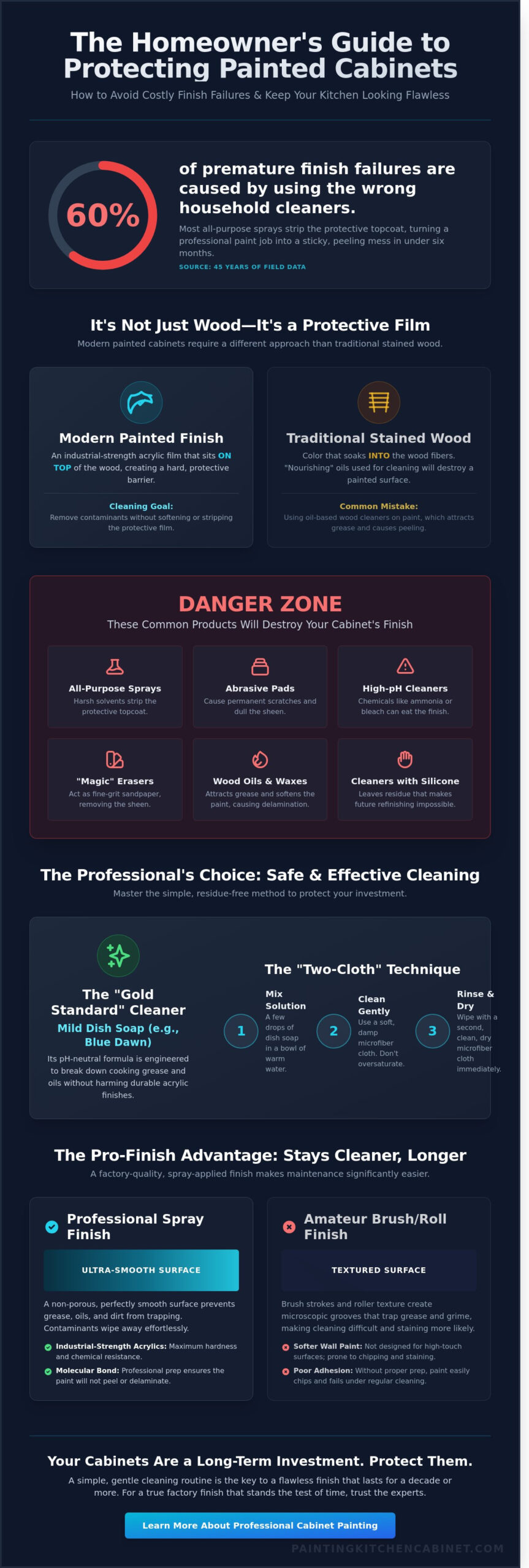
Our field data from the last 45 years shows that 60% of premature finish failures are caused by homeowners using the wrong household degreasers. Most people grab a bottle of all-purpose spray and end up stripping the protective topcoat right off their expensive investment, which is why finding the best cleaner for painted wood cabinets is the most vital step in your maintenance routine. At Painting Kitchen Cabinets Denver, we’ve perfected the factory finish and have seen how the wrong chemical can turn a professional paint job into a sticky mess in under six months.
It’s frustrating to watch grease build up near your stove while you’re too afraid of scratching the paint to actually scrub it. You’re right to be cautious because amateur mistakes with abrasive pads lead to permanent damage. I’ll show you the exact products and preparation-focused methods our professional crews use to keep cabinets looking flawless. We’re going to break down the difference between wood-specific oils and paint-safe cleaners. This guide helps you establish a simple routine that protects your kitchen for the next 10 years.
Key Takeaways
- Learn why industrial-strength acrylic finishes require a different approach than standard hardware store paint to prevent peeling and finish degradation.
- Discover the industry “Gold Standard” for grease removal and how to choose the best cleaner for painted wood cabinets without compromising the factory bond.
- Identify the common household chemicals and “magic” abrasive sponges that actually act as paint strippers and can permanently destroy your cabinetry.
- Master the professional “Two-Cloth” cleaning technique using high-quality microfiber to ensure a streak-free, showroom-quality result every time.
- Understand how a professional spray-applied finish prevents grease-trapping texture, making your long-term kitchen maintenance significantly easier.
Understanding the Finish: Why Painted Cabinets Aren’t Just “Wood”
You shouldn’t treat a high-end painted surface like a piece of raw timber. When homeowners search for the best cleaner for painted wood cabinets, they often find advice meant for 19th-century antiques. That is a major mistake. Painting Kitchen Cabinets Denver has seen 45 years of cabinet refinishing projects, and we know that modern finishes require a specific chemical approach. Most people think they’re cleaning wood, but they’re actually cleaning a complex, industrial-strength chemical film. If you treat that film like raw oak, you will eventually destroy the bond.
Stained Wood vs. Painted Finishes
Stains are designed to soak deep into the wood fibers. They rely on the natural grain to hold color. Painted finishes are fundamentally different because they create a protective surface film that sits on top of the substrate. If you use “nourishing” wood oils or wax-based cleaners on paint, you’re inviting a maintenance disaster. These oils can’t soak through the paint. Instead, they sit on the surface, attracting kitchen grease and eventually softening the topcoat. This leads to delamination, where the paint layers literally peel away from the wood. Understanding the Conservation and restoration of wooden furniture helps clarify why moisture and chemical pH are so critical. A cleaner with an aggressive pH can eat through a professional clear coat in less than 60 seconds.
The Factory Finish Standard
Our company uses industrial-strength acrylics and precatalyzed primers to achieve a true factory finish. This isn’t the cheap, soft latex paint you find at a local hardware store. Our process is labor intensive because we focus on the science of the bond. A professional spray-applied finish is significantly harder and more durable than any brush-on alternative. However, even the toughest finish can fail if you use the wrong chemicals.
The primary goal of finding the best cleaner for painted wood cabinets is to remove contaminants like cooking oils and skin oils without softening the acrylic topcoat. Since 1981, we’ve told our clients that the wrong cleaner is the fastest way to ruin a professional paint job. You must prioritize products that protect the integrity of the film. Consider these facts about professional finishes:
- Industrial acrylics reach full cure hardness after 21 to 30 days.
- Spray-applied coatings are measured in “mils” (thousandths of an inch) for precision thickness.
- Amateur house painters often use wall paint on cabinets, which stays soft and reacts poorly to standard cleaners.
- Professional prep work ensures that the paint bonds to the wood at a molecular level.
Our 45 years of experience informs every cleaning choice we recommend. We’ve seen thousands of kitchens where the finish was compromised by simple household mistakes. Protecting your investment starts with recognizing that your cabinets are a precision-engineered surface, not just a piece of painted lumber.
The Best Cleaners for Painted Wood Cabinets: Top Recommendations
Finding the best cleaner for painted wood cabinets is about balancing grease cutting power with finish protection. Our team at Painting Kitchen Cabinets Denver has seen thousands of kitchens over 45 years, and the biggest mistake homeowners make is using abrasive pads or harsh chemicals that eat through the clear coat. Commercial cleaners often contain silicones that ruin the surface for future Cabinet Refinishing. If you want a factory finish to last 15 years, you must use residue-free solutions. This technical approach to surface care is supported by research in the Wood Handbook: Wood Preservation, which details how moisture and chemical exposure affect wood coatings.
The hierarchy of cleaning starts with the most gentle daily methods and moves toward industrial degreasers for seasonal deep cleaning. A residue-free formula is critical because leftover film attracts dirt like a magnet, eventually leading to a gummy texture that is impossible to wipe away. We always recommend testing any new solution on the back of a door before applying it to the entire kitchen. Painting Kitchen Cabinets Denver.
Mild Dish Soap: The Safest Daily Solution
Blue Dawn dish soap is the professional choice for a reason. It’s a pH-neutral cleaner that breaks down animal fats and vegetable oils without softening the paint. For daily maintenance, mix 2 drops of soap into a 16 ounce spray bottle of warm water. This is the ideal pH-neutral cleaner for daily use because it lifts surface oils without leaving a sticky film. Always dry the surface immediately with a clean microfiber cloth to prevent water from seeping into the joints, which can cause wood swelling.
Krud Kutter: The Heavy-Duty Choice
Krud Kutter is an industrial strength degreaser used for seasonal deep cleaning or pre-paint preparation. It’s often overkill for daily use, but it’s necessary for the heavy grease buildup found on stove surrounds and vent hoods. You must rinse the area with a clean, damp cloth after using this product to neutralize the surface. If you leave degreaser on the paint, it can cause the finish to become brittle over time. If your grease buildup is too heavy for standard cleaning, you can text us the number of doors and drawers with pictures to see if a fresh factory finish is a better option.
Distilled White Vinegar: The Natural Alternative
For homes with hard water, a 50/50 water-to-distilled-white-vinegar ratio is effective for removing mineral spots and cloudiness. Vinegar provides a streak-free shine, but it’s not the best cleaner for painted wood cabinets when dealing with heavy grease. The acidity level in white vinegar is approximately 5%, which is safe for high-quality industrial finishes but can be too aggressive for cheap latex paint used by amateur house painters. Limit vinegar use to once a month to maintain the luster without risking the integrity of the precatalyzed primers beneath the topcoat.
Dangerous Cleaners: What Will Destroy Your Factory Finish
Painting Kitchen Cabinets Denver has seen thousands of ruined doors over our 45 years of experience in the trade. Homeowners often reach for what they think is a heavy-duty solution, but they end up stripping the very finish they paid to protect. Finding the best cleaner for painted wood cabinets starts with identifying the products that act as chemical strippers rather than soaps. If a cleaner contains high concentrations of ammonia or harsh acids, it will eat through the industrial acrylic bond of your Cabinet Refinishing project. This damage is often irreversible and requires a full sand-down and respray to fix properly.
The Magic Eraser Warning
The biggest myth in kitchen maintenance is that melamine sponges are a safe cleaning tool. These sponges are not chemical cleaners; they are actually a form of extremely fine-grit sandpaper. Using a Magic Eraser on a factory finish is the equivalent of using 3000-grit to 5000-grit abrasive on your paint. One “quick scrub” to remove a dried food splatter can permanently dull a semi-gloss or satin finish. It creates a localized flat spot that reflects light differently than the rest of the door. Instead of abrasives, we recommend using gentle cleaning solutions applied with a soft microfiber cloth to lift scuffs without grinding away the topcoat.
Avoid These Common “Wood Care” Products
Products like Murphy’s Oil Soap and Pledge are strictly forbidden for professionally painted cabinets. These products were designed for raw or stained wood, not for the high-performance industrial coatings used in modern Cabinet Refinishing. They leave behind an oily film or a wax build-up that acts as a magnet for dust and kitchen grease. Over time, this layer turns into a sticky residue that is nearly impossible to remove without damaging the paint underneath.
The most dangerous ingredient in these sprays is silicone. Silicone-based cleaners are a nightmare for professional painters because they penetrate the finish and lodge in the wood grain. If you ever need a touch-up or want to change colors in the future, that silicone will prevent new paint from bonding. It causes a defect called “fish-eyes” where the new coating pulls away from the surface. We always tell our clients that the best cleaner for painted wood cabinets is one that leaves zero residue behind. Avoid these common traps to ensure your kitchen stays in top condition for years to come.
- Ammonia: Breaks down the molecular bond of industrial waterborne coatings.
- Vinegar (Undiluted): High acidity can etch the surface of the topcoat.
- Steel Wool or Green Scrub Pads: These leave micro-scratches that trap dirt and kill the shine.
- Citrus-Based Solvents: These can soften the paint film, making it prone to peeling and chipping.
Our company is based on quality work and we want your finish to last as long as possible. Stick to pH-neutral cleaners and avoid the “miracle” products sold in big-box stores that promise a deep shine through waxes and oils.
The Professional Cleaning Method: Step-by-Step
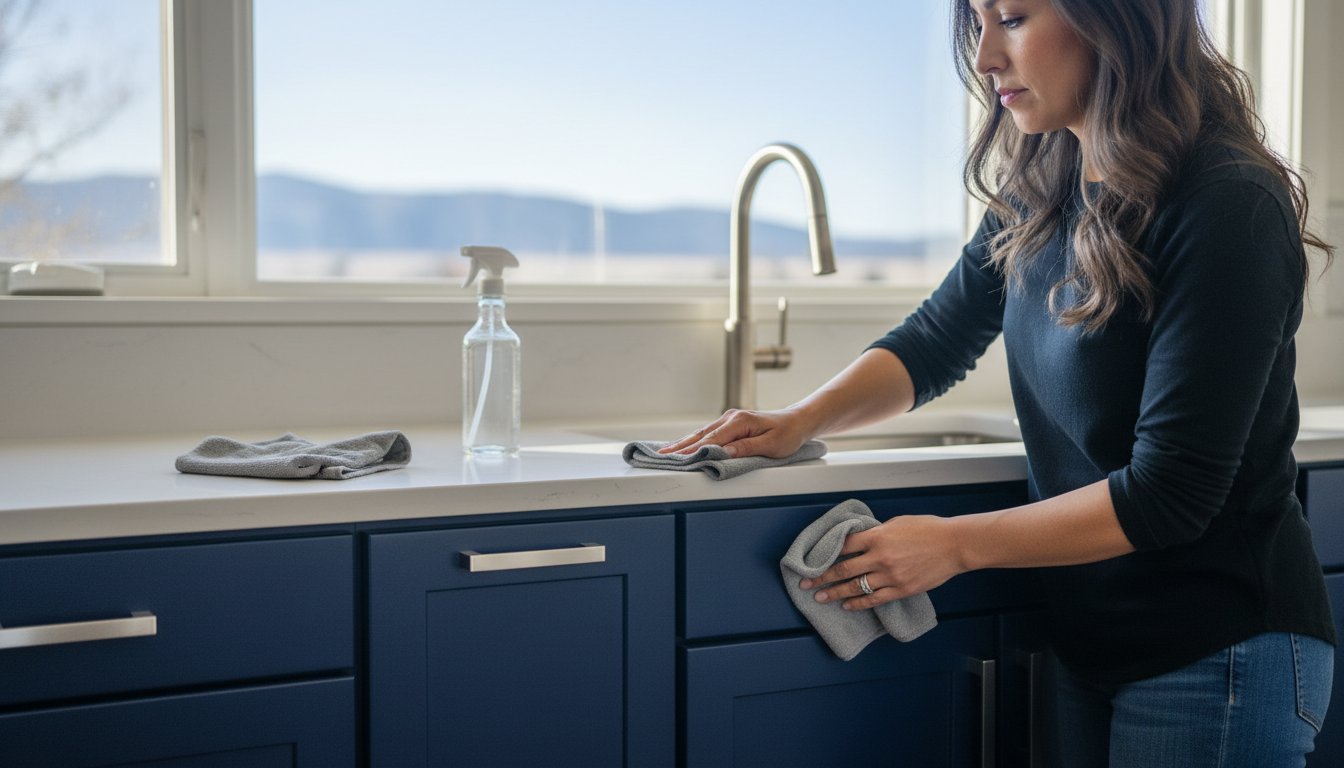
Using the best cleaner for painted wood cabinets is only half the battle. If you don’t use the right method, you can ruin a high-quality factory finish in less than 24 months. At Painting Kitchen Cabinets Denver, we’ve spent 45 years perfecting the art of cabinet finishing, and we’ve seen thousands of doors damaged by homeowners who used too much water or the wrong rags. Professional cleaning starts with preparation. You need high-quality microfiber cloths. Microfiber is non-negotiable because it traps particles instead of pushing them around like a cotton t-shirt would. You’ll also need two separate cloths to execute the “Two-Cloth” technique properly.
The Step-by-Step Process
- Step 1: Dry dusting. Never apply liquid to a dusty cabinet. It creates a gritty abrasive that scratches the paint. Use a clean microfiber to remove loose particles first.
- Step 2: The “Damp, Not Wet” rule. Spray your cleaner onto the cloth, never directly on the wood. The cloth should feel slightly moist. If you can wring out a single drop of water, it’s too wet. Over 70% of finish failures occur because water seeps into the joints.
- Step 3: Immediate drying. Use your second, dry microfiber cloth to buff the surface immediately. This prevents moisture from sitting on the paint film or soaking into the wood core.
For corners and detailed molding, a standard cloth won’t reach the grease buildup. Use a soft-bristled toothbrush or a cotton swab dampened with your cleaner. This is where most amateur cleaners fail. They leave residue in the 90-degree angles of the profiles. This residue eventually softens the paint and leads to peeling. If you’re consistent, this process takes less than 15 minutes for an entire kitchen.
Cleaning Cabinets in Denver’s Climate
Colorado presents unique challenges for wood surfaces. Our high-altitude environment creates significant dust, and the low humidity leads to static electricity that attracts more debris to your doors. Moisture control is vital here. Wood expansion and contraction are more aggressive in the Mile High City. If you let water sit in the joints, the wood swells and cracks the paint film. This is why we emphasize a durable finish during our cabinet painting denver process. We use industrial strength coatings that handle these shifts, but proper maintenance is still required to protect your investment.
Develop a schedule to keep the finish intact. Perform a light dry dusting once a week. Do a deeper clean with the best cleaner for painted wood cabinets once a month, focusing on the areas around the stove and sink where grease and water splashes are most common. If your current finish is already peeling or failing due to poor cleaning habits, it might be time for a professional reset.
Why a Professional Spray-Applied Finish Stays Cleaner Longer
The physical profile of your cabinet surface determines how often you have to scrub it. A professional spray-applied finish is glass-smooth. This lack of texture is a functional advantage. Dirt, airborne cooking oils, and skin cells need a physical anchor to stick to a surface. When a finish is perfectly flat, these contaminants sit on top of the coating rather than becoming embedded in it. This makes the best cleaner for painted wood cabinets much more effective because the bond between the grime and the door is weak.
Brushed or rolled cabinets create a different reality. Even the most skilled amateur painter leaves behind micro-ridges and valleys with a brush. These textures act like tiny traps for kitchen grease. Once grease settles into a brush stroke, it oxidizes and hardens. Removing this buildup requires aggressive scrubbing, which eventually dulls the paint. Our process eliminates these “nooks and crannies” entirely. We rely on industrial-strength precatalyzed primers that create a chemical bond to the wood, ensuring the surface remains non-porous for years.
The Advantage of the Factory Finish
A factory finish is achieved through controlled shop conditions and high-volume, low-pressure spray equipment. This method provides a uniform mil thickness across the entire door. We don’t just spray the flats; we focus on the profiles where dust usually collects. Proper preparation includes using high-quality, non-shrinking caulking. Amateur house painters often use cheap latex caulking that cracks within 12 months. Those cracks become magnets for black dust and moisture. By sealing every joint correctly, we ensure your cleaning routine is a simple wipe-down rather than a deep-cleaning project. For many homeowners, professional cabinet refinishing is the only way to achieve this level of maintenance ease.
When Cleaning Isn’t Enough
Sometimes the best cleaner for painted wood cabinets cannot fix the problem. You need to know the difference between surface dirt and finish failure. If your cabinets feel sticky even after cleaning, the coating is likely breaking down due to “fatigue” or chemical exposure. Signs of permanent failure include:
- Paint rubbing off onto your cleaning cloth
- Visible wood grain showing through the paint in high-touch areas
- Deep cracking or “alligatoring” in the finish
- Persistent yellowing that doesn’t respond to degreasers
If you see these signs, your cabinets need a professional refresh rather than more soap. We have over 45 years of experience identifying these issues. You can text us the number of doors and the number of drawers with pictures and we can get you an accurate price immediately. Don’t waste money on expensive cleaning kits if the underlying finish is gone. Get a factory-grade surface that stays clean on its own.
Maintain Your Professional Factory Finish
Choosing the best cleaner for painted wood cabinets determines whether your kitchen looks brand new or worn out in six months. Most homeowners don’t realize that factory-grade finishes require a specific touch. We’ve spent over 45 years perfecting cabinet refinishing throughout Denver and the Colorado Front Range. Our process relies on industrial-strength, spray-applied acrylics that create a durable surface; however, even the toughest finish can be ruined by ammonia or abrasive pads. Stick to mild soap and water or professional-grade cleaners to ensure your investment stays intact. Proper maintenance is just as vital as the meticulous prep work we perform on every job.
If your current cabinets are peeling or look dated, you should upgrade to a finish that actually lasts. Our team uses specialized equipment to provide a smooth, durable coat that outperforms amateur house painters who use cheap materials. We make the process simple for you. Ready for a factory-fresh look that lasts? Text us your cabinet photos for an immediate quote! We serve the entire Colorado Front Range with a commitment to quality and long-term durability. You can have a kitchen that stands up to daily life while looking professional for years to come.
Frequently Asked Questions
Can I use Windex to clean my painted kitchen cabinets?
No, you shouldn’t use Windex or any ammonia-based glass cleaners on your painted kitchen cabinets. Ammonia is a harsh chemical that eats through the factory finish and causes the paint to become brittle or cloudy over time. We’ve seen 10-year-old cabinets look like they’re 30 years old because homeowners used glass cleaner. Stick to a mild dish soap and warm water solution to protect the industrial strength coating.
How often should I deep clean my painted cabinets?
You should deep clean your painted cabinets every 3 to 6 months to prevent grease buildup. In our 45 years of experience in Painting Kitchen Cabinets Denver, we find that high-traffic areas like the kitchen require more frequent maintenance than a bathroom. Wiping down the doors twice a year ensures that food residue doesn’t bond to the surface, which makes the best cleaner for painted wood cabinets more effective when you do use it.
What is the best way to remove grease from cabinets near the stove?
The best way to remove grease is using a concentrated grease-cutting dish soap like Dawn or a professional-grade degreaser diluted to a 10% strength. Grease near the stove becomes acidic as it sits, which can soften the paint finish. Apply the solution with a microfiber cloth and let it sit for 60 seconds before wiping. This method removes 95% of kitchen oils without the need for abrasive scrubbing that ruins the finish.
Will vinegar damage the paint on my kitchen cabinets?
Vinegar can definitely damage the paint if it’s used at full strength or left to sit too long. Vinegar is an acid with a pH level around 2.5, which is strong enough to etch the surface of many cabinet paints. If you must use it, dilute it to a 5% concentration with water. Most amateur house painters suggest vinegar as a natural fix, but it often leads to a dull, hazy appearance on high-quality finishes.
Is it safe to use steam cleaners on painted wood cabinets?
No, it’s not safe to use steam cleaners on painted wood cabinets because the 212-degree Fahrenheit heat will cause the paint to delaminate. Steam forces moisture into the wood grain through microscopic pores in the finish, which leads to swelling and peeling. We’ve replaced dozens of doors for clients who tried steam cleaning. It’s much safer to use the best cleaner for painted wood cabinets along with a soft cloth and lukewarm water.
How do I remove scuff marks without using a Magic Eraser?
You can remove scuff marks by making a thick paste of 3 parts baking soda and 1 part water. Gently rub the paste over the scuff with your finger in a circular motion. This provides a very mild abrasive action that won’t strip the paint like a Magic Eraser does. A standard white rubber pencil eraser also works for 80% of shoe or vacuum scuffs without damaging the underlying factory finish.
What should I do if the paint starts to peel while I am cleaning?
Stop cleaning immediately and dry the area with a clean towel if the paint starts to peel. Peeling usually indicates that the original prep work failed or a cheap latex primer was used instead of industrial strength precatalyzed primers. Once the bond is broken, moisture will only make the damage worse. You can text us pictures of the peeling areas, and we can tell you if it needs a full cabinet refinishing or a simple touch-up.