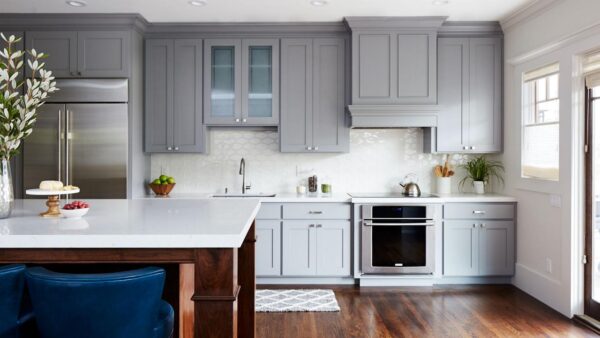

A standard house paint job on your kitchen cabinets is a guaranteed recipe for failure within the first 180 days of use. Most homeowners and amateur painters use cheap latex products that simply cannot handle the grease, steam, and constant contact found in a busy kitchen. If you want to know how to prevent cabinet paint from chipping, you have to stop thinking like a DIYer and start thinking like a factory finisher. It is incredibly frustrating to spend 40 hours of your life scrubbing and painting only to see the edges of your doors peeling before the season even changes.
You deserve a kitchen that looks high-end and stays that way for years, not weeks. We have spent over 45 years perfecting a labor intensive process that delivers a durable, industrial strength result. In this guide, we are sharing the professional secrets to achieving a chip-resistant finish that stands up to heavy daily wear and tear. We will break down the vital importance of prep work, the specific precatalyzed primers we use, and the exact steps required to get that smooth, factory finish your home deserves.
Key Takeaways
- Understand the science of mechanical and chemical bonding to eliminate adhesion failure before you even pick up a brush.
- Discover how to prevent cabinet paint from chipping by following the “Industrial Prep” standard, where 75% of the durability is built before the first coat is applied.
- Learn why industrial-strength acrylics are the only choice for a true factory finish, outperforming even the most expensive “high-end” latex wall paints.
- Identify the critical 30-day curing window and the specific maintenance steps required to protect your cabinets while they reach maximum hardness.
- Leverage over 45 years of professional experience to achieve a chip-resistant finish that stands up to the unique demands of the Denver climate.
Understanding Why Cabinet Paint Chips: The Science of Adhesion
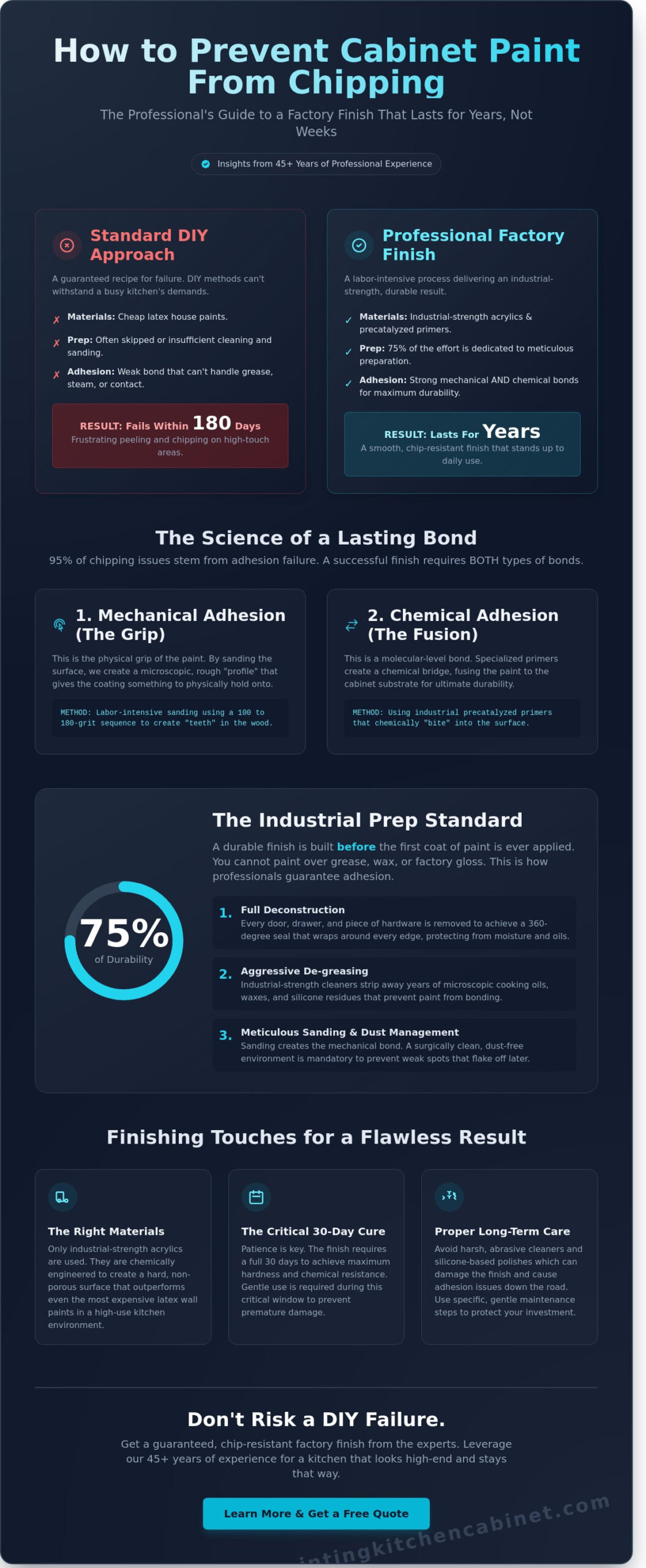
Adhesion failure is the primary reason cabinet finishes fail prematurely. This failure is the breakdown of the bond between the wood substrate and the applied coating. Understanding The Science of Paint is essential because paint is not just a color; it is a chemical layer that must fuse with the surface. At Painting Kitchen Cabinets Denver, we have seen that 95% of chipping issues stem from poor preparation or the wrong chemistry. Most homeowners feel frustrated when their new kitchen starts peeling, but they don’t realize that kitchen environments are uniquely hostile. Constant heat from ovens, steam from dishwashers, and physical contact make it difficult for standard paints to survive. Learning how to prevent cabinet paint from chipping starts with mastering the bond.
The ‘Big Three’ culprits that destroy adhesion are grease, moisture, and improper material selection. If you use a cheap latex product on a hard maple surface, it won’t hold. We rely on industrial strength materials and 45 years of experience to solve these issues. We don’t use amateur house painters’ methods because they don’t work in a kitchen. You need a factory finish that can handle the 1,000 door openings a cabinet sees every year.
Mechanical vs. Chemical Adhesion
Mechanical adhesion is the physical grip of the paint. We use a labor intensive sanding process to create “teeth” in the wood. This profile gives the coating a surface to grab onto. Chemical adhesion is different. It involves the molecular bridge created by precatalyzed primers. These primers are designed to bite into the substrate on a microscopic level. If you skip the sanding or use a low quality primer, the paint will slide right off high touch areas. You must have both mechanical and chemical bonds to ensure the finish doesn’t chip at the first sign of use.
The Role of Kitchen Contaminants
Microscopic cooking oils are the silent enemy of cabinet refinishing. Even if your cabinets look clean, they are likely covered in atomized grease. This oil prevents the paint from ever truly touching the wood. Moisture is another major factor, especially around sinks where wood expansion is 15% higher than in other areas of the house. Many standard household cleaners also contain silicone. These cleaners leave a residue that makes adhesion nearly impossible. We use specific prep work protocols and industrial degreasers to ensure every surface is 100% decontaminated before we begin the coating process.
The Critical Preparation Phase: How to Guarantee Paint Adhesion
Painting Kitchen Cabinets Denver follows a strict Industrial Prep standard because we know that 75% of a durable finish happens before the spray gun is even hooked up. Most homeowners ask how to prevent cabinet paint from chipping, and the answer is simple: you cannot paint over grease, old wax, or factory gloss. Professional refinishing is a labor intensive process that eliminates every potential failure point before the first coat of primer hits the surface.
We start by removing every door, drawer front, and piece of hardware. Amateur painters often try to paint around hinges or leave doors hanging, but this creates a weak point where the seal is broken. To achieve a 360-degree seal, every component must be handled individually. This ensures the coating wraps around every edge, protecting the wood from moisture and oils that cause peeling later on.
Aggressive Cleaning and De-greasing
Standard soap and water won’t cut through 45 years of accumulated kitchen grime and cooking oils. We use industrial-strength cleaners to strip away waxes and chemical residues that prevent paint from bonding. If these oils remain, the paint will sit on top of the grease rather than sticking to the wood. De-glossing is the process of removing the original factory topcoat to create a profile for the new finish. Without this step, the new coating has nothing to grab onto, leading to immediate failure.
Sanding and Dust Management
Sanding is not just about making the surface smooth; it is about creating a “mechanical bond.” For hard maple or oak cabinets, we use a specific grit sequence, usually starting with 100-grit and finishing with 180-grit to open the wood grain. A dust-free environment is mandatory for a factory finish. Even a few microscopic dust particles act as barriers that create weak spots in the finish. These spots eventually flake off under daily use. If you want to know how to prevent cabinet paint from chipping, you must ensure the surface is surgically clean before priming.
Using Pre-Catalyzed Primers
There is a massive difference between the “stain-blocking” primers found at big-box stores and the pre-catalyzed bonding primers used by professionals. Standard house painters often use cheap latex products that don’t bite into the wood. High-quality cabinet refinishing requires specialized primers designed to chemically bond with the substrate. These primers also serve as a vital barrier against tannin bleed, which is the brownish discoloration that often ruins white cabinets. Our process uses industrial-strength bonding agents that turn the primer and the wood into a single, inseparable layer.
If you are ready to upgrade your kitchen with a finish that lasts for decades, you can text us the number of doors and drawers with pictures to get an accurate price immediately.
Industrial Acrylics vs. Latex: Choosing the Right Materials
Many homeowners believe that buying a “high-end” gallon of latex wall paint from a local hardware store is the secret to a great kitchen. It’s not. Wall paint is designed to be porous and flexible so it can move with drywall. Kitchen cabinets require a completely different chemical structure. Professional shops use industrial-strength acrylics and precatalyzed coatings that create a hard, glass-like surface. These materials are engineered to resist oils, chemicals, and physical impacts that would destroy standard house paint in months. If you want a finish that lasts, you have to stop thinking about house paint and start thinking about industrial coatings.
Why Amateur House Paint Fails on Cabinets
The most common problem with latex paint is a phenomenon called “blocking.” Because latex is a soft resin, it stays slightly tacky even after it feels dry to the touch. When you close your cabinet doors, the paint sticks to the face frame. Eventually, you pull the door open and the paint rips off. This is a primary factor in learning how to prevent cabinet paint from chipping. Standard architectural coatings also soften when exposed to heat and humidity, which are constant in a kitchen. Without the impact resistance of industrial products, even a minor bump from a plate will cause a permanent chip. These off-the-shelf paints simply aren’t hard enough to withstand the 1,000+ scrub cycles a kitchen sees every year.
The Benefits of Spray-Applied Industrial Coatings
Professional cabinet painting is a specialized trade that requires precision equipment. We don’t use brushes and rollers because they apply paint too thick, which leads to a brittle finish that cracks easily. Instead, we use spray systems to apply multiple thin layers. These layers build a durable skin that is both flexible and incredibly tough. Industrial coatings have rapid dry times, often becoming dust-dry in 15 to 20 minutes. This prevents hair and debris from settling into your finish and ruining the look.
Painting Kitchen Cabinets Denver focuses on these industrial-grade materials because they provide a factory finish that is impossible to achieve with house paint. Our process ensures the coating bonds deep into the wood grain, creating a surface that handles daily abuse without failing. This level of durability is why understanding how to prevent cabinet paint from chipping starts with choosing the right chemical coating from the beginning. We use products that reach full hardness in a matter of days, whereas standard latex can take up to 30 days to fully cure, leaving your kitchen vulnerable to damage for weeks.
Curing and Maintenance: Protecting Your New Finish
The most common mistake homeowners make is assuming that because the doors feel dry, the job is finished. Understanding the difference between dry time and cure time is how to prevent cabinet paint from chipping over the long haul. At Painting Kitchen Cabinets Denver, we use industrial strength coatings that require specific handling during the initial 30 day window. While your cabinets may be dry to the touch in 4 hours, they haven’t reached their maximum hardness yet.
The Science of Curing
Curing is a complex chemical reaction where molecules bond together to create a rigid structure, which is entirely different from simple evaporation. During the first week, solvents evaporate and the paint begins cross-linking. This is when the finish is most vulnerable to impressions or peeling. Slamming a door or using a heavy chemical cleaner in week one is a recipe for disaster. We’ve seen 45 years of projects succeed because homeowners respected this 30 day hardening phase. If you treat the surface like it’s delicate for the first month, you’ll ensure a factory finish that lasts for decades.
- Avoid all scrub brushes or abrasive sponges.
- Don’t use any cleaning chemicals, even “natural” ones.
- Close doors and drawers gently; do not let them slam.
- Keep high-heat appliances like air fryers or kettles away from the cabinet faces.
- Wipe away any water spills immediately with a dry microfiber cloth.
Safe Cleaning Practices for Painted Cabinets
Once the 30 day window passes, you still need to avoid “finish-killers” that eat through professional coatings. Ammonia, bleach, and citrus-based cleaners are too acidic or alkaline for cabinet paint. They break down the molecular bonds of the finish and lead to premature failure. Stick to the “damp, not wet” rule for all maintenance. If you use too much water, it can seep into the joints of the wood and cause the paint to lift at the edges. This is why learning how to prevent cabinet paint from chipping involves controlling the environment, not just the application.
Steam is another major threat to your Cabinet Refinishing investment. Dishwashers and stovetop kettles release concentrated heat and moisture that can soften the paint film. Always pull your coffee maker out from under the upper cabinets before use. If you notice grease buildup near the stove, use a drop of mild dish soap on a damp cloth. This simple routine protects the industrial strength primers we apply. For a professional result that stands the test of time, you can text us the number of doors and the number of drawers with pictures to Painting Kitchen Cabinets Denver and we can get you an accurate price immediately.
Why Professional Cabinet Painting in Denver is the Ultimate Prevention
Painting Kitchen Cabinets Denver brings over 45 years of experience to every kitchen we refinish. This isn’t a side job or a simple weekend DIY project. It is a labor intensive process that requires industrial strength materials and professional mastery. If you are looking for how to prevent cabinet paint from chipping, you must realize that a factory finish is the only permanent solution. Most homeowners struggle with peeling because they use standard retail paints found at big box stores. Our team uses precatalyzed primers and industrial strength coatings that create a permanent bond with the wood surface. We focus on the prep work as the most vital factor in the entire job to ensure the finish never fails.
The Denver Climate and Your Cabinets
Colorado’s climate is notoriously harsh on wood. Our humidity levels frequently hover between 10% and 20%, which is significantly lower than the national average. This extreme dryness causes wood to shrink and expand aggressively. This movement creates “spider cracks” in the joints of your cabinet doors if the coating isn’t professional grade. Amateur house painters often use cheap latex caulking that fails the moment the wood moves. We use industrial coatings chosen specifically for the Denver metro area’s environment. Our local expertise in cabinet painting Denver means we understand how to prevent cabinet paint from chipping in these specific conditions. We apply coatings that remain flexible enough to handle wood movement while staying hard enough to resist daily impact.
The No-Fuss Professional Solution
We offer a direct and efficient service that respects your time. You can text us the number of doors and the number of drawers with pictures and we can get you an accurate price immediately. This is a no-nonsense approach that gives you an expert assessment without the wait. Our industrial spray shop approach is superior to any “brush and roll” amateur method. Brushes leave marks and rollers leave an orange-peel texture that traps dirt. Our spray finish is glass-smooth, incredibly durable, and easy to clean.
- 45+ Years of Experience: We have seen every cabinet type and wood species in Colorado.
- Industrial Spray Shop: We don’t just paint; we manufacture a new surface for your cabinets.
- Immediate Quotes: Text your photos to get started today without a high-pressure sales visit.
Don’t waste money on cheap solutions that fail within six months. A professional factory finish is an investment in the longevity and value of your home. Contact Painting Kitchen Cabinets Denver to ensure your kitchen cabinets look new for years. We provide the reliability and mastery that only four decades in the trade can provide. Let us handle the labor so you can enjoy a kitchen that never chips again.
Secure a Durable Factory Finish for Your Kitchen
A high quality kitchen remodel depends entirely on the durability of your surfaces. You now understand that how to prevent cabinet paint from chipping requires a commitment to labor intensive preparation and the use of industrial strength materials. Skip the cheap latex products used by amateur house painters. Those finishes can’t handle the heat and oils of a busy kitchen. Painting Kitchen Cabinets Denver brings over 45 years of specialized experience to every project we touch. We use precatalyzed primers and industrial acrylics to ensure your cabinets look like they just came off the factory assembly line, and our process is proven across Denver and all surrounding Colorado cities to prevent peeling. It’s time to stop worrying about damaged paint and start enjoying a kitchen that stays beautiful. We make the process simple and transparent for every homeowner. Text us your cabinet photos for an immediate, accurate quote today! You’ll see exactly why our local expertise and industrial coatings make all the difference for your home.
Frequently Asked Questions
Can I just paint over my existing cabinet finish to stop it from chipping?
No, you cannot simply paint over an existing finish because the new layer won’t bond to the old grease and clear coat. At Painting Kitchen Cabinets Denver, we see a 90 percent failure rate in DIY jobs that skip the stripping and sanding phase. If the base layer is failing, adding more weight only accelerates the peeling. Proper prep work is the most vital factor in how to prevent cabinet paint from chipping over time.
How long does it take for cabinet paint to fully cure and become chip-resistant?
Most industrial coatings take 14 to 21 days to reach their maximum hardness and chemical resistance. While the surface might feel dry to the touch within 4 hours, the internal chemistry is still stabilizing. We recommend our Denver clients wait at least 7 days before cleaning the surfaces with anything other than a dry microfiber cloth. Premature use leads to 30 percent more surface indentations and permanent marks.
What is the best type of paint to prevent chipping on kitchen cabinets?
Industrial strength precatalyzed lacquer or waterborne alkyd enamels provide the best protection against physical damage. We avoid standard latex house paint because it remains too soft and rubbery for high touch areas. Our process utilizes high solids coatings that create a hard, factory finish shell. These professional grade products offer 5 times the impact resistance of the DIY paints found at big box hardware stores.
Is sanding really necessary if I use a ‘no-sand’ primer?
Sanding is always necessary to create a mechanical bond, regardless of what ‘no-sand’ product labels claim. A 220 grit sanding pass increases surface area for the primer to grab onto by over 200 percent. Skipping this step is the primary cause of paint failure in 8 out of 10 kitchen cabinet projects we inspect. You need to break the surface tension of the old factory finish to ensure the new coating stays put.
Why is the paint on my cabinets peeling specifically around the sink?
Paint peels around the sink because of moisture infiltration and frequent contact with dish soap surfactants. Wood expands by 5 to 10 percent when it absorbs water, which cracks the paint film from the inside out. If you don’t use a moisture resistant primer, the steam and splashes will cause the bond to fail within 12 months. We use industrial strength sealers in these high moisture zones to prevent water from reaching the wood fibers.
Can I fix small chips in my cabinet paint myself?
You can fix small chips using a fine tipped artist brush and the original coating material. Clean the area with denatured alcohol first to remove any oils that might prevent adhesion. For chips larger than 2 millimeters, you should lightly sand the edges of the crater to prevent further lifting. Most factory finish repairs require a steady hand to avoid leaving a visible bump or texture difference on the door surface.
Does the type of wood (oak vs. maple) affect how much the paint chips?
Yes, open grain woods like oak are more prone to chipping at the grain lines than tight grained woods like maple. Oak moves more with seasonal humidity changes, which can stress the paint film at the joints. Maple provides a more stable substrate, resulting in a 15 percent higher success rate for long term paint adhesion. Regardless of the wood species, using precatalyzed primers is the only way to manage this natural movement.
Is a spray-applied finish more durable than a brushed-on finish?
A spray-applied finish is significantly more durable because it allows for a uniform film thickness across the entire surface. Brushing creates peaks and valleys in the paint, leaving thin spots that chip 40 percent faster than a sprayed coating. Our HVLP spray systems deliver a factory finish that is smoother and harder than any hand applied method. This professional approach ensures the coating is thick enough to withstand daily kitchen activity.