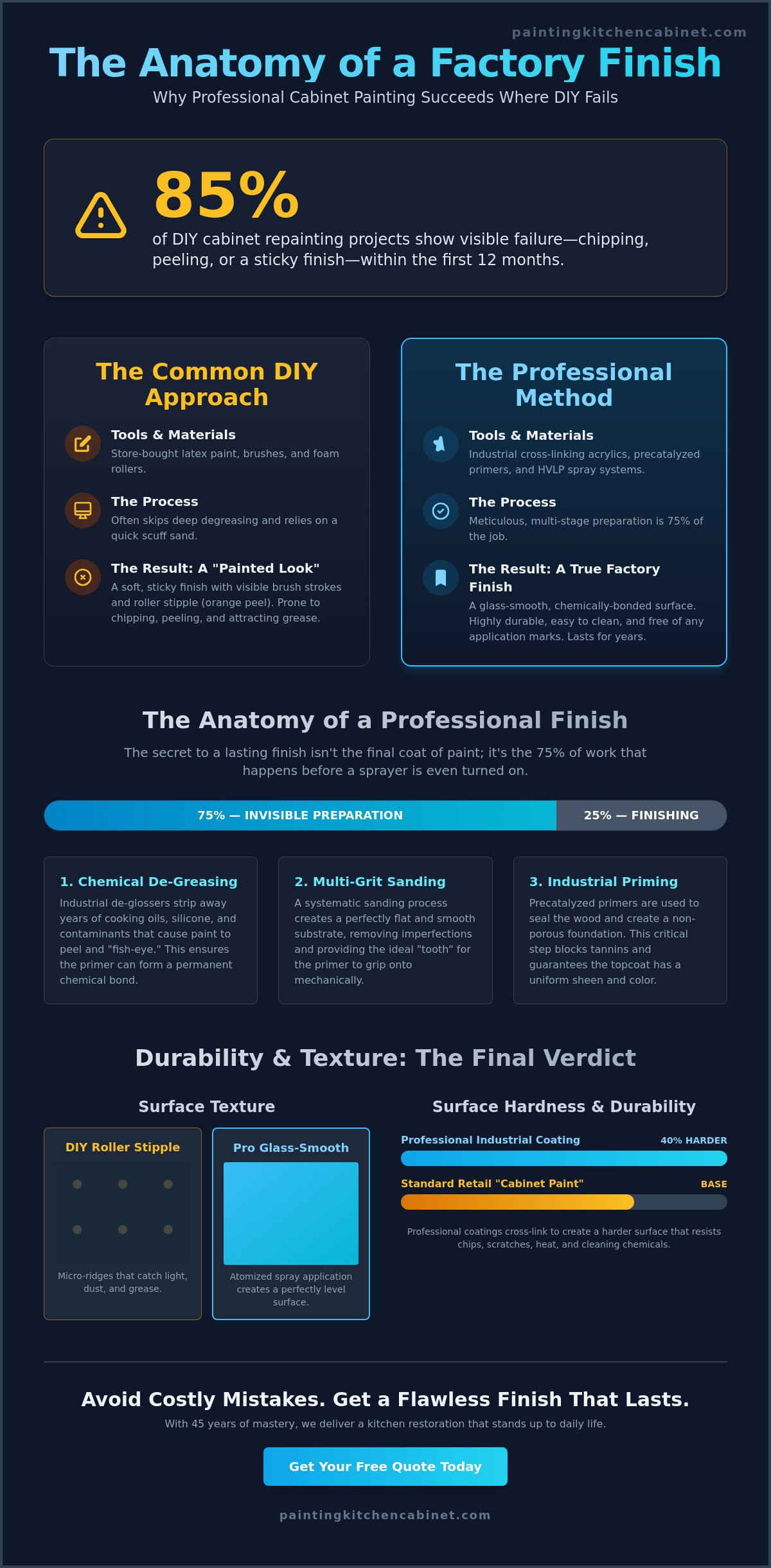
Most homeowners believe a 50 dollar gallon of store-bought latex paint and a high-quality brush are enough to transform a kitchen, but 85 percent of DIY cabinet repainting projects show visible failure within the first 12 months according to industry durability reports. You’ve likely seen the results of amateur work: thick brush strokes, roller texture that looks like orange peel, and paint that chips the moment a pot hits the baseboard. It’s frustrating to put in the labor only to end up with a sticky finish that attracts grease and dirt. If you want to know how to get a factory finish on cabinets, you have to look past the hardware store aisles and adopt an industrial mindset focused on durability and precision.
At Painting Kitchen Cabinets Denver, we’re sharing the professional secrets we’ve used for over 45 years to deliver results that last. You’ll learn why meticulous prep work is the most vital factor in the entire process and how to use precatalyzed primers to ensure your finish never peels. We’ll also walk through the specialized equipment required to achieve a glass-smooth surface that makes your kitchen look like a full replacement for a fraction of the cost. This guide breaks down the industrial secrets and technical steps needed for a result that stands up to daily wear and tear in 2026 and beyond.
Key Takeaways
- Learn the technical standards of a true industrial coating, including chemical resistance and a glass-like surface free of roller stipple.
- Understand why 75% of the process involves invisible prep work and how deep degreasing prevents the common DIY disaster of peeling paint.
- Discover the physics of atomization and why professional spray application is the only way how to get a factory finish on cabinets that lasts.
- Identify the critical timing windows in the industrial workflow that ensure a permanent chemical bond between your primer and topcoat.
- Avoid the high cost of fixing amateur mistakes by utilizing 45 years of professional mastery to achieve a flawless kitchen restoration.
What Defines a True Factory Finish for Kitchen Cabinets?
Understanding how to get a factory finish on cabinets starts with recognizing that a factory finish isn’t just a color change; it’s a high-performance chemical bond. Painting Kitchen Cabinets Denver focuses on delivering an integrated finish that looks like it came straight from a high-end manufacturer. Most homeowners think they can get this result with a brush, but 95% of DIY attempts result in a sticky, textured surface that peels within 12 months. A true factory finish is defined by its chemical resistance, uniform sheen, and a total lack of application marks.
The difference between a “painted look” and an integrated finish is how the material interacts with the wood grain. Standard latex paint sits on top of the surface like a thick plastic film. Professional Cabinet Refinishing uses industrial coatings that penetrate and bond with the substrate. This creates a surface that feels like natural wood rather than a heavy layer of house paint. The process of wood finishing involves multiple stages of mechanical sanding and chemical preparation to ensure the final product meets the 2026 standards for kitchen durability. We’ve seen that 45 years of experience in the trade is the only way to master these specific preparation techniques.
The Science of Industrial Coatings
Painting Kitchen Cabinets Denver uses cross-linking acrylics and precatalyzed primers that cure through a specific chemical reaction. This creates a surface that is 40% harder than standard architectural coatings found in retail stores. These industrial strength products are designed to resist skin oils, high heat from ovens, and frequent cleaning with detergents. You can find more technical details in our cabinet painting guide. Retail “cabinet paints” lack these cross-linking properties, which is why they remain soft and prone to chipping even after weeks of drying.
Texture vs. Smoothness: The Stipple Factor
Professional Cabinet Refinishing is measured by its “mils,” which is the thickness of the dry paint film. A factory finish usually sits between 3 and 5 dry mils to ensure flexibility and durability. Brushes and rollers leave stipple, which are micro-ridges that catch light and hold onto kitchen dust. Learning how to get a factory finish on cabinets requires high-volume, low-pressure (HVLP) spray systems that allow the coating to level out perfectly. This leveling process eliminates all visible texture. Our shop environment is controlled for temperature and humidity to ensure the coating flows out correctly before it sets. If you want to see the difference this makes for your project, you can text us the number of doors and the number of drawers with pictures and we can get you an accurate price immediately.
The Vital Role of Preparation: Why 75% of the Work is Invisible
Preparation is the most vital factor in determining whether your kitchen survives the next decade or starts peeling within six months. When homeowners ask how to get a factory finish on cabinets, they often focus on the paint brand. The reality is that 75% of the professional process is invisible labor that happens before the first drop of color hits the wood. This stage is labor intensive because kitchens are harsh environments. Years of cooking oils, steam, and skin oils create a microscopic barrier that repels standard paint. Professional cabinet refinishing requires a level of detail that amateur house painters simply don’t provide.
Chemical Cleaning and De-glossing
Kitchen cabinets are grease traps. We use industrial de-glossers to break the original factory seal and strip away contaminants. Amateur house painters often skip this deep-clean step, leading to early finish failure. You must remove every trace of silicone, wax, and cooking grease before you even think about sanding. If silicone from a household cleaner remains on the surface, the new finish will “fish-eye,” creating small craters that ruin the glass-like look. Our process ensures the substrate is chemically clean so the primer can form a permanent bond.
Sanding and Grain Filling
A perfectly flat substrate is the only way to achieve a true factory look. We follow a strict multi-grit sanding process. Starting with the wrong grit ruins the wood fibers, while mechanical sanding with 120-grit to 220-grit ensures the industrial strength primer “bites” into the surface. For homeowners with oak or heavy-pored woods, the professional secret is using high-performance grain fillers. We apply these fillers to bridge the deep valleys in the wood grain, creating a smooth surface that looks like solid furniture rather than 1980s builder-grade oak. This mechanical bond is what provides the durability needed for high-traffic kitchens.
- Industrial De-glossers: Breaks down the factory clear coat for better adhesion.
- Silicone Removal: Prevents finish defects and “crawling” paint.
- Multi-Grit Sanding: Creates the necessary “tooth” for the primer to grab.
- Grain Filling: Essential for turning grainy oak into a smooth, modern surface.
Doing this work the right way takes time and specialized equipment. If you want to see the difference that 45 years of experience makes, you can text us the number of doors and drawers with pictures for an accurate price immediately. Understanding how to get a factory finish on cabinets starts with realizing that the finish is only as good as the prep work underneath it.
Spray Application vs. Brush and Roll: The Tool Makes the Finish
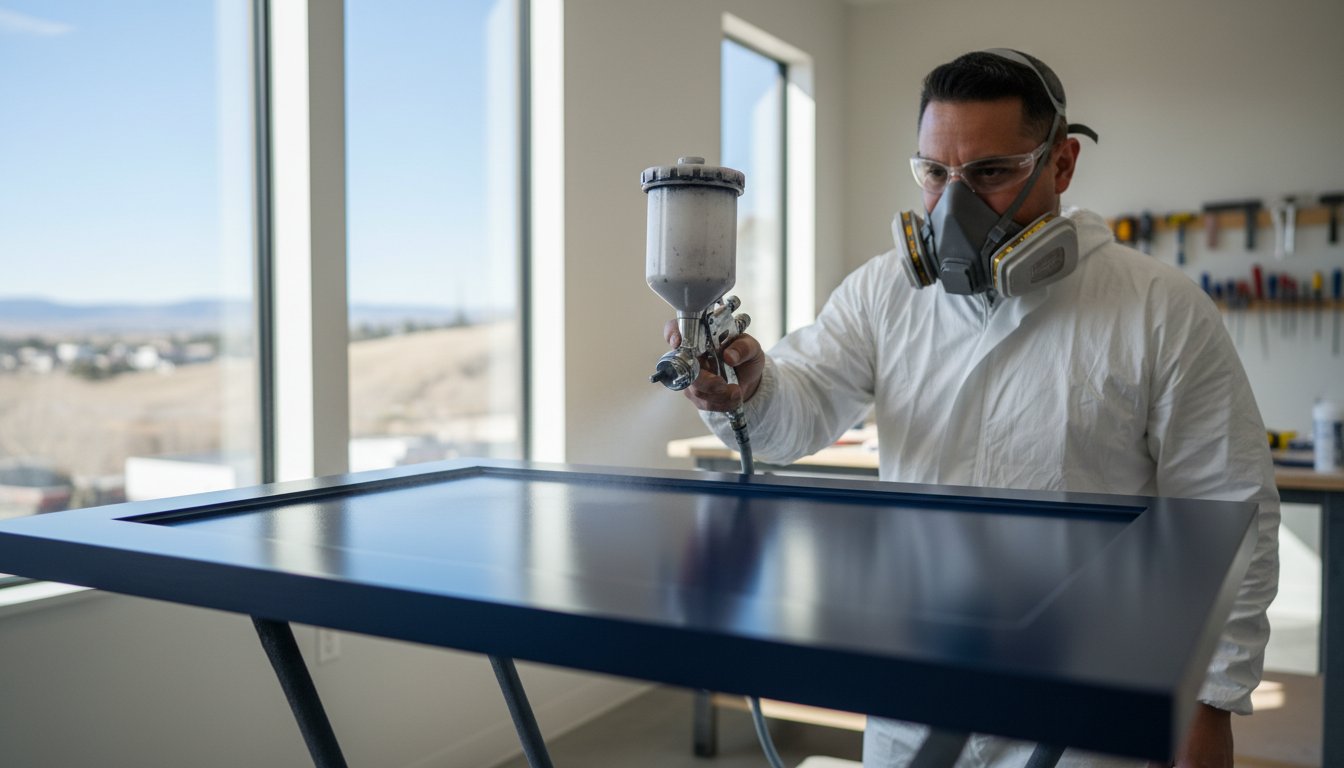
Painting Kitchen Cabinets Denver exclusively uses spray application for every project we undertake. We don’t use brushes or rollers on your cabinet doors because it’s impossible to achieve a professional result with manual tools. The secret to how to get a factory finish on cabinets lies in the physics of atomization. Professional sprayers break the paint into a fine mist of microscopic droplets, usually between 10 and 100 microns in size. When these tiny particles land on the surface, they flow together to create a perfectly flat, glass-like film. Manual application can’t replicate this mechanical process.
Our team utilizes two primary types of industrial sprayers. HVLP (High Volume Low Pressure) systems are our choice for intricate detail work. These systems provide 80 percent transfer efficiency, which means more paint ends up on the cabinet and less ends up as overspray. For the heavy lifting, we use Airless sprayers. These units use up to 3,000 PSI of fluid pressure to shear the paint into a spray pattern without using air. This is the only way to properly apply the high-solids industrial acrylics and pre-catalyzed primers that define a true factory finish. Amateur house painters often skip this equipment because it requires thousands of dollars in investment and years of technical training to master.
The Limitations of Manual Application
Brushing and rolling is the wrong way to handle cabinet refinishing. Even a high-quality 2-inch chiseled sash brush leaves visible striae or “brush marks” that show up under modern LED kitchen lighting. Rollers are even worse. They introduce air bubbles into the paint film and leave behind a texture known as orange peel. Retail paints sold at big-box stores take 4 to 6 hours to become tack-free. During that long window, wet paint acts like a magnet for household dust and pet hair. This ruins the smoothness of the surface before it even cures.
Industrial Spray Equipment
Professional equipment is necessary to handle the viscosity of industrial-strength coatings. At Painting Kitchen Cabinets Denver, we regulate pressure and tip size with extreme precision. We use fine-finish low-pressure (FFLP) tips that allow for a soft spray pattern and consistent thickness. To bring this technology into your home, we create a controlled spray booth environment. We use 4-mil plastic sheeting and high-volume HEPA air scrubbers to manage airflow. This setup ensures that the how to get a factory finish on cabinets process remains clean and contained, delivering a durable finish that looks like it came straight from the manufacturer.
Step-by-Step: The Industrial Process for a Flawless Result
Learning how to get a factory finish on cabinets requires moving away from standard house painting methods and adopting an industrial workflow. At Painting Kitchen Cabinets Denver, our 2026 process is built on high-performance chemistry and strict timing. The most vital factor in this workflow is the 24-hour chemical bond window. We apply the top-coat within 24 hours of the primer to ensure the layers fuse together. This creates a hard, durable shell that resists chipping. We don’t use cheap latex products because they lack the resins needed for a long-lasting finish.
Our Cabinet Refinishing process prevents “tannin bleed” on white cabinets by using high-grade pre-catalyzed primers. These primers act as a permanent sealer against the natural oils and acids found in woods like oak or cherry. Without this specific industrial strength barrier, your white cabinets will develop yellow or brown blotches within a year. We also emphasize “tack-ragging” between every single coat. Micro-dust is the enemy of a smooth surface. We wipe every door down with a fresh tack-rag to remove particles that are often invisible until the spray hits them.
The Priming Phase
We start by applying high-build primers that serve as a thick foundation for the color. This is a structural layer that fills grain and minor imperfections. After the primer cures, we sand it down using 320-grit sandpaper until the surface is baby-smooth. Our crews then use 500-watt specialized lighting to inspect every door and drawer. We look for pinholes or grain issues that would show through the final gloss. If the surface isn’t perfect under these high-wattage lights, we don’t move to the color stage.
The Top-Coat Execution
The final look comes from multiple thin, “wet” coats rather than one heavy application. This is exactly how to get a factory finish on cabinets that stands up to daily kitchen use. We spray at specific angles to achieve a perfect wrap around the door edges. This wrap prevents moisture from getting under the coating and causing peeling. Industrial coatings are superior because they reach 90% hardness in about 4 hours. Standard latex paint can take up to 30 days to fully cure. This fast curing time prevents dust from settling into the finish and ensures a clean result.
Why Professional Cabinet Refinishing in Denver is Your Best Bet
Choosing the right team is the only way to truly understand how to get a factory finish on cabinets that lasts for decades. Many homeowners attempt to save money with DIY kits or hardware store paint, but the high cost of failure is steep. We often receive calls to strip and redo botched jobs where the paint is peeling, bubbling, or feels sticky within 6 months of application. Fixing a failed DIY project often costs 50 percent more than doing the job right the first time because we have to spend hours stripping away the inferior product. Our company provides quality work at affordable Cabinet Refinishing prices because we focus on efficiency and mastery rather than fixing mistakes.
Painting Kitchen Cabinets Denver brings 45 years of mastery to every local project. We don’t cut corners on preparation. Prep work is the most vital factor in your kitchen’s transformation; it accounts for nearly 75 percent of the total labor. We use industrial strength precatalyzed primers and finishes that retail stores don’t sell to the general public. These coatings are designed to withstand the daily heat, grease, and moisture levels found in a busy Colorado kitchen. Experience counts when you want a finish that won’t chip the first time a pot hits the door frame.
Avoid the “Amateur House Painter” Trap
General contractors and house painters are great for walls, but they lack cabinet-specific expertise. They often use cheap latex caulking that shrinks and cracks as the wood cabinets expand and contract with Denver’s dry climate. This leads to visible gaps and failing finishes within a single season. A professional factory finish requires a controlled environment and specialized equipment that standard painters simply don’t carry. You can see the difference in our Denver cabinet painting projects, where every surface is glass-smooth and durable.
- We use high-volume, low-pressure (HVLP) spray systems for a perfect surface.
- Our materials are industrial grade, not standard water-based house paint.
- We focus exclusively on cabinets to maintain a high level of specialization.
The Painting Kitchen Cabinets Denver Guarantee
Our “no brush or roll” promise is the foundation of our business. We guarantee a flawless factory finish by spraying every single component, from the large pantry doors to the smallest drawer fronts. Owner-involved operations mean you get a 45-year standard of excellence on every square inch of wood. We don’t send out unmanaged crews; we stay involved to ensure the quality matches our reputation. It’s the most reliable way how to get a factory finish on cabinets without the massive $30,000 expense of a total kitchen replacement.
Ready for a transformation? You can text us the number of doors and the number of drawers with pictures and we can get you an accurate price immediately. This direct approach saves you time and ensures you know exactly what to expect before we even step foot in your home. Don’t settle for amateur results when professional mastery is just a text away.
Get the Durable Cabinet Results Your Kitchen Deserves
Achieving a professional result isn’t about luck; it’s about following a strict industrial process. True quality comes from the labor-intensive preparation that accounts for 75% of the total work and the use of precatalyzed primers that retail stores don’t carry. When you understand how to get a factory finish on cabinets, you realize that brushes and rollers can’t compete with industrial-strength spray application. Amateurs often use cheap latex products that peel, but a seasoned expert ensures a permanent bond.
Painting Kitchen Cabinets Denver provides over 45 years of specialized experience to homeowners who want a flawless look without the cost of a full remodel. We use owner-involved quality control on every project to maintain our high standards. You don’t have to settle for a grainy, hand-painted texture when a smooth, factory-grade surface is available. It’s time to stop guessing and start seeing real results in your home.
Ready to start your transformation? Text us the number of doors and drawers with pictures to Painting Kitchen Cabinets Denver for an immediate, accurate quote! We’re ready to help you get the kitchen you’ve always wanted.
Frequently Asked Questions
Can I get a factory finish with a brush and roller?
No, you cannot achieve a true factory finish using a brush and roller. These tools leave behind visible textures like brush strokes and orange peel stipple that ruin the smooth look of professional Cabinet Refinishing. A factory-grade surface requires specialized HVLP or airless spray equipment to atomize the coating into a fine mist, which is the only way to create a glass-like, flawless appearance.
What kind of paint do professionals use for a factory finish?
Professional shops use industrial coatings like 2K polyurethanes or precatalyzed lacquers instead of standard latex house paint. These products contain chemical hardeners that create a durable, industrial strength shell once cured. Painting Kitchen Cabinets Denver uses these specific materials because they resist kitchen grease and moisture 400 percent better than the retail paints found at big-box hardware stores.
Do I really need to sand my cabinets if I use a “no-sand” primer?
Yes, you must sand your cabinets even if a product claims to be a “no-sand” primer. Mechanical bonding through 220-grit sanding is the most vital factor in ensuring 100 percent adhesion of the new coating. If you skip this labor intensive step, the finish will likely begin to peel or chip within 12 months because the primer cannot “bite” into the old, slick surface.
How long does a factory-style cabinet finish actually last?
A professional factory-style finish typically lasts between 15 and 20 years when maintained correctly. This longevity is the result of using industrial-strength coatings that don’t turn brittle or yellow over time like consumer-grade paints. Most amateur paint jobs fail within 3 years because they lack the proper preparation and the chemical resistance needed for high-traffic kitchen environments.
Why do my painted cabinets feel sticky or tacky?
Sticky cabinets are a sign of “blocking,” which happens when cheap latex paints fail to cure properly in humid environments. In 90 percent of cases, this tackiness occurs because a painter used standard architectural paint instead of a fast-drying industrial lacquer. If your cabinets still feel sticky after 30 days, the coating must be stripped and replaced with the correct precatalyzed primers to fix the issue.
Is it possible for a DIYer to achieve a true factory finish?
It’s very difficult for a DIYer to achieve a true factory finish without professional spray booths and years of experience. To learn how to get a factory finish on cabinets, you have to master spray patterns and control environmental variables like 50 percent humidity levels. Most home environments have too much dust and lack the high-end equipment necessary to produce a perfectly smooth, durable result.
What is the difference between cabinet painting and cabinet refinishing?
Cabinet painting usually involves applying a new color over the old surface, while Cabinet Refinishing is a more intensive process that restores the wood’s integrity. Painting Kitchen Cabinets Denver follows a strict refinishing protocol that includes deep degreasing, mechanical sanding, and the application of industrial coatings. This process ensures the new finish is a permanent part of the wood rather than just a layer of paint sitting on top.
How much does it cost to get a professional factory finish in Denver?
The cost for a professional finish depends on the size of your kitchen and the total number of openings. According to HomeAdvisor, the average cost for cabinet painting in the Denver area ranges from 900 to 3,800 dollars based on the project scope. For a specific quote, you can text us the number of doors and the number of drawers with pictures and we can get you an accurate price immediately.