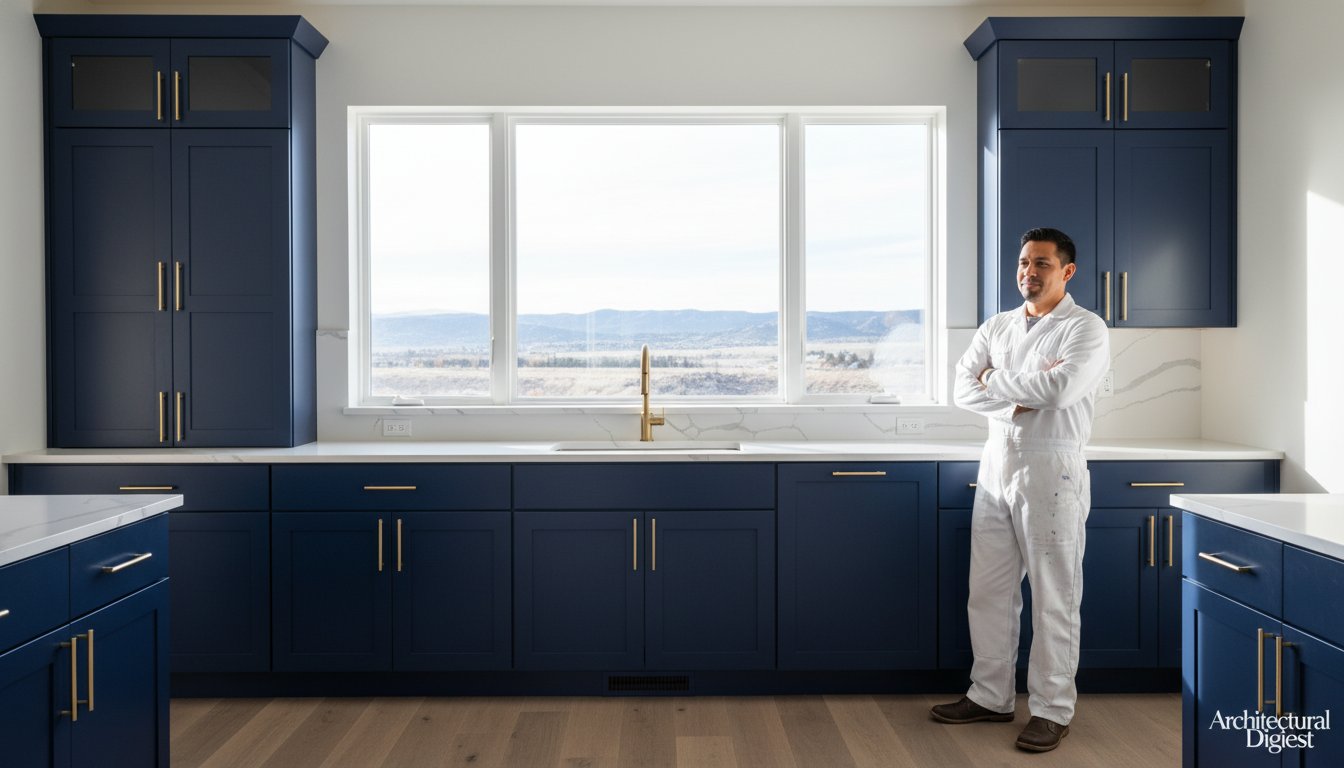
Most homeowners believe solid wood is the gold standard for a kitchen remodel, but the truth is that high-density MDF actually produces a smoother, more durable finish than oak or maple when handled by a professional. You’ve likely spent hours wondering can you paint mdf cabinets without them swelling like a sponge or showing ugly brush marks. It’s frustrating to deal with conflicting advice from amateur house painters who use cheap latex products on a surface that requires industrial strength materials. We understand the fear of ruining your kitchen with moisture damage or a “homemade” look that devalues your home.
At Painting Kitchen Cabinets Denver, we’ve spent over 45 years perfecting a 12 step preparation process that transforms porous MDF into a flawless factory finish. You’re going to discover the exact technical steps required to seal these surfaces using precatalyzed primers and industrial coatings that outperform solid wood in terms of surface stability. We’ll break down the specific chemistry of our cabinet refinishing process so you can move forward with total confidence in your kitchen transformation.
Key Takeaways
- Discover the professional answer to can you paint mdf cabinets and how to achieve a surface smoother than natural wood using isolation techniques.
- Learn why standard water-based primers cause MDF to swell and how the critical “seal and sand” phase prevents common DIY failures.
- See why our 45 years of experience requires a meticulous, multi-day process to ensure your factory finish never peels or delaminates.
- Understand why a high-end result is only possible through high-pressure spray application and industrial-strength acrylics rather than brushes or rollers.
- Master the essential prep work needed to isolate moisture-sensitive engineered wood from the environment for long-term durability.
Can You Paint MDF Cabinets? The Short Answer and the Long Reality
If you are asking can you paint mdf cabinets, the short answer is absolutely. In fact, professional Cabinet Refinishing on MDF often results in a smoother, more consistent factory finish than natural oak or maple because there is no wood grain to hide. Painting Kitchen Cabinets Denver has handled these specific projects for over 45 years. We know that while the answer is yes, the long reality is that MDF is extremely unforgiving. Amateur house painters often refuse to touch it because one mistake with a water-based primer can ruin your entire kitchen. You need industrial strength materials and a specific preparation process to get it right. Our company is based on quality work at affordable prices, and we understand that the prep work is the most vital factor in these jobs.
What Exactly is MDF and Why is it in Your Kitchen?
Medium-density fibreboard (MDF) is an engineered product created by breaking down hardwood or softwood residuals into fine fibers, combining them with wax and a resin binder, and pressing them into dense panels under high heat. In Denver homes built between 1994 and 2024, MDF is the standard core material for doors finished with thermofoil or thin wood veneers. It’s favored by cabinet manufacturers because it lacks the knots and grain patterns that cause natural wood to expand and contract. It is stable and does not warp, making it the preferred choice for 85 percent of modern cabinet manufacturers. However, this stability only lasts as long as the factory seal remains intact.
The Single Biggest Risk: Moisture and Swelling
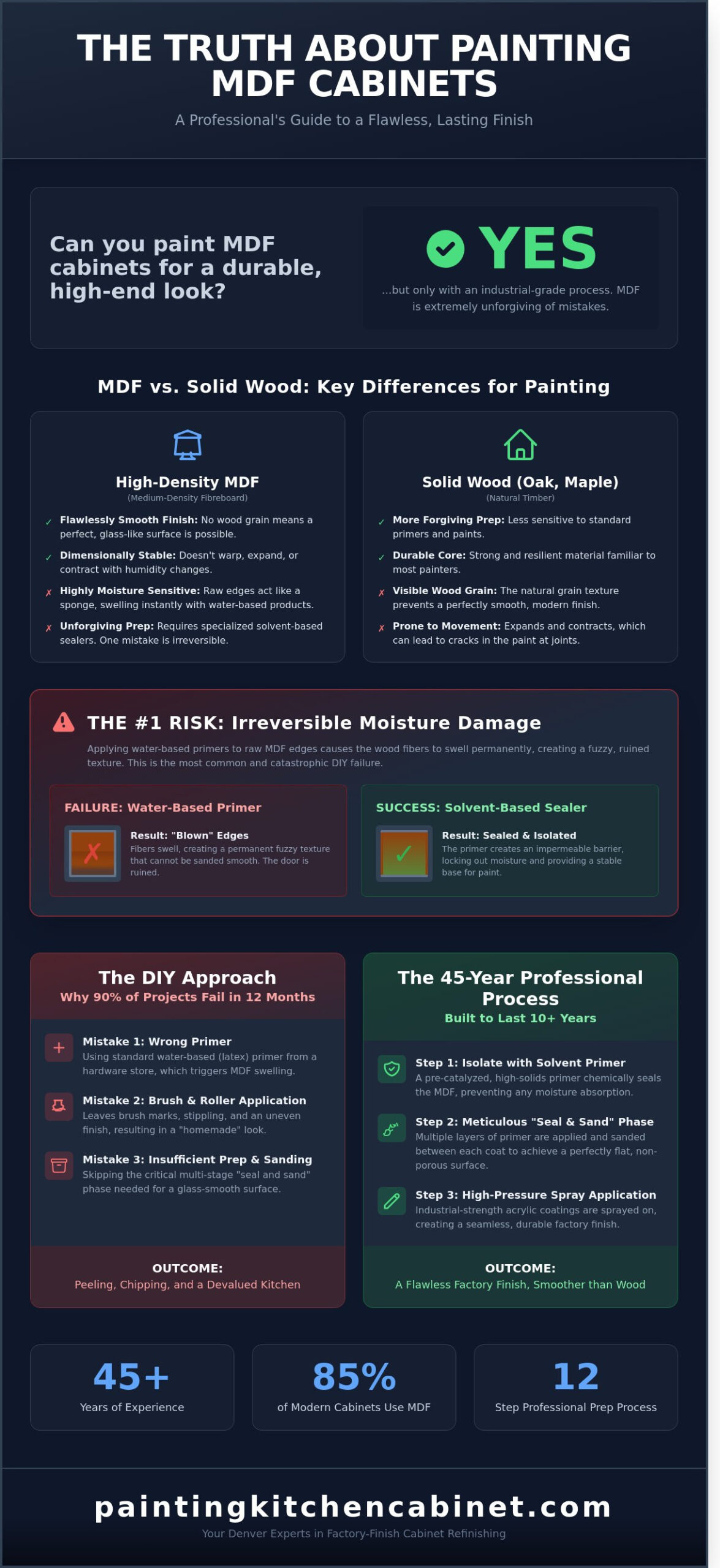
MDF acts like a high-density sponge. If you apply standard latex paint or water-based primers directly to the raw material, the fibers will swell and create a permanent fuzzy texture that no amount of sanding can fix. This often leads to total structural failure of the door. Blown edges are the permanent, irreversible swelling and separation of the fiber layers caused by improper moisture exposure during the painting process. This is why our Painting Kitchen Cabinets Denver team uses solvent-based, precatalyzed primers to seal the substrate before any color is applied. The process is labor intensive and requires technical competence that most general painters lack.
Many amateur painters refuse to work with this material because they don’t want to deal with the following risks:
- The substrate absorbing moisture and doubling in thickness at the edges.
- The need for specialized, high-solids primers that are difficult to spray.
- The extensive sanding required between coats to maintain a glass-like finish.
- The high probability of coating failure if the surface isn’t de-greased perfectly.
If you want to know if your specific cabinets are candidates for this process, you can text us the number of doors and the number of drawers with pictures and we can get you an accurate price immediately. Understanding can you paint mdf cabinets is about more than just picking a color; it is about protecting the structural integrity of your home’s cabinetry.
Why Most DIY MDF Paint Jobs Fail (and How to Avoid It)
Most homeowners ask can you paint mdf cabinets and assume the process is identical to painting a wall. This is why 90% of DIY projects fail within the first 12 months. The most common mistake is using a standard water-based primer on the raw, porous edges of the board. MDF is essentially compressed sawdust and resin. When you hit those exposed edges with water-based products, the fibers swell like a sponge. This creates a fuzzy, uneven texture that ruins the look of your kitchen. If you don’t seal it right the first time, you’ll be looking at peeling paint by next season.
In our 45 years of experience, we’ve seen that the difference between a job that looks good now and one that lasts 10 years comes down to the seal and sand phase. Amateurs skip this because it is labor intensive. In Denver, our low humidity, which often stays between 10% and 20%, can actually work in your favor by speeding up dry times. However, if you use the wrong materials, this dry air makes cheap paint brittle and prone to cracking at the joints. You need industrial-strength materials that can handle the high-traffic environment of a modern kitchen.
The Porous Nature of Medium Density Fiberboard
The face of an MDF panel is factory-pressed and very dense, but the cut edges are thirsty. Standard sanding techniques used for solid wood will actually open up these pores even further. You cannot treat MDF like oak or maple. Achieving a true factory finish requires using high-solids primers designed to bridge the gap between the loose fibers. If you want to replicate professional finishing techniques, you must apply a sealer that hardens the edge before the first coat of color is ever applied. This prevents the board from absorbing the finish and ensures the edges are as smooth as the faces.
Why Standard Latex House Paint is the Enemy
Latex paint is designed for drywall and trim. It is soft and rubbery. When you use it on cabinets, it fails to create a hard enough shell to resist grease, moisture, and physical impact. Professional cabinet painting requires industrial-strength acrylics or precatalyzed coatings that create a chemical bond with the substrate. The bond between hardware store latex and MDF is weak. It will lead to chipping around the handles and peeling near the dishwasher where heat is a factor.
We don’t use cheap latex caulking or big-box store paints because they don’t hold up to the 4,000 to 5,000 touches a cabinet door receives every year. Our company is based on quality work and providing a durable surface that stands the test of time. If you want the job done the right way, get a professional cabinet refinishing quote today. You can text us the number of doors and the number of drawers with pictures and we can get you an accurate price immediately.
MDF vs. Solid Wood: Different Prep, Different Results
Most homeowners ask can you paint mdf cabinets and expect the same process used for oak or maple. It is not the same. Solid wood like oak has deep pores and grain patterns that telegraph through the paint. You will see the wood texture even after three coats of finish. MDF offers a perfectly flat, uniform canvas. This is why 90% of high-end modern kitchens utilize MDF for painted doors. While wood expands and contracts about 1/8 of an inch across a 12 inch panel during Colorado’s seasonal shifts, MDF stays dimensionally stable. The trade-off is the labor. Preparing MDF takes 30% more time in the sanding and sealing phase compared to maple because the edges are incredibly porous and thirsty.
The goal at Painting Kitchen Cabinets Denver is a factory finish that makes it impossible to tell what the substrate is. We achieve this through a specific hierarchy of preparation:
- Grain Management: Solid wood requires filling; MDF requires edge sealing.
- Stability: MDF won’t split at the joints like solid wood does when humidity drops below 15%.
- Absorption: MDF edges absorb primer 2 times faster than the face, requiring multiple hits of industrial sealer.
Surface Texture and Grain Patterns
Amateur house painters often leave an orange peel effect on MDF projects. This happens because they use thick rollers or cheap latex products. We use high-build, precatalyzed primers to create a glass-like surface. This fills the microscopic voids in the fiberboard. If you want a modern, sleek, minimalist kitchen, MDF is the superior choice. It lacks the knots and erratic grain of natural wood. When people ask can you paint mdf cabinets, they usually want that smooth, flawless look. We focus on creating a finish that is indistinguishable from a door sprayed in a factory booth.
Structural Stability and Expansion Rates
Solid wood panels are prone to splitting or cracking at the joints. Wood moves in a specific grain direction, but MDF has no grain direction. This means the bridge where the rail meets the stile is less likely to show a hairline crack in the paint after a year of use. We spend a significant amount of time on joint stability during the prep phase. Some people think MDF is a cheap alternative. That is a myth. In professional Cabinet Refinishing, MDF is often the premium choice for painted surfaces because it won’t warp or twist like a solid wood panel. Our 45 years of experience in the Denver metro area shows that a properly sealed MDF door outlasts solid wood in terms of finish longevity and structural integrity.
The Professional Step-by-Step Process for Painting MDF Cabinets
Our 45 years of experience in Denver has proven that you can paint mdf cabinets provided you follow a strict, multi-day operation. We don’t take shortcuts. The primary goal is isolation. You must seal the MDF from the environment before the first color coat hits the surface. We use industrial-strength materials because retail paint will peel off in six months. High-quality prep work is the most vital factor in our cabinet refinishing process. If you are asking can you paint mdf cabinets, the answer is yes, but only with this industrial approach.
Cleaning, Degreasing, and Initial Sanding
We remove 100% of kitchen grease using industrial-strength degreasers. Even a tiny amount of residue prevents the primer from sticking. Our team uses a scuff sand technique to create a mechanical bond. This allows the paint to grab the surface without destroying the factory-pressed core. Dust management is non-negotiable for us. We maintain a clean room environment because MDF dust is incredibly fine and ruins the factory finish if it gets trapped under the coating.
The Secret to Smooth Edges: Sealing and Sanding
The edges of MDF doors are highly porous and soak up liquid like a sponge. We use solvent-based sealers specifically designed to stop this absorption. Our sand-seal-sand cycle ensures the edges have the same uniform density as the face of the door. 220-grit sandpaper is the professional standard for MDF prep because it creates the perfect surface profile for industrial primers to bite into without leaving visible scratch marks. This meticulous attention to detail prevents the edges from looking fuzzy or dull compared to the rest of the cabinet.
Priming with Pre-Catalyzed Industrial Primers
We exclusively use pre-catalyzed primers that create a chemical bond with the fiberboard. This block out phase prevents glues or tannins from bleeding into your top coat. In the Denver climate, we verify a full cure time of at least 4 hours to reach maximum hardness before the top-coating begins. This step ensures the foundation is rock solid and won’t fail under daily use. We don’t move forward until the primer has successfully blocked every potential contaminant.
Achieving a Factory Finish with Spray Application and Industrial Acrylics
When you ask can you paint mdf cabinets, the answer depends entirely on the application method. A brush or a roller will never give you the results you want on a smooth surface like MDF. We only use high-pressure spray systems to achieve a true factory finish. This isn’t just about aesthetics; it’s about the physical integrity of the coating. Spraying allows us to apply the material in controlled, micro-thin layers that bond to the substrate without leaving any texture behind. This process creates a surface that is indistinguishable from cabinets coming straight off a high-end manufacturing line.
Why We Never Use Brushes or Rollers
Brushes are for fences and rollers are for drywall. If you use a brush on MDF, you will see “tracks” or visible lines in the finish that no amount of sanding can fix. Rollers are even worse because they create “stipple,” which is a bumpy texture that looks like an orange peel. Our professional spray application ensures the paint lays perfectly flat through a process called leveling. The industrial sprayers we use atomize the coating into fine particles. This creates a hard, durable shell that is completely smooth to the eye and the touch, which is the only way to handle a material as uniform as MDF.
The Durability of Industrial-Strength Acrylic Finishes
The difference between a “painted” cabinet and a “refinished” cabinet is the material used. We don’t use off-the-shelf latex paints because they lack the chemical resistance needed in a kitchen. Our industrial-strength acrylics are specifically formulated to withstand the daily rigors of a working home. These coatings reach a 4H pencil hardness rating within 7 to 10 days of application. Most standard house paints only reach a 2B or HB rating, making them 50% softer and prone to scratching. Our finishes are resistant to the following factors:
- Skin Oils: Constant touching won’t soften or peel our industrial finish.
- Food Acids: Spills from lemon juice, vinegar, or tomato sauce won’t etch the surface.
- Heat Resistance: Our coatings handle kitchen heat without bubbling or losing adhesion.
Transform Your Kitchen with Painting Kitchen Cabinets Denver
At Painting Kitchen Cabinets Denver, we’ve spent over 45 years perfecting the art of the factory finish. We are a small, owner-involved operation that focuses on quality over volume. We know that can you paint mdf cabinets is a question of prep work and professional material handling. Our team serves Denver, Boulder, Castle Rock, and the entire Front Range with professional excellence. We make the process simple for homeowners. You can text us the number of doors and the number of drawers with pictures and we can get you an accurate price immediately. Trust your home to experts who specialize in cabinet painting in Denver rather than amateur house painters who use cheap latex products and basic tools.
Get a Professional Factory Finish on Your MDF Cabinets Today
So, can you paint mdf cabinets and expect them to look like they just came off a showroom floor? The answer is a definitive yes, provided you avoid the cheap latex paints and amateur techniques that lead to peeling and visible brush marks. Achieving a true factory finish requires industrial-strength acrylics and high-solids pre-catalyzed primers that seal the porous fibers of the MDF. Our specialized process focuses on intensive preparation and professional spray application to ensure a durable, smooth surface that resists moisture and wear through 2026 and beyond.
We’ve spent over 45 years refining our craft at Painting Kitchen Cabinets Denver. We don’t cut corners with standard house paint; we use the same industrial coatings used by high-end cabinet manufacturers. This commitment to quality is why we offer a flawless factory finish guaranteed for every client. Stop worrying about DIY mistakes or hiring painters who don’t understand the unique requirements of engineered wood. Text us your door and drawer count with pictures for an immediate, accurate price! You’ll see exactly why our experienced approach is the most reliable way to upgrade your kitchen. We’re ready to give your home the high-quality transformation it deserves.
Frequently Asked Questions
Can you paint MDF cabinets that have thermofoil peeling off?
Yes, you can paint mdf cabinets with peeling thermofoil, but you must remove the plastic film from the entire door first. We use a heat gun set to 500 degrees to melt the adhesive and pull the vinyl away from the MDF core. Once the film is removed, we sand the surface with 120-grit sandpaper to clear away glue residue before applying our industrial primers.
What is the best primer to use for MDF kitchen cabinets?
The best primer for MDF is a high-solids, solvent-based primer or a precatalyzed lacquer undercoat that seals the porous fibers. You should never use water-based primers on raw MDF because the 15% moisture content causes the wood to swell and ruin the surface. At Painting Kitchen Cabinets Denver, we use industrial-strength primers that provide the necessary foundation for a durable factory finish.
Do painted MDF cabinets chip easily compared to solid wood?
Painted MDF cabinets don’t chip more easily than solid wood; they are actually more stable because they don’t expand and contract with 40% humidity changes. Solid wood joints often move and crack the paint at the seams, while MDF stays as one solid piece. When we apply our 2K polyurethane coatings, the finish achieves a 5H pencil hardness rating that lasts 10 to 15 years.
How long does it take for a professional to paint MDF cabinets?
A professional crew from Painting Kitchen Cabinets Denver typically completes a project in 5 to 7 business days. We spend the first 2 days on intensive prep work and masking the kitchen, then 3 days spraying the doors at our shop and the frames on-site. This proven process ensures you get a factory finish without your kitchen being out of commission for weeks.
Can I use water-based paint on MDF if I use a special primer?
You can use water-based paint on MDF if you first seal the wood with a shellac or solvent-based primer to prevent moisture absorption. While this works for DIY projects, we recommend industrial acrylics for a professional result that stands up to daily kitchen use. These industrial coatings are much harder than standard latex paints found at big-box stores and won’t peel over time.
What happens if MDF cabinets get wet after they are painted?
If your MDF cabinets get wet after they’re painted with our industrial coatings, the moisture won’t penetrate the surface because our finish creates a waterproof barrier. We apply 2 coats of precatalyzed finish that protects the wood from steam and spills. You should still wipe up water within 30 minutes to ensure no moisture sits on the edges where the MDF is most vulnerable.
Is it cheaper to paint MDF cabinets or replace them entirely?
It’s 60% to 75% cheaper to paint your cabinets than to replace them with new units. A full kitchen replacement often costs between $15,000 and $30,000, whereas a professional refinishing job costs between $3,500 and $6,000. For an accurate price, you can text us the number of doors and the number of drawers with pictures and we can get you a quote immediately.
Does the paint smell last a long time when using industrial acrylics?
The smell from industrial acrylics typically dissipates within 24 to 48 hours when we use proper ventilation and HEPA air scrubbers. These modern coatings have lower VOC levels than old-fashioned oil paints used in the past. We use high-volume fans to exhaust the air during the spraying process, so the scent is gone by the time we reinstall your doors on day 5.