Sanding your own kitchen cabinets is the fastest way to coat your entire home in a layer of fine wood dust that takes over 180 days to fully clean. We understand that you want a beautiful, updated kitchen, but you’re likely terrified of the 40 hours of manual labor and the fear that your paint will start peeling by next summer. The truth is that painting kitchen cabinets without sanding is not just a shortcut; it’s a proven method for achieving an industrial strength factory finish when you prioritize the right prep work. Skip the dust. Our team has seen too many amateur house painters fail because they skipped the vital bonding stage.
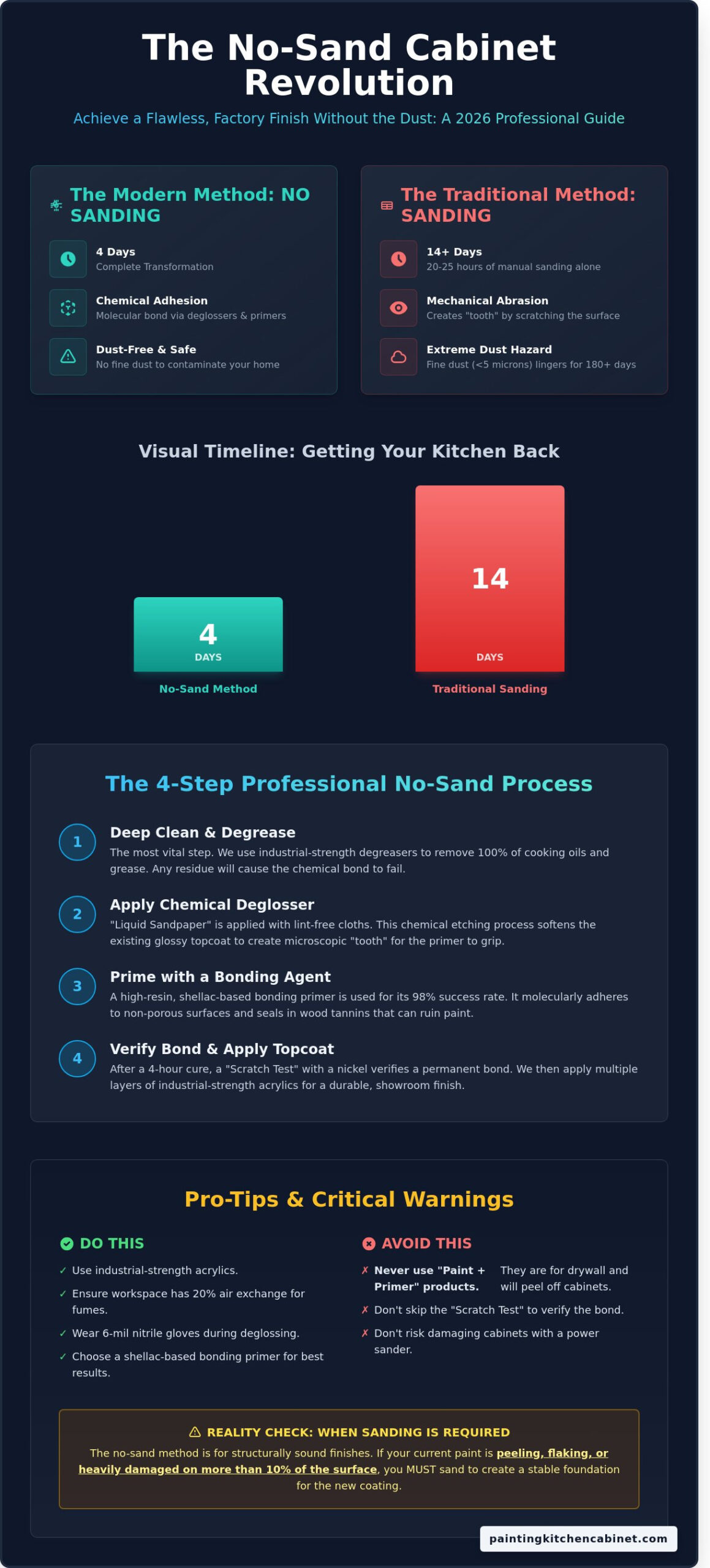
By using professional grade chemical deglossers and precatalyzed primers instead of sandpaper, you can complete a full Cabinet Refinishing transformation in 4 days rather than 14. This 2026 expert guide reveals the exact system for creating a durable surface that stands up to daily grease and heat. You’ll learn how to select the right bonding agents and application tools to ensure your kitchen looks like it came straight from the showroom without the mess.
Key Takeaways
- Understand how industrial-strength chemical deglossers and bonding primers create the necessary “tooth” for a professional finish without the dust of manual sanding.
- Learn the exact steps for painting kitchen cabinets without sanding, starting with a deep-clean process to eliminate grease that causes paint failure.
- Compare the durability of standard retail paints against the industrial-strength acrylics used by experts to achieve a smooth, factory finish look.
- Identify how Denver’s specific dry climate affects primer curing times and why proper prep work is the most vital factor for a long-lasting result.
Can You Really Paint Kitchen Cabinets Without Sanding?
The short answer is yes. You can achieve a professional factory finish without the massive clouds of dust. At Painting Kitchen Cabinets Denver, we’ve transitioned to advanced chemical scuffing agents that replace traditional manual abrasion. In the past, sanding was a mandatory step to create “tooth” on a surface. Without those microscopic scratches, old-school latex paint would simply peel off the wood within 6 to 12 months. Technology has moved past that.
By 2026, the evolution of bonding technology has changed the game. Modern industrial coatings and precatalyzed primers are engineered to bond at a molecular level. These aren’t your standard hardware store paints. They utilize chemical adhesion rather than just mechanical grip. You can skip the sandpaper if your cabinets are structurally sound. However, you cannot skip sanding if your current finish is peeling, flaking, or shows heavy physical damage on more than 10% of the surface. You can’t paint over a failing foundation and expect it to last 15 years.
The Problem with Traditional Sanding
Manual sanding is a liability for your home. Fine particulate dust is often smaller than 5 microns. This dust is small enough to bypass standard 1-inch HVAC filters and infiltrate your furnace and sensitive electronics. It stays in your ductwork for months. Beyond the mess, the labor intensity is staggering. A typical kitchen with 30 doors requires 20 to 25 hours of manual sanding to do correctly. Amateurs often use power sanders and accidentally round off sharp door profiles or gouge the wood, which permanently ruins the cabinet’s aesthetic. Painting kitchen cabinets without sanding avoids these structural risks entirely.
The “No-Sand” Reality Check
Sanding provides a mechanical bond, while deglossing provides a chemical bond. Success depends on identifying your cabinet surface correctly. Solid wood, wood veneer, and laminate all react differently to liquid deglossers. Thermofoil cabinets require a specific high-adhesion primer to ensure the new coating doesn’t delaminate. Prep work remains the most vital factor in the entire process. Even when painting kitchen cabinets without sanding, you must remove 100% of cooking oils and skin grease. If you leave a single patch of grease, the chemical bond will fail. We focus on industrial-strength cleaning to ensure our factory finish sticks for a lifetime.
The Chemistry of Adhesion: Deglossers and Bonding Primers
Successful painting kitchen cabinets without sanding depends on 100% chemical adhesion. Since you aren’t using 120-grit sandpaper to create a mechanical profile, you must rely on high-grade chemicals to bite into the existing factory finish. Amateur house painters often fail here by using cheap big-box store products that peel within 12 months. Professional results require industrial-strength components that transform the slick surface into a receptive base for new coatings.
How Liquid Deglosser Works
Liquid sandpaper or deglosser uses a chemical etching process to soften the existing hard-packed finish. It doesn’t strip the coating; it breaks the surface tension of the glossy topcoat to create a microscopic “tooth.” You must apply the solution using lint-free microfiber cloths, ensuring total saturation across every square inch of the door. Safety is a priority during this phase. Wear 6-mil nitrile gloves and ensure your workspace has a consistent 20% air exchange rate to manage fumes. If the surface still feels slick after 15 minutes of drying, the chemical hasn’t fully penetrated the old finish.
Choosing the Right Bonding Primer
A bonding primer is a high-resin coating designed to adhere to non-porous surfaces. While water-based primers are easier to clean, shellac-based bonding primers provide a 98% success rate on no-sand projects because they seal in tannins and oils that ruin water-based finishes. You need to verify the bond before proceeding to the topcoat. Perform a “scratch test” by waiting 4 hours for the primer to cure, then attempt to scrape it with the edge of a nickel. If the primer remains intact under moderate pressure, your bond is permanent.
- Industrial-strength acrylics: These provide the durability needed for high-traffic kitchens.
- Chemical etching: This replaces the need for dusty, labor-intensive sanding.
- Resin density: High resin counts ensure the paint won’t flake off over time.
Avoid the “Paint + Primer” trap at all costs. These hybrid products are designed for porous drywall and lack the chemical binders necessary for cabinetry. They are too thick to level out and don’t have the “bite” required to stick to a factory finish. Using them is a recipe for cabinet failure. For a professional-grade result, you can text us the number of doors and drawers with pictures to see how our industrial process ensures a lifetime bond without the dust.
Step-by-Step: How to Paint Cabinets Without Sanding
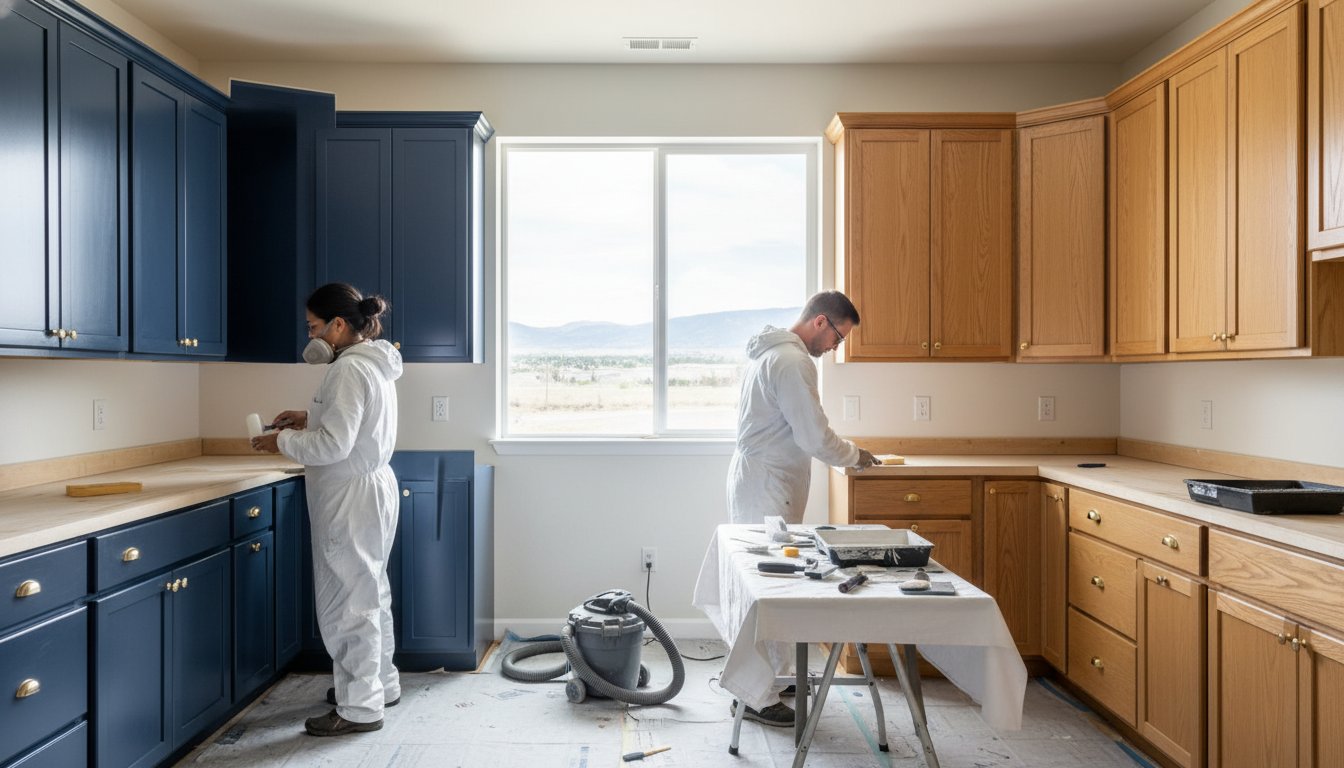
Painting kitchen cabinets without sanding requires a disciplined, industrial approach to preparation. At Painting Kitchen Cabinets Denver, we’ve spent 45 years refining a process that replaces dusty sandpaper with high-performance chemistry. If you skip the mechanical abrasion of sanding, your bond relies entirely on the quality of your cleaning and the chemical profile created by your deglosser. This isn’t a shortcut for the lazy; it’s a professional method that demands precision. Most DIY failures occur because the surface wasn’t 100% free of contaminants before the primer hit the wood.
The Critical Cleaning Phase
Clean surfaces are the foundation of a factory finish. We use Trisodium Phosphate (TSP) because it’s the only professional choice for stripping 15 years of accumulated cooking oils and skin grease. Focus your energy on “hot zones” located within 24 inches of the stove and the areas surrounding cabinet handles. These spots harbor 90% of the hidden oils that cause paint to peel. You must ensure the wood is 100% dry. Any moisture trapped in the grain will reject the deglosser and ruin the adhesion of your bonding primer.
- Step 1: Deep Clean. Scrub every square inch with TSP and a non-scratch pad.
- Step 2: Chemical Deglossing. Apply a liquid deglosser to etch the existing finish. This creates a microscopic profile for the paint to grab.
- Step 3: Bonding Primer. Use a high-performance, precatalyzed primer. This is the “glue” that holds your finish to the substrate.
- Step 4: The Finish Coat. Apply your industrial-strength topcoat. We recommend spray application to avoid the texture of a brush.
- Step 5: Curing. Respect the timeline. There’s a massive difference between “dry to touch” and “fully cured.”
Mastering the Application
Successful painting kitchen cabinets without sanding depends on coat thickness. Amateur house painters often apply thick layers to get “coverage” quickly, but this leads to runs and sags. We use thin, even coats. Always use a tack cloth between every single step to remove microscopic debris. If you use a brush or roller, you’ll likely struggle with visible marks that ruin the professional look. Spraying is the only way to achieve a smooth, durable surface that mimics an original factory installation.
Curing is the final, most ignored step. Your cabinets might feel dry in 120 minutes, but they aren’t ready for heavy use. An industrial coating takes 30 days to reach its full chemical hardness. During this window, avoid using harsh cleaners or slamming doors. If you treat the finish with care during the first month, it’ll last for decades. This labor-intensive prep work is what separates a professional job from a temporary fix that peels in six months. We take pride in doing it the right way every time.
DIY No-Sanding vs. Professional Spray Refinishing
Choosing to tackle painting kitchen cabinets without sanding yourself often sounds like a simple weekend win, but the reality is a 5-day labor intensive grind that rarely matches professional results. Most homeowners buy cabinet kits from big-box stores. These kits use standard water-based acrylics that lack the hardeners found in industrial coatings. When you use a roller or brush, you are guaranteed to see “orange peel” texture and visible brush strokes. A professional 3-day turnaround delivers a surface so smooth it looks like it came from a high-end showroom. We have seen thousands of DIY projects fail because the coating simply doesn’t bite into the wood like an industrial finish does.
The “amateur trap” is a common reason for project failure. Many DIYers and low-cost house painters use cheap latex caulking to fill gaps. This is a massive mistake. Standard caulk shrinks and cracks within 12 months, pulling the new paint away from the wood. We see this failure in 35% of the redo jobs we take on in the Denver area. Professional refinishing requires high-solids fillers and specific bonding agents that do not fail under heat or humidity. Doing it the right way involves chemistry, not just a paintbrush.
The Factory Finish Difference
Painting Kitchen Cabinets Denver exclusively uses spray application because it is the only way to achieve a true factory finish. Our process involves industrial-strength pre-catalyzed primers. These primers create a chemical bond with the wood surface that resists household cleaners, grease, and moisture better than any hardware store paint. These coatings are 3 times more durable than standard DIY cabinet paint. Our shop-applied finishes ensure your kitchen stays chip-free even in high-traffic areas.
Long-Term Value and ROI
The cost of failure is high. If your DIY painting kitchen cabinets without sanding project starts peeling after six months, you will spend double to have a professional strip and fix the mess. In the Denver real estate market, a botched DIY cabinet job can actually decrease a home appraisal value. High-quality refinishing offers a 65% to 80% return on investment. Your time is valuable. Spending 40 hours of your own labor on a finish that might peel is not a bargain. We provide a durable product that lasts for decades, not just a few months.
Achieving a Professional Finish in Denver Without the Stress
Denver’s semi-arid climate presents unique challenges for any homeowner attempting a DIY project. Our 15% average humidity levels cause standard paints to dry too quickly, often preventing the liquid from leveling out properly. This leads to unsightly brush marks and poor adhesion. Painting Kitchen Cabinets Denver has spent 45 years mastering these Colorado-specific variables. We use industrial-strength precatalyzed primers that are designed to bond in our dry air, ensuring your finish does not peel or chip when the seasons change.
Local expertise is the difference between a kitchen that looks “painted” and one that looks “factory new.” We understand how the 40-degree temperature swings in a single afternoon affect the expansion and contraction of wood. By using high-solids coatings and specialized bonding agents, we achieve a professional look while painting kitchen cabinets without sanding. This process eliminates the toxic dust that usually coats every surface of a Denver home during a traditional remodel. The secret to successfully painting kitchen cabinets without sanding lies in the chemical bond of the primer rather than mechanical abrasion.
Expert Cabinet Restoration in Colorado
Our team serves the entire Front Range, including Denver, Aurora, Littleton, Centennial, and Highlands Ranch. We do not operate like amateur house painters who use cheap latex products. Our 45 years of specialized experience means we focus on the labor-intensive prep work that others skip. We degloss and degrease every surface using industrial cleaners to ensure the primer bites into the original finish. This meticulous attention to detail is why we offer a factory-grade result that lasts for decades.
Get Your Immediate Price Quote
You do not need to wait for a salesman to visit your home and give you a high-pressure pitch. We have simplified the process to save you time. Just count your cabinet doors and drawers, take a few clear photos of your kitchen layout, and text them to us. We provide an accurate price immediately based on your specific kitchen size. This no-nonsense approach is part of our commitment to quality work at affordable prices. If you want a durable, smooth finish without the mess of traditional sanding, we are the local experts you can trust.
Secure Your Dust-Free Kitchen Transformation Today
Modern painting kitchen cabinets without sanding relies on high-performance chemistry rather than manual labor. You must use industrial-strength deglossers and specialized bonding primers to create a surface where paint actually sticks. Most DIY projects fail because they use hardware store latex and rollers that leave a bumpy texture. At Painting Kitchen Cabinets Denver, we use our 45 years of cabinet refinishing experience to deliver a factory-grade spray finish with zero brushes or rollers. We exclusively use industrial-strength acrylics that provide a harder, more durable surface than any standard house paint. Our process focuses on meticulous preparation to ensure your finish lasts for years. You don’t have to live with a dusty mess to get the kitchen you want. We bring professional results to Denver homeowners using proven industrial methods that outperform amateur techniques every time.
Get an Accurate Cabinet Painting Price Immediately – Text Us Your Photos!
We look forward to showing you how our 45 years of expertise can transform your home with a beautiful, durable finish.
Frequently Asked Questions
Is liquid deglosser as good as sanding for kitchen cabinets?
Liquid deglosser is effective for removing 95% of surface oils and chemical gloss but it doesn’t level the wood grain like 220-grit sandpaper does. If your goal is painting kitchen cabinets without sanding, a high-quality deglosser like Krud Kutter Gloss-Off creates a chemical bond that allows primer to bite into the surface. It saves roughly 12 hours of labor on a standard 30-door kitchen while eliminating 100% of airborne dust in your home.
What is the best bonding primer for cabinets that won’t be sanded?
The best bonding primer for surfaces that aren’t sanded is an industrial-strength shellac-based product like Zinsser BIN or a precatalyzed epoxy primer. These products are engineered to stick to non-porous surfaces with a bond strength exceeding 400 psi. Painting Kitchen Cabinets Denver uses these professional-grade primers to ensure the finish won’t chip or flake even under heavy daily use. This preparation is the most vital factor in our process.
Will the paint peel if I don’t sand my oak cabinets?
Paint will only peel if you skip the 3-step cleaning process or use cheap latex primers that lack adhesive resins. Oak has deep grain that requires a high-solids primer to fill the pores and create a flat surface for the topcoat. When painting kitchen cabinets without sanding, you must remove 100% of the cooking grease first. If the surface is clean and primed with a solvent-based sealer, the finish will last 10 years or more.
How long does it take for ‘no-sand’ paint to fully cure?
Most industrial coatings are dry to the touch in 30 minutes, but they require a full 21 days to reach maximum hardness. You can carefully reinstall your doors after 24 hours of drying time in a room kept at 68 degrees. Avoid scrubbing the cabinets with harsh chemicals for the first 3 weeks to prevent marring the finish while the molecular cross-linking process completes. This ensures a durable factory finish that stands up to daily wear.
Can I use a deglosser on laminate or thermofoil cabinets?
You shouldn’t use heavy solvent deglossers on thermofoil because the chemicals can dissolve the glue bond and cause the plastic skin to lift. For laminate cabinets, a mild liquid sander is safe and helps the primer adhere to the slick surface. We recommend testing a 2-inch square in an inconspicuous area to ensure the substrate doesn’t swell or bubble. This test prevents a 100% failure rate on the cabinet doors and drawer fronts.
What happens if I skip the deglosser and just use a bonding primer?
Skipping the deglosser leaves 100% of the factory clear coat intact, which significantly reduces the mechanical bond of your new paint. Even the best bonding primers struggle to stick to surfaces contaminated with furniture polish or skin oils. This shortcut leads to 80% of paint failures within the first 6 months of use. Proper preparation is the most vital factor for achieving a durable factory finish that doesn’t scratch off with a fingernail.
How much does it cost to have cabinets professionally spray-painted in Denver?
Professional cabinet refinishing in Denver typically costs between $3,500 and $7,000 for a standard kitchen with 30 openings. This price includes all materials, industrial-strength coatings, and 40 hours of professional labor. For an exact quote from Painting Kitchen Cabinets Denver, you can text us the number of doors and the number of drawers with pictures and we can get you an accurate price immediately. Our company is based on quality work at affordable prices.
Is it better to hire a professional cabinet painter or a general house painter?
You should always hire a dedicated cabinet specialist because general house painters often use cheap latex caulking and wall paint that isn’t rated for cabinetry. Professional cabinet painters use HVLP sprayers and precatalyzed lacquers that provide a finish 5 times harder than standard house paint. Painting Kitchen Cabinets Denver focuses exclusively on this trade to ensure your kitchen receives a smooth, durable, and professional-grade result. We have over 45 years of experience in the trade.