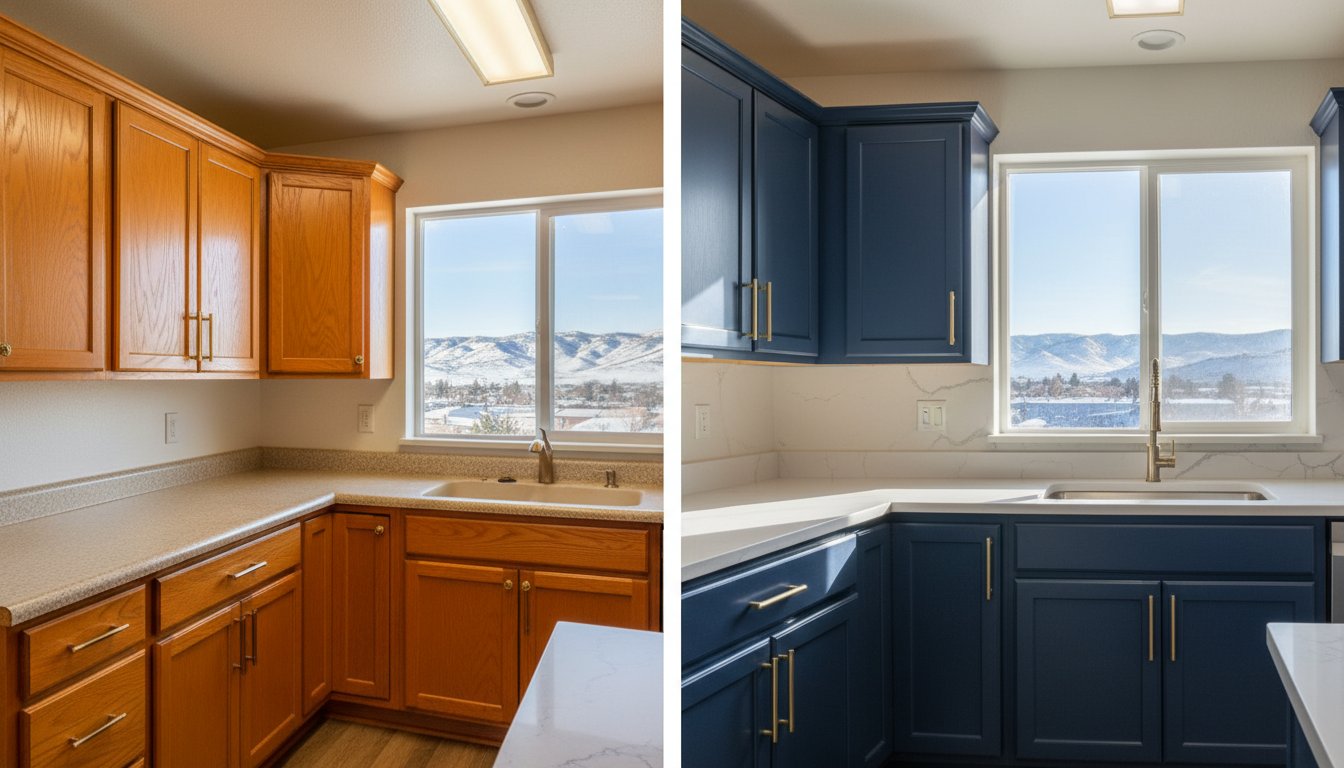
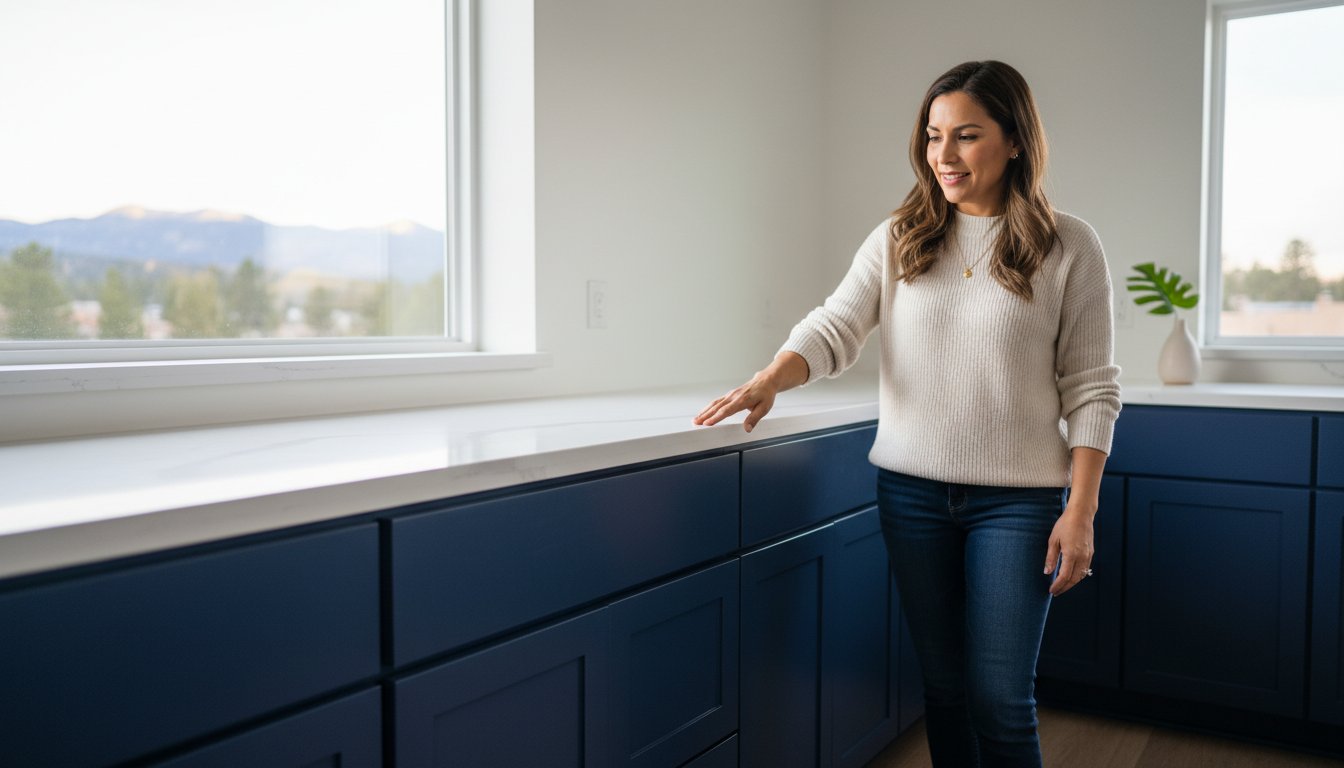
You can spend $5,000 on high quality cabinet refinishing and ruin the entire surface in under 20 seconds by leaning a heavy appliance against the wood too early. Most homeowners assume that if the doors feel dry after 6 hours, the kitchen is ready for full service. However, knowing exactly how long for cabinet paint to cure is the difference between a finish that lasts 20 years and one that peels in 6 months. We understand the massive inconvenience of a non-functional kitchen and the urge to put your spice racks back immediately.
Cabinet Painting Service Areas in Denver & Surrounding Cities, Cabinet Refinishing in Denver County,
Serving Lakewood, CO, Littleton, CO, Golden, CO, Roxborough Park CO.
Arvada, CO, Wheat Ridge, CO,
and Castle Pines CO. Englewood CO. Centennial CO.
Cabinet Painting in Arapahoe County, CO
Including Centennial, CO, Greenwood Village, CO,
Cherry Hills Village, CO,
and Aurora, CO.
Cabinet Painting in Adams County & Broomfield, CO
It’s frustrating to wait when you want to enjoy your investment, but rushing the process destroys the industrial strength bond we work so hard to create. This guide gives you the facts about the chemical hardening process so you don’t accidentally damage your new factory finish. We provide a clear 30 day timeline for kitchen usage and professional tips to safely speed up the process. You’ll gain the confidence to handle your cabinets the right way, ensuring your kitchen stays beautiful and durable for the long haul.
Key Takeaways
-
Understand the critical difference between surface drying and full chemical curing to ensure your new factory finish reaches maximum industrial hardness.
-
Discover exactly how long for cabinet paint to cure when using professional-grade coatings versus the 30-day wait required for inferior consumer latex paints.
-
Learn how to leverage the "Denver Advantage" of low humidity to speed up evaporation and achieve a more durable bond through proper environmental control.
-
Follow our essential 30-day care guide to protect your investment during the delicate "No Touch" zone and early handling phases.
-
See why meticulous prep work and professional spray techniques are the only ways to eliminate the tacky feeling and peeling issues common in amateur projects.
Table of Contents
Drying vs. Curing: Why Your Cabinets Aren’t Ready Yet
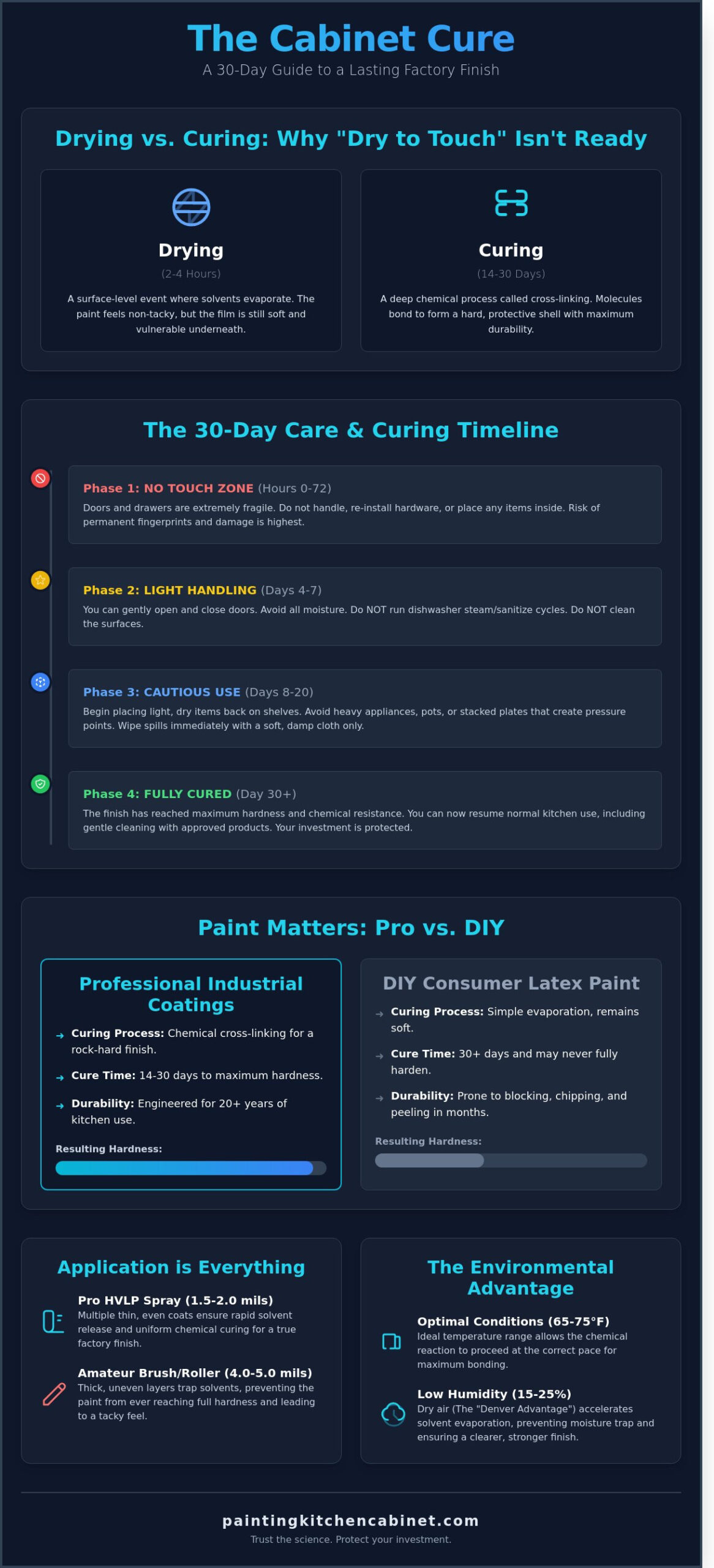
At Painting Kitchen Cabinets Denver, we see homeowners make the same mistake every week. They feel a door, think it’s dry, and start hanging hardware. This is a recipe for a ruined factory finish. Understanding how long for cabinet paint to cure requires knowing the difference between drying and curing. Drying is a surface level event where solvents evaporate, usually within 2 to 4 hours. Curing is a chemical process called cross-linking. This is when the molecules in professional-grade coatings bond together to create a hard, protective shell. For industrial-strength acrylics and pre-catalyzed primers, this process can take 14 to 30 days to reach maximum ASTM D3363 pencil hardness.
-
Dry to Touch: The surface feels non-tacky but the film is still soft.
-
Full Cure: The coating has achieved its final chemical resistance and durability.
-
Blocking: This occurs when uncured paint on a door sticks to the paint on a frame, causing the finish to peel off when opened.
The "Touch Test" Delusion
A surface that feels dry can still be soft as butter underneath. Standard wall paint is designed to look good on a vertical surface that nobody touches. Industrial coatings used in professional Cabinet Refinishing are different. If you press your thumb into a door 6 hours after spraying, you’ll likely leave a permanent indentation. This happens because a "skin" has formed while the base layer remains unstable. Amateur house painters often tell clients they can use their kitchen the next day. We know better after 45 years in the trade; rushing the process leads to immediate finish failure.
The Risks of Rushing the Process
Rushing the timeline results in 85% of the finish failures we see in Colorado homes. If you put a heavy ceramic plate on a shelf that hasn’t cured, the paint will delaminate. Moisture trapped under a damp dish can cause the finish to swell and peel because the chemical bond hasn’t fully locked out liquids. Professional Cabinet Refinishing requires patience. We’ve seen $10,000 paint jobs ruined in 48 hours because a homeowner used harsh cleaning chemicals too early. You should wait at least 72 hours before light use and 30 days before heavy cleaning to ensure your factory finish lasts for the next 20 years.
Factors That Dictate Your Cabinet Paint Cure Time
Every professional cabinet refinishing project relies on chemistry. While a surface might feel dry in 60 minutes, the internal bonding of the coating takes longer. Several variables determine how long for cabinet paint to cure before it can withstand daily use without chipping or peeling. We use industrial strength acrylic resins and precatalyzed primers that behave differently than standard house paint. These materials are designed for hardness, but their success depends on the environment and the application method used during the process.
-
Chemical Composition: Industrial coatings and lacquers use specific catalysts to harden. Unlike latex paint that dries by evaporation alone, our finishes undergo a chemical cross-linking process.
-
Atmospheric Conditions: Moisture in the air slows down the release of solvents. High humidity can trap moisture under the topcoat, leading to a cloudy finish or "blushing."
-
Coating Density: A single thick layer of paint traps wet solvents underneath a dried "skin." This prevents the bottom of the layer from ever reaching full hardness.
The Role of Colorado Climate
Living in Denver provides a massive advantage for cabinet refinishing. Our high altitude of 5,280 feet and low relative humidity, which often stays between 15% and 25%, allows solvents to release from the coating much faster than in coastal regions. For the best results, we keep Denver homes between 65 and 75 degrees Fahrenheit during the first 48 hours. You must avoid running your dishwasher on a high-heat "steam" or "sanitize" cycle for at least 7 days. The intense localized humidity from the steam can soften the fresh coating on adjacent cabinet doors before it reaches maximum durability.
Coating Thickness and Spray Application
The secret to a true factory finish is the thickness of the application. We use specialized HVLP (High Volume Low Pressure) spray equipment to apply multiple thin layers, usually measuring between 1.5 and 2.0 mils each. Amateur painters often use brushes or rollers that create "valleys" of paint up to 4.0 or 5.0 mils thick. These thick areas take twice as long to dry and often remain soft for weeks. Our spray method ensures even chemical bonding across the entire surface. If you want a professional result, text us the number of doors and drawers with pictures and we can provide an accurate price for a durable finish immediately.
Painting Kitchen Cabinets Denver focuses on precision. We know that how long for cabinet paint to cure is a matter of science, not guesswork. By controlling the thickness of our industrial coatings and leveraging the dry Colorado air, we deliver a finish that is ready for light use in 24 hours and fully hardened within a week. Our 45 years of experience shows that rushing this timeline or using cheap materials leads to failure, which is why we stick to proven industrial processes.
Industrial Acrylics vs. DIY Latex: The Cure Time Gap
Understanding how long for cabinet paint to cure depends entirely on the chemical makeup of the resin used in the product. Most homeowners buy "Cabinet, Door & Trim" enamels from big-box stores and expect a factory finish. It doesn’t happen. These consumer-grade products rely on a 30-day cure rule because they use softer resins designed for easy brushing. Painting Kitchen Cabinets Denver never uses cheap latex paints because they don’t provide the impact resistance required for high-traffic kitchens. We prioritize industrial-strength coatings that harden through a chemical reaction rather than just air drying.
The Failure of Standard House Paint
Big-box store paints often stay soft for 21 to 30 days. This happens because they are designed to be flexible to prevent cracking on exterior siding or trim. Flexible paint is the enemy of a kitchen cabinet. If the paint film doesn’t dry brittle-hard, it will peel when exposed to skin oils and steam. Older oil-based finishes used high-VOC solvents that took 14 days to stop smelling. Modern DIY water-based paints are safer for the environment, but they lack the resin density of an industrial coating. You’ll find that heavy plates or coffee mugs will stick to these shelves even after two weeks of drying. We call this "blocking," and it’s a clear sign of an inferior finish.
Our Industrial Finish Advantage
We exclusively use spray-applied acrylics and pre-catalyzed primers. Our primers contain a specific chemical hardener that triggers an accelerated hardening reaction. While DIYers wonder how long for cabinet paint to cure over several weeks, our industrial process achieves 90% hardness within 48 hours. Painting Kitchen Cabinets Denver has 45 years of experience refining this specific application process. Our finishes offer 100% resistance to household grease and common cleaners like 409 or Dawn after the full cure is reached. We deliver a factory finish that stands up to 30 daily touches without softening. Our process includes:
-
Pre-catalyzed primers: These bond to the wood and start hardening in 15 minutes.
-
Industrial resins: These create a high-density film that resists scratches better than any store-bought gallon.
-
Spray application: This ensures a smooth, even layer that dries faster than thick brush marks.
Our method gets you back in your kitchen faster. You won’t have to wait a month to use your cabinets. By using industrial-grade materials, we ensure the finish is durable enough for a busy family home within just a few days of completion.
The 30-Day Care Guide: How to Live with Curing Cabinets
Understanding how long for cabinet paint to cure is the only way to protect your investment. At Painting Kitchen Cabinets Denver, we provide an industrial strength factory finish, but that finish requires 30 full days to reach maximum hardness. The first 72 hours are the "No Touch Zone." Do not hang dish towels over doors and do not install shelf liners. Your cabinets are dry to the touch within 4 hours, but the chemical bonding process is still active. Touching the surface too early can leave permanent fingerprints or smudge the coating.
From day 4 to day 14, you should practice light usage. Use a feather-touch when opening drawers. If you have children or pets, keep them away from the kitchen area during this 11-day window. Between day 15 and day 30, the finish is 90% cured. You still need to avoid heavy cleaning or exposing the wood to high heat. Avoid using the "sanitize" cycle on your dishwasher if it vents steam directly toward the bottom of your cabinet doors. After the 30-day mark, the resins have fully cross-linked, and you can return to your normal cleaning routines.
Handling Doors and Hardware
Always use the handles and knobs to open your cabinets. Never grab the edges of the door. Your skin contains natural oils that can soften the finish during the first 21 days of the curing process. We install 1/2 inch clear silicone bumpers on every door we spray. These bumpers prevent the door from sticking to the face frame. If a door feels tacky or resists opening, do not pull hard. This usually happens if a bumper falls off. You should replace any missing bumpers immediately to prevent the paint from peeling off the frame.
Cleaning and Maintenance During Cure
Do not use any chemical cleaners, degreasers, or abrasive pads for the first month. These products will dissolve the finish before it reaches its full industrial strength. The only safe way to spot-clean a fresh finish is with a clean, damp microfiber cloth. Use a mixture of 95% warm water and 5% mild dish soap for stubborn spots. Pay close attention to the sink cabinet. Water splashes are common here, and standing water can damage a curing finish in less than 15 minutes. Wipe all drips immediately with a dry cloth.
Our Cabinet Refinishing process is built on 45 years of experience and professional preparation. If you want a durable factory finish for your kitchen, you can text us the number of doors and the number of drawers with pictures and we can get an accurate price immediately for your project.
Why Professional Prep and Spray Leads to a Faster Cure
Professional cabinet refinishing is about chemistry, not just color. When homeowners ask how long for cabinet paint to cure, they often overlook how surface contaminants like cooking oils or hand grease stop the hardening process entirely. We use industrial strength degreasers and 220-grit sanding to ensure 100% chemical adhesion. This process removes the factory oils that make DIY jobs feel tacky for weeks. Our factory-like finish is dry to the touch in 30 minutes and reaches full durability within 7 to 10 days. Cheap latex paints from a big-box store often stay soft for 30 days or more.
Our spray-applied process eliminates the thick, uneven layers created by brushes and rollers. Thin, uniform coats of high-solids coatings allow solvents to evaporate quickly and evenly. This precision prevents the "blocking" effect where doors stick to the frames. We’ve spent 45 years perfecting a system that delivers a hard, non-stick surface that stands up to the high-traffic demands of a Denver kitchen.
Meticulous Preparation
Prep work is the most vital factor in cure success. We spend 75% of our labor time on a project just getting the wood ready for the spray booth. We strip away the kitchen grime that hinders paint hardening. Our labor-intensive process for a flawless surface includes:
-
Scrubbing surfaces with heavy-duty de-glossers to remove wax and oils.
-
Machine sanding every square inch to create a "tooth" for the primer.
-
Applying pre-catalyzed primers that bond at a molecular level.
-
Vacuuming and tack-ragging to ensure zero dust interference.
This level of detail ensures that how long for cabinet paint to cure is a predictable 7-day window rather than a month-long guessing game. We don’t use cheap latex caulking or house paint that stays rubbery. We use industrial coatings designed for cabinetry.
Get Your Denver Cabinet Quote
Skip the amateur mistakes that lead to peeling and sticky doors. We provide a factory finish that’s more durable than a $40,000 full renovation at a fraction of the price. We’ve transformed kitchens across Aurora, Littleton, and Highlands Ranch with zero shortcuts. You can get an accurate price for your project immediately without a high-pressure salesperson entering your home. Text us at Painting Kitchen Cabinet Denver for your accurate quote. Just text us the number of doors and the number of drawers along with a few pictures of your kitchen. We will provide a professional estimate right away.
Achieve a Durable Factory Finish for Your Denver Kitchen
Understanding how long for cabinet paint to cure is the only way to ensure your kitchen survives daily wear and tear. While your cabinets may feel dry in a few hours, they require a full 30-day window to reach maximum hardness. We skip the cheap latex used by amateur house painters and focus exclusively on industrial-strength acrylics that provide a superior bond. Our team brings over 45 years of professional cabinet refinishing experience to every job in Denver; we ensure the prep work is handled correctly from the start. We never use brushes or rollers. We only use professional spray equipment to provide that smooth, factory-grade surface you expect. This labor-intensive process is what separates a professional job from a DIY mistake. You deserve a kitchen that stands the test of time without the long wait times of inferior products.
Text us the number of doors and drawers with pictures to get an accurate price immediately!
Get started today and see why our experience makes all the difference for your home.
Frequently Asked Questions
Can I put my dishes back in the cabinets after 24 hours?
No, you should wait at least 7 to 10 days before placing heavy dishes or glassware back on the shelves. Most industrial strength coatings need this time to reach a hardness level that prevents the paint from indenting under the weight of ceramic plates. At Painting Kitchen Cabinets Denver, we recommend waiting the full 14 day window for a total cure to ensure your factory finish stays perfect. Putting items back too early will cause them to stick to the surface.
How can I tell if my cabinet paint is fully cured?
You can tell the paint is fully cured when it no longer feels soft or catches your fingernail under light pressure. A fully cured surface feels like a hard plastic shell instead of a flexible film. If you press your thumb into an inconspicuous area for 5 seconds and it leaves a print, the coating is still outgassing and needs more time. Most precatalyzed primers and industrial finishes reach 100 percent hardness after 30 days.
Does a humidifier in my home slow down the curing process?
Yes, a humidifier slows the process because moisture levels above 50 percent prevent solvents from evaporating efficiently. For the best results in the Colorado climate, keep your home between 30 and 40 percent humidity. If moisture levels are too high, it can double the time for how long for cabinet paint to cure. We use industrial strength coatings that dry fast, but environmental control is still the most vital factor for a durable finish.
What happens if I use my cabinets before they are cured?
Using cabinets before they cure results in blocking, which is when the doors stick to the frames and pull the paint off when opened. You also risk permanent staining because the chemical bonds haven’t closed yet. If you spill a liquid on a 2 day old finish, it can penetrate the surface and cause a permanent blemish. This is why our Cabinet Refinishing process emphasizes extreme patience during the first 72 hours of light use.
Why do my cabinet doors feel sticky even though they look dry?
Your cabinet doors feel sticky because of solvent trap, where the top layer dries too fast and traps wet solvents underneath. This happens if the paint was applied in layers thicker than 4 mils or if the temperature is below 65 degrees. It doesn’t mean the paint is failing, but it means the chemical hardening process is stalled. Give the room another 48 hours with better airflow to let those trapped gases escape through the surface.
Can I speed up the curing process with a fan or heater?
You can use a fan to improve airflow, but you shouldn’t point a heater directly at the cabinets. Indirect airflow from a standard floor fan helps move solvents away from the surface, while a heater can cause the paint to crack or skin over too quickly. Keep the room at a steady 70 degrees. This consistent temperature helps achieve that professional Painting Kitchen Cabinets Denver factory finish without compromising the bond between the wood and the coating.
Is there a difference in cure time between light and dark colors?
Yes, dark colors often take 20 to 30 percent longer to cure because they contain higher concentrations of universal colorants. These pigments stay soft longer than the base resin itself. While a white cabinet might feel hard in 4 days, a deep navy or black finish might require 7 days before it reaches the same level of durability. We adjust our drying rack times based on these specific pigment loads to ensure every door is stable.
How should I clean my cabinets once they are fully cured?
Clean your cured cabinets using a simple mixture of 1 ounce mild dish soap to 1 gallon of warm water and a soft microfiber cloth. Avoid all harsh chemicals, ammonia, or abrasive sponges for the first 30 days. Even after the 30 day mark, industrial strength finishes don’t need heavy scrubbing to look new. Just a quick wipe will maintain the quality work we provide at Painting Kitchen Cabinets Denver for years to come.