If you have been searching for “spray painted kitchen cabinets with factory finish” in Denver, you know the term gets thrown around loosely. But a true factory finish is not just a look. It is a chemical process, a controlled environment, and a specific set of industrial materials that most homeowners never see. This article will walk you through exactly what that process entails, compare your options, and help you decide whether DIY, professional refinishing, or full replacement makes sense for your home in Castle Rock, Castle Pines, Highlands Ranch, or Parker. Colorado’s dry air and wide temperature swings add another layer of complexity: paints that work fine in humid climates can skin over too fast here, trapping solvents and leading to early failure. Understanding the chemistry behind the finish is the first step to making a smart decision.
Table of Contents
-
What Actually Defines a “Factory Finish” on Kitchen Cabinets?
-
Can You Really Paint Cabinets to Look Like a Factory Finish? (The DIY Reality Check)
-
The Professional Path: How We Achieve Spray Painted Kitchen Cabinets with a Factory Finish On-Site
-
Cost Breakdown: Factory Finish vs. Site-Sprayed vs. DIY (2026 Pricing)
-
How Long Do Spray Painted Kitchen Cabinets Last? (Real-World Data)
-
Frequently Asked Questions About Factory-Finish Cabinet Refinishing
What Actually Defines a “Factory Finish” on Kitchen Cabinets?
A factory finish is not simply the result of using a spray gun instead of a brush. The defining characteristic is the coating itself. True factory finishes use two-part catalyzed polyurethane, the same chemistry found in high-end automotive clear coats. Brands like ML Campbell, Milesi, Sher-Wood, Gemini, and Centurion dominate this space. These coatings do not merely dry when exposed to air. They undergo a chemical cross-linking reaction when a hardener, or catalyst, is mixed into the resin. That reaction creates a molecular bond that is fundamentally different from the film formed by a one-part paint. The result is a surface that resists moisture, heat, household cleaners, and impact in ways that conventional paint cannot match.
The environment where the finish is applied matters just as much as the chemistry. Cabinet factories operate dust-free, temperature-controlled spray booths. Many use flat-line finishing systems: automated spray heads positioned at multiple angles that coat doors and drawer fronts as they move down a conveyor. Some facilities integrate UV-curing ovens that cure the finish in seconds, eliminating the hours or days of rack time that air-drying requires. Even in factories that rely on skilled hand-sprayers, the booth conditions are tightly regulated to prevent dust nibs, orange peel, and solvent pop. These are the defects that plague site-applied finishes, no matter how careful the applicator.
For Colorado homeowners, this distinction carries extra weight. One-part paints, including high-quality waterborne alkyds, cure by solvent evaporation. In our dry climate, the surface can skin over before the deeper solvents escape. That trapped solvent eventually tries to push out, causing peeling or blistering months after the job looks complete. Catalyzed polyurethanes cure by chemical reaction, not evaporation alone, making them far less sensitive to humidity swings. They reach full hardness regardless of whether the air is bone-dry or carrying monsoon-season moisture.
Factory Finish vs. Site-Sprayed Professional Finish: The Real Difference
Professional site-sprayed finishes can look excellent. A skilled finisher with a turbine or airless rig can lay down a glass-smooth coat that impresses at a glance. But the material itself is almost always a one-part conversion varnish or waterborne alkyd, such as Sherwin Williams Pro Classic. These products harden into a durable film, but they do not cross-link at the molecular level the way a catalyzed polyurethane does. Think of it as the difference between a strong adhesive sticker and a weld. Both hold, but one is bonded to the substrate and the other sits on top of it.
Longevity tells the story. A well-executed site-sprayed finish using one-part paint typically lasts five to ten years before chipping appears on door edges, near the dishwasher, or around high-touch hardware. A catalyzed factory finish, properly applied and cured, can last fifteen to twenty years or longer. The “baked on” reputation is not a myth. Factories force-cure finishes in heated ovens, driving out every trace of solvent and completing the chemical cross-linking before the cabinet ever leaves the building. That is a level of cure that air-drying, even with patience, cannot replicate.
Can You Really Paint Cabinets to Look Like a Factory Finish? (The DIY Reality Check)
The internet is full of tutorials promising factory-quality results from a weekend project. The most popular method, demonstrated in a YouTube video with over 1.8 million views, involves brushing paint into crevices and then rolling over the surface with a dry foam roller to eliminate brush strokes. The technique works, to a point. On flat-panel slab doors, a careful DIYer using a self-leveling alkyd paint like Sherwin Williams Pro Classic can achieve a finish that looks smooth from a few feet away. Add steel wool sanding between coats and a clear topcoat, and the result can be surprisingly good.
The problem is that smoothness is only one attribute of a factory finish. Depth, hardness, and chemical resistance are the others, and those come from the coating chemistry, not the application method. Consumer-grade paints, even premium options like Sherwin Williams Emerald Urethane, are one-part products. They will never match the cross-linked durability of a two-part polyurethane. A DIY finish might look the part for a year or two, but it will wear like paint because it is paint.
Contamination is the second hurdle. A home kitchen, garage, or basement cannot match the cleanliness of a factory spray booth. Airborne grease, dust, and pet hair settle into wet paint. Even a meticulously cleaned garage will produce orange peel texture and dust nibs that a controlled booth eliminates. The Reddit threads and forum posts from DIYers who have attempted this are telling. Those who get closest to a factory look report spending forty to eighty hours on prep alone, using unconventional products like automotive primer, and still describe their result as “95% there.” For most homeowners in Castle Rock and the surrounding communities, the time investment and risk of a disappointing outcome make the DIY path hard to justify.
The “Dry Roll” Technique: When It Works and When It Fails
The dry roll method works best on flat-panel doors with no raised details. The foam roller cannot reach into the corners of a Shaker-style frame, leaving paint buildup that ruins the clean lines. The technique also demands a specific product type: a self-leveling alkyd that stays open long enough to flow out after the roller passes. Standard latex paint will not self-level adequately and will leave a rubbery, tacky surface that collects dirt. Even with the right paint, the process adds two to three days to the project for inter-coat sanding and clear coat application. It fails entirely when shortcuts are taken on prep or when the wrong primer is used beneath the finish coat.
The Professional Path: How We Achieve Spray Painted Kitchen Cabinets with a Factory Finish On-Site
The process we use is not magic. It is chemistry, applied with precision and controlled for Colorado’s specific climate conditions. We use two-part catalyzed polyurethane coatings from Centurion and Gemini, the same industrial-grade products supplied to high-end cabinet manufacturers. These are not shelf-stable paints you can buy at a hardware store. They must be mixed with a catalyst immediately before application and used within a pot life of a few hours. Once catalyzed, the chemical reaction is irreversible, and the resulting finish is harder than the wood it coats.
Application happens inside a temporary spray booth we construct within your home. This is not a plastic sheet draped over a doorway. It is a sealed, ventilated enclosure with controlled airflow that pulls airborne particles away from the wet finish. We use a high-volume low-pressure, or HVLP, turbine system that atomizes the coating into a fine mist, reducing overspray and laying down a smooth, even film. The booth environment lets us manage temperature and humidity, which is critical in Colorado. Without that control, fast-evaporating solvents in our dry air can cause blushing: a white, cloudy haze trapped in the finish that ruins clarity and depth.
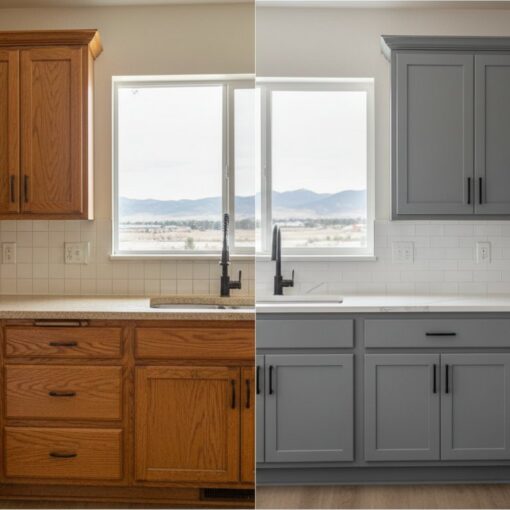
Prep is where the factory look is really built. We sand every surface to bare wood or to a sound substrate if the cabinets have been painted before. We fill the grain on oak and other open-pored species so the finish floats on top rather than sinking into the wood. Then we apply a sealer coat before any color goes on. This is the step most DIYers skip, and it is why factory finishes look deep and monolithic rather than painted on. The sealer creates a uniform base that the color coat bonds to, building a film that reflects light evenly across the entire surface.
Curing on-site requires replicating the factory oven environment. We use heat and dehumidifiers to force-cure the catalyzed polyurethane, driving the chemical reaction to completion in twenty-four to forty-eight hours. Without this step, the finish would take up to thirty days to reach full hardness. The accelerated cure means you can hang doors and use your kitchen normally within two days of completion, with full chemical resistance developing over the following week.
This approach beats replacement on multiple fronts. Your existing cabinet boxes, if they were built in the last twenty to thirty years, are likely plywood or solid wood construction. Modern RTA and big-box replacement cabinets are often particleboard with a thin veneer. By refinishing what you already have, you keep the better-built boxes and simply restore the visible surfaces. We spray the frames in place with protective masking and spray the doors and drawer fronts in the mobile booth, creating a seamless match between the two.
The Materials That Matter: Why We Don’t Use “Cabinet Paint”
“Cabinet paint” is a marketing term, not a product category. The coatings we use come from ML Campbell, Milesi, and Sher-Wood, the same suppliers that serve custom cabinet shops and commercial millwork operations. These are catalyzed polyurethanes that require a hardener. They are not shelf-stable. Once mixed, the clock is ticking, and the finish must be sprayed within hours. The result is a surface that withstands hot pans set directly on it, repeated cleaning with household chemicals, and the kind of daily abuse that a toddler with a toy dump truck can dish out. That is not an exaggeration: a designer cited by Salt Design Co. specifically references dog food bowls and children’s toys as the real-world tests that factory finishes survive and one-part paints do not.
Cost Breakdown: Factory Finish vs. Site-Sprayed vs. DIY (2026 Pricing)
Understanding the numbers helps clarify the decision. A DIY project using consumer-grade paint, primer, sandpaper, and a sprayer rental will run between $300 and $600 in materials alone. The time commitment is forty to eighty hours for someone learning as they go. The risk of wasted materials, a poor finish, or the need to hire a professional to fix mistakes is real and common.
Professional site-sprayed refinishing using catalyzed polyurethane, the service we provide, typically ranges from $4,500 to $8,500 for a standard ten-by-ten kitchen with thirty to forty doors and drawer fronts. That price includes full prep, industrial-grade coatings, the controlled spray booth setup, force-curing, and a five-year warranty on workmanship. The range depends on cabinet condition, door style complexity, and color changes.
Full factory replacement with new cabinets starts around $15,000 for mid-grade RTA products and climbs past $30,000 for custom cabinetry. That figure often does not include demolition, disposal, countertop replacement, or plumbing and electrical adjustments that arise when cabinets are removed. For homeowners in Highlands Ranch, Parker, or Castle Pines who plan to stay in their home for five years or more, professional refinishing with a factory-grade finish delivers the look and durability of new cabinets at forty to sixty percent of the replacement cost.
How Long Do Spray Painted Kitchen Cabinets Last? (Real-World Data)
With proper preparation and catalyzed polyurethane, professionally refinished cabinets last fifteen to twenty years before needing a refresh. The finish is harder than the wood substrate, meaning the wood will dent before the coating chips. Site-sprayed cabinets finished with one-part paint last five to ten years, with chipping typically appearing first on door edges, around the dishwasher where heat and steam concentrate, and near frequently used hardware.
Several factors shorten lifespan regardless of the finish. Grease buildup that is not regularly cleaned acts as a solvent over time, softening the film. Direct sunlight through kitchen windows causes UV degradation, particularly on dark colors. Abrasive cleaners and scrub pads scratch even the hardest finishes. One critical note: catalyzed finishes cannot be easily touched up. If a chip does occur, the entire door or drawer front must be re-sprayed to blend correctly. This is why proper prep and complete curing are non-negotiable. The finish must be right the first time.
Frequently Asked Questions About Factory-Finish Cabinet Refinishing
Can you spray paint MDF cabinets to look like factory finish?
Yes, but MDF requires a different approach than solid wood. The edges of MDF doors are porous and will swell if moisture reaches them. We use a high-build, sandable two-part epoxy primer on MDF to seal the edges completely before the color coat goes on. This creates a uniform, non-porous surface that the catalyzed polyurethane can bond to.
Is the finish food-safe?
Once fully cured, which takes approximately seventy-two hours after application, catalyzed polyurethane is inert and food-safe. It is the same chemistry used on commercial restaurant tables and food preparation surfaces. There is no off-gassing or leaching once the chemical reaction is complete.
Do you need to remove the cabinets to spray them?
No. We spray doors and drawer fronts in a mobile spray booth set up on-site. The cabinet boxes are sprayed in place with thorough protective masking of surrounding surfaces. This avoids the risk of warping or damage that can occur when cabinets are removed and reinstalled.
How long does the smell last?
The low-VOC catalyzed polyurethanes we use off-gas for twenty-four to forty-eight hours after application. We recommend ventilating the home and staying elsewhere for one to two days. After that window, the odor dissipates completely and does not return.
Ready for a Factory Finish Without the Factory Price? We Serve Castle Rock, Castle Pines, Highlands Ranch & Parker
You do not need to rip out your cabinets and endure a months-long renovation to get a factory-quality finish. The chemistry and the process exist to bring the factory to your kitchen. We serve homeowners throughout the south Denver metro area, from The Meadows in Castle Rock to Terrain in Castle Pines, Northridge in Highlands Ranch, and the growing neighborhoods of Parker. Every project includes a free, no-obligation consultation and color sample so you can see and feel the finish before committing. Our work is backed by a five-year warranty, and we use the same coatings as high-end cabinet manufacturers, applied by certified finishers who specialize exclusively in cabinet refinishing. If you are ready to explore what a true factory finish can do for your kitchen, we are ready to paint your kitchen cabinets in Denver with the materials and methods that make the difference.