
The difference between a stunning, modern kitchen and a peeling, brush-marked disaster often comes down to one thing: the painter you hire. But in a world full of generalists, finding a true specialist for professional kitchen cabinet painting can feel overwhelming. You know a durable, factory-like finish is possible, but you’re worried about hiring the wrong person, seeing your investment fail in a year, and simply not knowing what questions to ask to tell a craftsman from a handyman.
This is a non-negotiable question with a simple yes or no answer. Ask for a copy of their certificate of general liability insurance. This is not for their protection; it is for yours. If a painter accidentally damages your new countertops, floors, or appliances, their insurance covers the replacement cost. An uninsured painter leaves you with the bill. Any legitimate, professional business, like Higher Impact Painting, will provide this documentation without hesitation. Do not proceed with any contractor who cannot.
This critical job demands more than just a brush and a can of paint; it requires intensive preparation and industrial-strength coatings that most house painters don’t use. That’s why we’ve created this direct, no-nonsense hiring checklist. We are giving you the essential questions to ask any company to ensure they perform the work the right way, from the initial prep work to the final catalyzed topcoat.
Use this guide to confidently vet any painter, understand exactly what you’re paying for, and guarantee you receive the flawless, easy-to-clean finish that transforms your kitchen for years to come. Your peace of mind and a beautiful kitchen are just a few questions away.
Key Takeaways
- Understand that a durable finish depends entirely on the painter’s preparation process; be sure to ask for a step-by-step breakdown.
- Learn the specific types of industrial-strength primers and topcoats that separate a cabinet specialist from a general house painter.
- A quality professional kitchen cabinet painting service provides a clear, predictable timeline and explains exactly how they will manage the project inside your home.
- Demand a transparent, itemized quote and a detailed contract to avoid hidden costs and ensure you know exactly what you’re paying for.
Foundation First: Questions About Preparation and Process
The success of any professional kitchen cabinet painting project is determined long before the first coat of paint is ever applied. The final, durable finish you expect is 90% preparation. This labor-intensive groundwork is the single biggest difference between a true cabinet refinishing expert and an amateur house painter. The following questions are designed to cut through sales pitches and reveal the quality of the work you will actually receive. A painter who stumbles on these answers is likely taking shortcuts that will lead to a failing finish.
Question 1: What is your step-by-step preparation process?
A professional’s answer should be immediate and detailed, showing a deep respect for the process. A vague response is a major red flag. Their process is rooted in a fundamental understanding of wood finishing techniques, which ensures the new coating bonds permanently. Look for them to describe these non-negotiable steps:
- Degreasing and Cleaning: All surfaces must be thoroughly cleaned with industrial-strength degreasers to remove years of accumulated grease, oils, and contaminants.
- Sanding: Every square inch of the doors, drawers, and cabinet boxes must be scuff-sanded to de-gloss the old finish and create a “tooth” for the new primer to grip.
- Repairs: They should confirm that they fill and repair minor dings, dents, and scratches to create a smooth, unblemished surface before priming begins.
Question 2: How do you protect my kitchen and home?
A quality cabinet painter treats your home with meticulous care. Their job is to transform your kitchen, not cover it in a fine layer of dust and overspray. They should describe a comprehensive containment strategy, including masking off floors, countertops, backsplashes, and appliances with paper and plastic. A true professional will go further by creating a completely sealed environment-a “spray booth” inside your kitchen-around the cabinet boxes to contain all fumes and particles. Ask specifically about their ventilation system; they should use fans or air scrubbers to create negative air pressure, exhausting dust and fumes outside your home.
Question 3: Do you remove doors and drawers to paint them?
There is only one right answer to this question: yes, absolutely. Any contractor who suggests painting cabinet doors and drawers while they are still hanging in your kitchen is not a specialist. For a flawless, factory-like finish, all doors, drawers, and hardware must be removed and taken to a dedicated, off-site workshop. This controlled environment allows for horizontal spraying, proper curing, and eliminates the risk of dust, drips, and imperfections. Painting them in place is an unacceptable shortcut that signals an amateur approach to professional kitchen cabinet painting.
The Perfect Finish: Questions About Materials and Application
The color you choose is important, but the chemical composition of the paint and the application method are what truly determine the final look and durability of your cabinets. This is the single biggest difference between a general house painter and a specialist in professional kitchen cabinet painting. A craftsman who understands coatings technology will deliver a finish that lasts; a house painter using wall paint will deliver a finish that fails. Don’t be afraid to get technical-the answers to these questions reveal a contractor’s true expertise.
Question 4: Do you spray or brush and roll the cabinets?
There is only one correct answer here: spraying. For a true, factory-like finish, a sprayed application is non-negotiable. This technique atomizes the coating, allowing it to lay down perfectly smooth and even, eliminating the brush strokes and roller texture (known as “stipple”) that are the tell-tale signs of an amateur job. A sprayed finish is not just visually superior; it’s also harder, more uniform, and provides a more durable, long-lasting bond to the cabinet surface.
Question 5: What specific type of paint and primer do you use?
Listen closely to this answer. If a painter mentions a standard latex wall paint from a big-box store, it’s a major red flag. True cabinet coatings are industrial-strength products formulated for high-contact surfaces. A professional should confidently name their products, such as a high-adhesion bonding primer and a hard-wearing, 2-component acrylic urethane or a water-based alkyd enamel. Ask them why they chose that specific system. Their process and material choices should align with established professional painting industry standards, which define the benchmarks for a properly prepared and coated surface.
Question 6: How do you guarantee the finish won’t chip or peel?
A contractor’s guarantee is a direct reflection of their confidence in their work. A vague answer is not acceptable. A credible professional will immediately connect their guarantee back to their meticulous preparation process, the industrial-strength materials they use, and their controlled spray application. They should also discuss the importance of proper curing time-the period required for the coating to achieve maximum hardness-which is often 2-4 weeks. Finally, ask for a written warranty and understand what it covers. A solid warranty protects against failure due to workmanship, like chipping or peeling under normal use.

Project Logistics: Questions About Timeline and Professionalism
A true craftsman delivers more than just a beautiful finish; they provide a predictable, organized, and respectful service from start to finish. The quality of a professional kitchen cabinet painting service is reflected in its logistics. Asking the right questions about the timeline and the company’s credentials will tell you everything you need to know about the impact the project will have on your daily life and whether you are protected.
Question 7: What does the full project timeline look like?
Get a firm start and end date. Your kitchen is the heart of your home, and you need to know exactly how long it will be disrupted. A key detail to clarify is how much work happens on-site versus in their workshop. We remove all doors and drawers and take them to our facility for preparation and spraying to achieve a true factory finish. This minimizes the dust, mess, and fumes in your home. The on-site work on your cabinet boxes is often completed in just a couple of days. A typical, high-quality project should take approximately 5-7 business days from start to finish.
Question 8: Are you fully licensed and insured?
This is a non-negotiable question with a simple yes or no answer. Ask for a copy of their certificate of general liability insurance. This is not for their protection; it is for yours. If a painter accidentally damages your new countertops, floors, or appliances, their insurance covers the replacement cost. An uninsured painter leaves you with the bill. Any legitimate, professional business will provide this documentation without hesitation. Do not proceed with any contractor who cannot.
Question 9: Can I see local, recent examples of your work?
Talk is cheap-the proof is in the final product. A proud craftsman will be eager to show you their work. A portfolio of high-resolution photos is good, but video walkthroughs are even better as they are harder to fake or filter. A painter’s portfolio should show a consistent, flawless finish across multiple projects. It’s the result of a meticulous system; experts detail how to paint kitchen cabinets like a pro by focusing on a step-by-step process, and a painter’s work should reflect that same discipline. Ask to see kitchens with cabinets similar to yours and inquire about local references you can contact.
The Bottom Line: Questions About Cost and Contract
The final stage of vetting a painter comes down to the paperwork. A vague, single-line price scribbled on a business card is a major red flag. True professionals are transparent because they are confident in their process and the value they provide. The quote and contract are not just formalities; they are your protection against surprise costs and shoddy workmanship. They document the exact scope of work and ensure you get the durable, factory finish you were promised.
Question 10: Can you provide a detailed, itemized quote?
A legitimate quote is more than just a number-it’s a detailed breakdown of the entire project. Insist on an itemized estimate that clearly separates costs. This transparency is a hallmark of a serious professional kitchen cabinet painting company. Your quote should explicitly state every step of the process discussed, including:
- Labor: The cost associated with all preparation, sanding, spraying, and re-installation.
- Materials: The specific industrial-strength primers, paints, and topcoats being used for your project.
- Scope of Work: A clear description of the job, including the number of doors and drawers, and confirmation that all surfaces will be prepped and painted correctly.
What is included in the final price?
“All-inclusive” can mean different things to different contractors. Before signing anything, confirm what the final price covers to avoid unexpected charges upon completion. A proper contract should detail every aspect of the service, leaving no room for expensive assumptions. Ask directly:
- Does the price include removing and re-installing all cabinet hardware (hinges, knobs, pulls)?
- Is the full cleanup of the work area and proper disposal of all job-related materials covered?
- Are there any potential extra charges for extensive repairs or unforeseen issues?
A clear contract locks in these details and protects both you and the contractor. At Painting Kitchen Cabinet Denver, we provide straightforward, detailed quotes that cover the entire job from start to finish. We believe in total transparency because our work speaks for itself. For an example of how a professional quote should look, Text us photos for a fast, detailed quote! We’ll show you exactly what you’re paying for.
From Checklist to Flawless Finish: Your Next Step
Choosing the right contractor is the most critical step in your kitchen transformation. This checklist empowers you to look beyond a simple price quote and identify a true craftsman for your professional kitchen cabinet painting project. Remember, meticulous preparation is non-negotiable, and the quality of the materials and application method directly determines the durability of the finish. These are the hallmarks of a job done right.
At Painting Kitchen Cabinets Denver, we set the standard. With over 45 years of experience, our entire process is built on intensive prep work and our exclusive spray-application for a flawless, factory-like finish. We use only durable, industrial-strength coatings designed to last. Ready to see the difference true expertise makes?
Get Your Fast, No-Obligation Quote – Text Us Your Cabinet Photos!
Transform your kitchen with the confidence that comes from hiring a proven expert.
Frequently Asked Questions About Professional Cabinet Painting
How much does professional kitchen cabinet painting typically cost?
The cost for a professional kitchen cabinet painting project in the Denver area typically ranges from $3,500 to $7,500 for an average-sized kitchen. The final price depends on the number of doors and drawers, the condition of the cabinets, and the extent of the prep work required. Be wary of significantly lower quotes, as they often indicate an amateur painter who will skip the vital, labor-intensive preparation needed for a durable, factory-grade finish that lasts.
How long does a professional cabinet paint job last?
A high-quality, professional paint job done the right way should last 10 years or more. Durability is not about the paint alone; it is a direct result of meticulous prep work and the use of industrial-strength materials. We use precatalyzed primers and hard-curing urethane acrylics that create a tough, non-porous surface. This is far superior to the latex paint used by house painters, which will inevitably chip, peel, and fail under kitchen conditions.
Is professional painting more cost-effective than refacing or replacing cabinets?
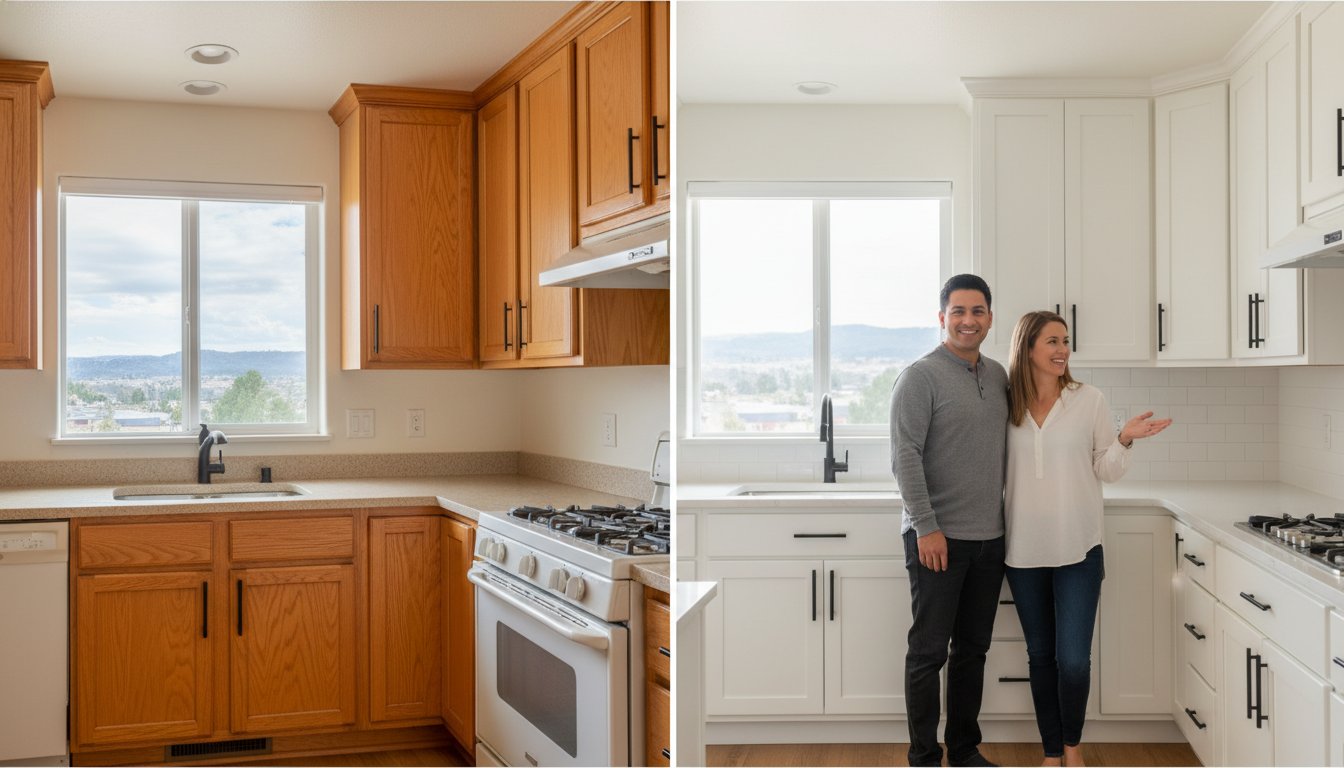
Yes, professional painting is by far the most cost-effective option for a major kitchen transformation. A professional refinishing job typically costs 60-70% less than a full cabinet replacement. It also costs significantly less than refacing, which involves applying new veneers and doors. With our process, you get a durable, factory-like finish that achieves a like-new appearance for a fraction of the cost and disruption of a total remodel.
Can you professionally paint laminate or thermofoil cabinets?
Yes, laminate and thermofoil cabinets can be painted, but it requires a specialized process that most painters cannot perform correctly. These slick surfaces demand extensive preparation, including a thorough cleaning, scuff sanding, and the application of an industrial-strength bonding primer. This is a labor-intensive task that is absolutely critical for long-term adhesion. Without this expert prep work, the paint is guaranteed to peel from the non-porous surface.
What are the most popular and durable colors for kitchen cabinets?
Timeless whites and off-whites, such as Sherwin-Williams Pure White and Alabaster, remain the most popular choices for a bright, clean look. Versatile grays like Repose Gray and dramatic dark tones like Tricorn Black or Hale Navy are also in high demand. However, the durability of the finish is not determined by the color. It comes from the quality of the industrial-strength topcoat, which provides a hard, washable surface that protects any color you choose.
Will my kitchen be usable during the painting process?
Your kitchen remains largely functional during our process. We remove all doors and drawer fronts to be sprayed at our off-site shop, which is where most of the work happens. The work inside your home-prepping and painting the cabinet boxes and frames-is contained to a specific area and typically takes only 2-3 days. While access to cabinet interiors will be limited during that time, your appliances, sink, and countertops remain accessible and usable.