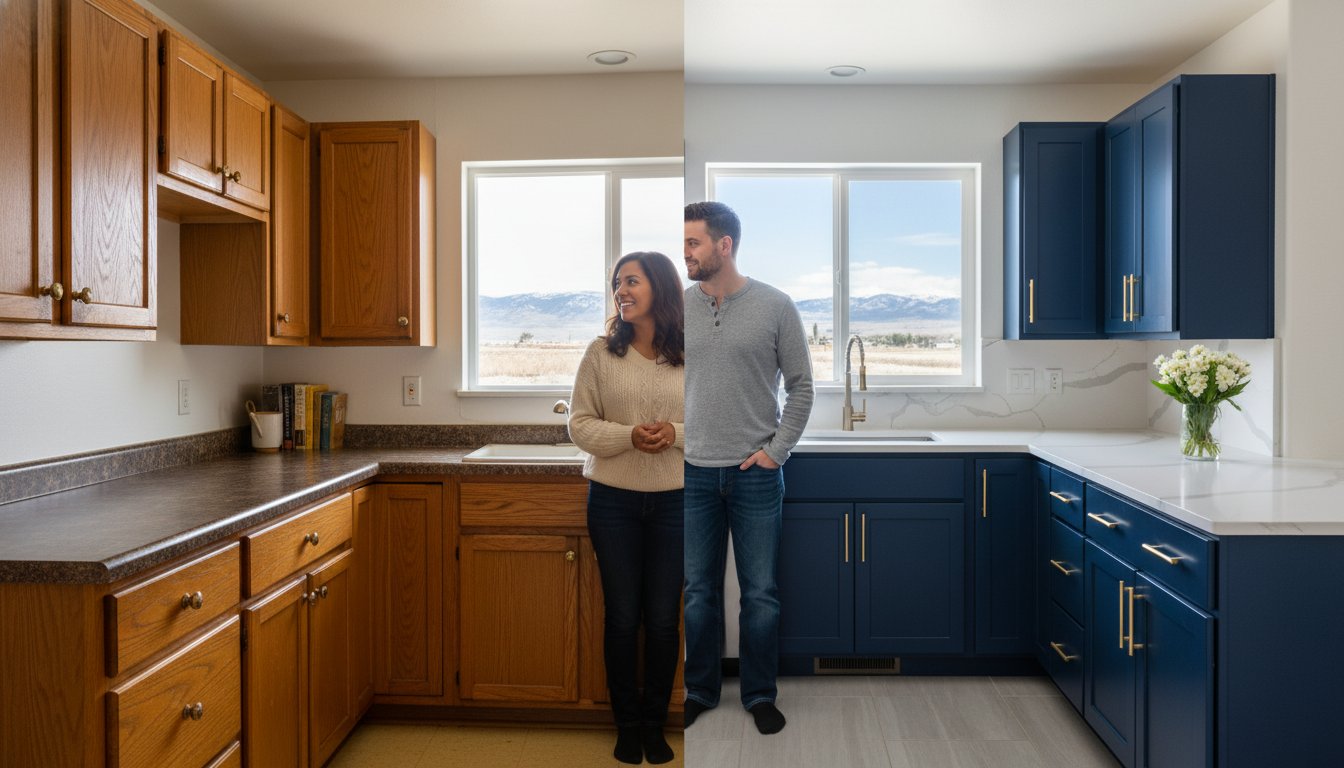
If your cabinet paint chips when you rub it with a fingernail, the previous painter skipped the 8-step industrial prep process required for wood. Most homeowners feel stuck when a $3,500 paint job starts flaking off within 10 months. It’s embarrassing to host guests when your kitchen looks like it’s shedding; you likely fear that an expensive $15,000 replacement is your only remaining option. You’re right to be frustrated because kitchen cabinets endure more daily abuse than any other surface in your home.
The good news is that you can stop the cycle of chipping without ripping out your woodwork. We’ll show you exactly how to fix peeling paint on kitchen cabinets by using the same industrial strength materials and precatalyzed primers we’ve used for over 45 years at Painting Kitchen Cabinets Denver. This guide outlines our labor intensive restoration process that delivers a durable factory finish. You will learn how to identify why the original bond failed and follow a clear path to a permanent, professional restoration that stands up to real world use.
Key Takeaways
- Understand why heat and grease cause adhesion loss and how to identify the root cause of paint failure in your specific kitchen environment.
- Learn why “Paint + Primer” products lead to cabinet failure and how to achieve the industrial-strength chemical bond necessary for a permanent finish.
- Master the professional process of how to fix peeling paint on kitchen cabinets through intensive industrial de-greasing and meticulous prep work.
- Determine if your cabinets require a simple spot repair or a full professional restoration to avoid the amateur look of visible feathered edges.
- Discover the specialized techniques and factory-grade materials used to ensure a durable, long-lasting result that stands up to daily wear and tear.
Diagnosing Why Your Kitchen Cabinet Paint is Peeling
Paint failure is the technical term for the loss of adhesion between the coating and the wood substrate. In the 45 years we’ve spent Painting Kitchen Cabinets Denver, we’ve found that 90% of these failures happen because the paint didn’t “bite” into the surface correctly. The kitchen is the most hostile environment in your home for any coating. Your cabinets constantly face 120-degree steam from dishwashers, high humidity from boiling water, and acidic grease splatters from the stovetop. These elements work 24 hours a day to get under the paint film and push it off the wood.
You need to determine if you’re dealing with a chip or a true adhesion failure. A chip is usually a small, localized spot caused by a physical impact from a pot or pan. Peeling is a systemic issue where the paint lifts away in large flakes or sheets. Use the fingernail test in high-traffic areas like the sink base or the trash pull-out. If you can easily scrape the paint away with light pressure, the original painter skipped the vital prep work. Understanding this distinction is the first step in learning how to fix peeling paint on kitchen cabinets so the problem doesn’t return in six months.
Common Culprits: Grease and Contaminants
Cooking oils are porous wood’s worst enemy. Over 20 or 30 years, aerosolized oils from frying penetrate deep into the wood grain and create a permanent barrier that rejects new paint. Amateur house painters often think a quick wipe with dish soap is enough. It isn’t. Most household cleaners leave behind an invisible silicone or wax film that prevents bonding. We use industrial strength degreasers and mechanical abrasion to strip these layers because even a 1% residue of grease will cause the paint to bubble and lift. Professional Cabinet Refinishing requires removing every trace of these contaminants to ensure a factory finish.
The ‘Honey Oak’ and Laminate Problem
Older honey oak cabinets were built with high-gloss factory topcoats designed to repel liquids for decades. These surfaces are slick and non-porous, meaning they offer no “tooth” for new paint to grab onto. If a painter doesn’t use the correct grit sandpaper, they leave behind glossy valleys in the grain that cause the paint to slide right off. Laminate is even more difficult because it’s essentially a plastic sheet. Without a specialized precatalyzed primer and heavy labor intensive sanding, the paint has zero chance of sticking. When homeowners ask how to fix peeling paint on kitchen cabinets that are made of laminate or oak, the answer always starts with breaking that factory seal through aggressive, professional preparation.
The Science of Adhesion: Why DIY Fixes Usually Fail
Painting Kitchen Cabinets Denver has seen thousands of failed DIY projects where the finish peels off in sheets within the first 12 months. When homeowners research how to fix peeling paint on kitchen cabinets, they often find bad advice that ignores the science of adhesion. True adhesion requires two distinct types of bonds: mechanical and chemical. A mechanical bond is the physical “teeth” created by sanding the surface to create microscopic valleys for the paint to grab. A chemical bond occurs when the resins in the primer fuse with the wood fibers or the previous finish at a molecular level. Most homeowners buy “Paint + Primer” in one can, but this is a recipe for disaster. These products are formulated for porous drywall and do not have the chemistry to bite into hard, non-porous cabinet factory finishes.
- Mechanical Bond: Created by 220-grit or 320-grit sanding to remove the old shine and provide grip.
- Chemical Bond: Achieved through high-solids, industrial-strength primers that melt into the substrate.
- Tannin Bleed: Natural oils in woods like Oak, Cherry, or Mahogany will penetrate cheap latex paint, causing yellowing and bond failure within 180 days.
Standard big-box latex house paint is designed to be flexible for walls that don’t get touched. Cabinet surfaces are high-touch areas exposed to moisture and grease. Industrial acrylics and pre-catalyzed lacquers cure to a rock-hard finish that resists hand oils and cleaning chemicals. If you want a professional result that lasts, Cabinet Refinishing must be done with industrial-grade materials, not standard house paint. These industrial coatings cure through a chemical reaction, while house paint simply “dries” by evaporation, leaving it soft and prone to damage.
Amateur House Painters vs. Cabinet Specialists
Wall painters often treat cabinets like a vertical wall, which is a major mistake. They use “brush and roll” applications that leave a thick, 8-mil layer of paint. These heavy edges are prone to catching and peeling because the paint is too thick to properly bond. Professional specialists use HVLP (High Volume Low Pressure) sprayers to apply thin, 2-mil to 3-mil coats. This creates a factory finish that is durable and sleek. Our process relies on industrial-strength, pre-catalyzed primers that provide a level of adhesion that standard house painters cannot match with retail products.
The Vital Role of Proper De-glossing
You must remove the old factory polish before adding new layers of paint. We use a dual approach of mechanical etching and chemical de-glossing to ensure the surface is completely neutralized. This process removes 100% of the grease and wax buildup that has accumulated over 15 or 20 years of kitchen use. De-glossing is the foundation of a 20-year finish that ensures your new paint becomes part of the wood rather than just sitting on top of it. Painting Kitchen Cabinets Denver focuses on this labor-intensive preparation because it is the only way to guarantee the job never fails.
Can You Repair Peeling Paint or Do You Need a Full Redo?
Determining how to fix peeling paint on kitchen cabinets requires a hard look at the existing bond. If paint is lifting in more than 10% of the kitchen, you have a systemic failure. Many homeowners try “feathering,” which involves sanding the edges of a chip to make it flush with the wood. This rarely looks seamless for an amateur. The surrounding paint is usually brittle and will continue to flake off within 6 to 12 months because the underlying adhesion is gone.
Painting over peeling areas creates a “sandwich” of failure. You’re sticking new material to a layer that’s already detached from the wood. This trap leads to double the labor later. Professional Cabinet Refinishing is roughly 75% cheaper than total cabinet replacement. A full replacement in a standard Denver kitchen can easily exceed $25,000, making a professional restoration a smarter financial move.
- Systemic Failure: If paint peels when you run a fingernail over it, the entire surface must be stripped.
- Feathering Issues: Sanding edges often reveals more loose paint, leading to a never ending cycle of prep.
- The Sandwich Trap: New paint adds weight and tension, which pulls the old, loose paint off the wood even faster.
When a Spot Repair is a Temporary Band-Aid
You can temporarily stabilize a 1/4 inch chip near a hinge with a touch-up pen or a small brush. This is just a short term fix. Cabinet paint fades by 5% to 10% every year due to UV exposure and kitchen grease. A fresh dab of the original color will look like a dark smudge. Spot repairs also fail because they don’t address the moisture or grease that caused the initial peel. Adjacent areas will likely start bubbling within 90 days of your patch job.
The Case for Professional Cabinet Refinishing
Stripping the wood and starting over is the only way to guarantee a factory finish. Painting Kitchen Cabinets Denver uses industrial strength precatalyzed primers and coatings that you can’t buy at a big box store. These industrial finishes are rated to last 15 to 20 years. When you learn how to fix peeling paint on kitchen cabinets the right way, you choose durability over a quick fix. Professional restoration adds $5,000 to $10,000 in actual resale value to your Denver home. Our process ensures the new coating bonds to the wood grain, not just the old surface.
How to Fix Peeling Cabinet Paint the Right Way
Painting Kitchen Cabinets Denver follows a strict, 5-step industrial process to ensure your finish never fails again. Most homeowners ask how to fix peeling paint on kitchen cabinets after a cheap latex job starts bubbling or chipping. We fix this by treating the cabinet like a piece of fine furniture, not a bedroom wall. Our process is labor intensive because we refuse to provide anything less than a permanent, durable solution.
- Step 1: Complete Teardown. We remove every door, drawer front, and piece of hardware. You cannot get a factory finish while doors are hanging on hinges. Everything is labeled and moved to our shop for controlled processing.
- Step 2: Industrial De-greasing. Kitchens accumulate layers of cooking oils that regular soap won’t touch. We use industrial-strength de-greasers to strip every ounce of contaminate from the surface.
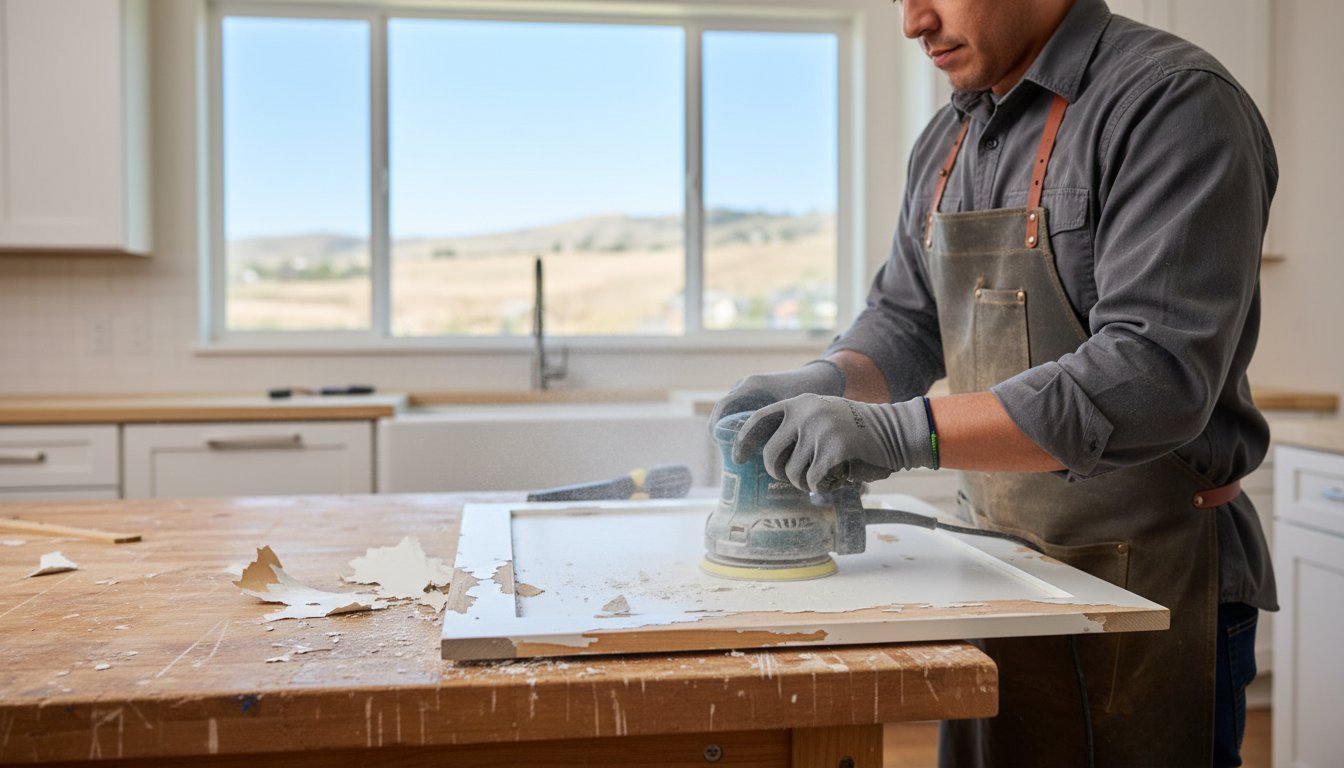
- Step 3: Sanding to Substrate. We sand the surfaces back to the original wood or stable substrate. If the previous layer is peeling, we remove it entirely so the new finish has a solid foundation to bite into.
- Step 4: High-Adhesion Priming. We apply industrial-strength, precatalyzed primers. These are not hardware store products. These primers are designed to chemically bond to the wood fibers.
- Step 5: Spraying Topcoats. We apply industrial acrylic topcoats using professional spray equipment. This creates a hard, durable surface that resists moisture and impact.
The Prep Work: The Most Vital Factor
Preparation is where the real work happens. At Painting Kitchen Cabinets Denver, we spend 75% of our time on prep work because the painting is the easy part. We use a process called tack-ragging between every stage to remove 100% of microscopic dust particles. If your cabinets have heavy oak grain, we use specialized fillers and sand them flat to achieve a smooth-as-glass surface. This level of detail is what separates a professional Cabinet Refinishing job from an amateur one.
Achieving the Factory Finish via Spraying
We never use brushes or rollers on your kitchen cabinets. Brushes leave ugly stroke marks and rollers leave a stipple texture that traps dirt. We use HVLP (High Volume Low Pressure) spray systems to atomize the coating for a flawless look. Our team applies 3 to 4 thin coats rather than one thick layer. This creates a much stronger bond and a finish that is 5 times more durable than standard house paint. If you want to know how to fix peeling paint on kitchen cabinets for good, text us the number of doors and drawers for an immediate quote.
Professional Cabinet Restoration in Denver, CO
Painting Kitchen Cabinet Denver brings over 45 years of specialized experience to every project. We understand exactly how to fix peeling paint on kitchen cabinets because we’ve spent decades correcting the mistakes of others. We don’t provide a quick cover-up. Our team delivers a permanent, factory-like result using industrial-strength acrylics that outperform standard retail paints. We serve the entire Denver metro area and surrounding Colorado cities with a commitment to quality that “cheap” alternatives simply cannot match. Our reputation is built on delivering a finish that looks and feels like it came straight from the manufacturer.
Our Meticulous Denver Cabinet Refinishing Process
Our process is labor intensive because prep work is the most vital factor in a lasting finish. We refuse to take shortcuts like amateur house painters who use cheap latex products or basic hand-brushing techniques. We utilize a unique spray-only application for a flawless, smooth surface without brush marks or drips. Our finishes are specifically engineered to withstand Colorado’s 15% average humidity and the intense heat of a working kitchen. We use precatalyzed primers and industrial coatings that create a chemical bond to the wood. This prevents the chipping and flaking common with standard residential paints. We’ve seen 100% of “quick fix” jobs fail within the first year, which is why we only do things the right way.
Get an Immediate Quote for Your Kitchen
We’ve simplified the estimation process to save you time. You don’t have to wait days for a technician to visit your home for a quote. You can text us the number of doors and the number of drawers with pictures, and we can get you an accurate price immediately. To provide your restoration estimate, we need:
- A clear count of all cabinet doors
- A count of all drawer fronts
- 4 to 6 photos showing the current condition and layout
We provide expert service across Aurora, Lakewood, Thornton, Arvada, Westminster, Centennial, and the entire front range. Don’t settle for a temporary fix that will peel again in 12 months. Text us your cabinet photos today for an immediate quote!
Get a Durable Factory Finish for Your Denver Kitchen Today
Peeling paint isn’t just an eyesore; it’s a sign that your previous coating failed to bond with the wood. Professional results depend on the most vital factor: meticulous prep work. You can’t just paint over the problem with cheap store-bought latex. Knowing how to fix peeling paint on kitchen cabinets means understanding that a permanent solution requires stripping away failed layers and applying industrial-strength precatalyzed primers. At Painting Kitchen Cabinets Denver, we’ve spent over 45 years perfecting a spray-only application that eliminates brush marks and roller textures entirely.
Our team provides a factory finish that stands up to daily kitchen use. We don’t cut corners with amateur house-painting techniques. We use high-grade materials that bond at a molecular level to ensure your cabinets look new for years. If you’re tired of seeing flakes on your floor, it’s time to do the job the right way. Text us your cabinet photos today for an immediate quote! We’ll look at your doors and drawers to give you an accurate price right away. You deserve a kitchen that stays beautiful, and we’re ready to make it happen for you.
Frequently Asked Questions
Can I just sand down the peeling spots and paint over them?
No, you can’t just sand the spots because the underlying bond has already failed across the entire surface. If 10% of your door is peeling, the other 90% is likely right behind it. To learn how to fix peeling paint on kitchen cabinets properly, you must remove all failing material back to a sound substrate. We see 100% failure rates when homeowners try to “patch” paint instead of performing a full mechanical sand and prime.
Why is the paint peeling specifically around my cabinet handles?
Skin oils and kitchen grease break down the chemical bond of the paint over time. About 95% of peeling near handles happens because the original painter didn’t use an industrial strength degreaser during the prep work. These oils soak into the wood grain and push the paint off from the inside out. This is why we emphasize cleaning as the most vital factor in any Painting Kitchen Cabinets Denver project.
What kind of primer is best for preventing peeling on kitchen cabinets?
High-solids precatalyzed primers or shellac-based bonding primers are the only products that provide a permanent bond. Amateur house painters often use cheap latex primers that fail within 12 months on slick cabinet surfaces. We use industrial strength primers that bite into the wood. These coatings create a foundation for a factory finish that won’t chip or flake under heavy daily use.
Is it better to strip or sand peeling cabinets before repainting?
Sanding is the superior method for 90% of kitchen cabinet refinishing projects. Chemical strippers are messy and often leave behind a paraffin residue that causes the new coating to fail immediately. We use a labor intensive process involving 80-grit to 220-grit sandpaper to create a mechanical profile. This ensures the new primer has a clean, textured surface to grab onto for a long-term bond.
How much does it cost to have a professional fix my peeling cabinets in Denver?
A professional project in the Denver metro area typically ranges from $3,500 to $7,500 for a standard 30-piece kitchen. The price depends on the extent of the damage and the labor required for prep work. You can text us the number of doors and the number of drawers with pictures and we can get you an accurate price immediately. This is the fastest way to understand how to fix peeling paint on kitchen cabinets for your specific home.
Can humidity in the kitchen cause my cabinet paint to peel?
Yes, sustained humidity levels above 50% cause the wood to expand and contract, which eventually cracks the paint film at the joints. Most residential paints aren’t flexible enough to handle this movement. Our Painting Kitchen Cabinets Denver process uses industrial coatings designed to move with the wood. This prevents the “spiderweb” cracking often seen in kitchens with poor ventilation or high moisture levels.
How long does a professional cabinet refinishing job last compared to DIY?
A professional factory finish lasts 15 to 20 years when maintained properly. In contrast, 80% of DIY cabinet projects show signs of peeling or chipping within the first 24 months. We use 45 years of experience to ensure the finish is durable and scrubbable. The difference lies in the industrial strength products and the rigorous prep work that most homeowners and amateur painters skip.
Do I need to take my cabinet doors off to fix the peeling paint?
Yes, 100% of the doors and drawers must be removed to fix the peeling paint correctly. You can’t achieve a factory finish while the doors are hanging on the hinges. We take the doors to our shop where they are cleaned, sanded, and sprayed in a controlled environment. This allows us to apply the coatings horizontally, which prevents runs and ensures an even, durable layer of protection on every edge.