
If you are searching for “custom glazed cabinet refinishing services near me,” you are likely standing in a kitchen that needs a refresh but does not need a demolition crew. Homeowners in Castle Rock, Castle Pines, Highlands Ranch, and Parker, CO, are increasingly turning to professional refinishing to get a high-end, factory-finish look without the six-figure price tag of a full remodel. Custom glazing adds depth, shadow, and old-world character to cabinet doors, and when it is applied by a trained crew using commercial-grade materials, the result rivals anything coming out of a custom millwork shop. This guide covers what the process costs, how it works, which materials qualify, and why a factory-quality finish matters more than you might think.
My Review of Graco FFLP Tips for Spraying Cabinets
Table of Contents
- Why Choose Custom Glazed Cabinet Refinishing in 2026?
- How Much Do Custom Glazed Cabinet Refinishing Services Cost?
- The Professional Refinishing Process: From Prep to Factory Finish
- Custom Glaze vs. Solid Color Refinishing: What’s the Difference?
- Is Refinishing Right for Your Cabinet Material?
- How Long Does a Custom Glazed Cabinet Refinishing Project Take?
- Will Refinishing Increase Your Home’s Value?
- Maintenance and Longevity of Glazed Refinished Cabinets
- Why Choose a Local Professional for Custom Glazed Cabinet Refinishing?
- Frequently Asked Questions About Custom Glazed Cabinet Refinishing
- Ready to Transform Your Kitchen? Get a Free Estimate for Custom Glazed Cabinet Refinishing
Why Choose Custom Glazed Cabinet Refinishing in 2026?
Custom glazing transforms flat, one-dimensional paint into something with genuine architectural presence. A translucent glaze is hand-applied over a base color, then wiped back to settle into corners, beadboard grooves, and raised-panel profiles. The result is a subtle halo effect that draws the eye to the craftsmanship of the door itself.
In the Castle Rock and Highlands Ranch markets, glazed finishes continue to dominate transitional and traditional kitchens in 2026. They pair naturally with quartz countertops, farmhouse sinks, and matte brass hardware. Unlike a solid paint job, a glazed finish looks intentional and layered, as if the cabinets have been there for decades and were simply well cared for.
Professional Kitchen Cabinet Painting
Kitchen Cabinet Painting Denver
How Much Does It Cost to Paint Kitchen Cabinets?
There is also a practical advantage. Professional refinishing with a factory-grade topcoat produces a harder, more uniform surface than any brush-on DIY kit can achieve. When the glaze is sealed under a UV-cured clear coat, the finish resists chipping, staining, and moisture intrusion in ways that air-dried paints simply cannot match.
How Much Do Custom Glazed Cabinet Refinishing Services Cost?
Most custom glazed cabinet refinishing projects in the Denver metro area fall between $1,800 and $4,320. That range accounts for kitchen size, door count, and the complexity of the glaze application. A straightforward single-color glaze on a modest kitchen lands at the lower end. A multi-step antiquing process with a custom-tinted glaze on a large kitchen with an island and pantry wall pushes toward the upper end.
To put those numbers in perspective, full cabinet replacement routinely exceeds $15,000 for a mid-sized kitchen, and even traditional refacing, where doors and drawer fronts are swapped out but boxes stay, averages north of $10,000. Refinishing with custom glaze typically costs 50 to 70 percent less than replacement. You keep your existing cabinet boxes, which are often better built than anything available at a big-box retailer today, and you redirect the savings toward other upgrades like countertops or lighting.
A detailed estimate from a local professional should include surface preparation, priming, base coat application, custom glaze work, and the protective topcoat. If any of those line items are missing, ask why. Shortcuts in prep or topcoating are where refinishing jobs fail prematurely.
Cost Breakdown by Cabinet Size and Glaze Complexity
A small kitchen with 10 to 15 cabinet doors and drawers generally runs $1,800 to $2,500. A medium kitchen with 16 to 25 openings falls between $2,500 and $3,500. Large kitchens with 26 or more doors and drawers, plus an island or butler’s pantry, range from $3,500 to $4,500. Custom glaze colors that require hand-tinting or multi-step antiquing techniques add 10 to 20 percent to the base refinishing price. The extra cost reflects the additional labor hours involved in layering and hand-wiping the glaze to achieve a consistent, controlled look across every door face.
The Professional Refinishing Process: From Prep to Factory Finish
A factory-quality glazed finish does not come from a can. It comes from a sequence of steps that cannot be rushed, and each one builds on the last.
Step one is cleaning and degreasing. Kitchen cabinets accumulate a film of cooking oils, dust, and hand oils that paint will not bond to. Every surface is scrubbed with a degreasing agent before any sanding begins. Skipping this step guarantees adhesion failure within months.
Step two is sanding and patching. The existing finish is scuffed with fine-grit abrasives to create a mechanical bond for the primer. Dents, deep scratches, and open grain are filled and sanded smooth. On oak cabinets, some homeowners choose to fill the grain for a smoother look, while others prefer to let the grain texture show through the glaze for added depth.
Step three is primer application. A high-bonding oil-based or shellac primer is sprayed on to block tannin bleed from wood species like oak and cherry and to create a uniform base that the paint can grip. This is not a step where a water-based primer will do the same job.
Step four is the base color and glaze application. The base coat is sprayed in the chosen color and allowed to cure. Then the glaze, a translucent tinted medium, is hand-applied over the base. The technician wipes it into corners, along routed edges, and across raised panels, then selectively wipes it back to control the intensity. No two doors are exactly alike, which is the point. The variation reads as authentic craftsmanship rather than machine-made uniformity.
Step five is the protective topcoat. A clear, factory-grade finish is sprayed over the entire door and allowed to cure. In a high-end shop, this is where UV light curing technology changes the game.
UV Light Curing Technology for a True Factory Finish
Some professional refinishers, including those using systems like N-Hance’s Lightspeed Nano process, cure the topcoat instantly with proprietary UV light systems. The coating hardens in seconds rather than hours. That eliminates the window where airborne dust can settle into the wet finish, which means fewer nibs and a glass-smooth surface.
UV-cured finishes also outperform air-dried coatings on hardness, scratch resistance, and chemical resistance. In a kitchen, where cabinets face steam from boiling pots, splatter from cooking oils, and daily handling, that durability translates directly to longevity. Projects using UV curing are typically completed in two to three days, compared to five to seven days for traditional air-dried methods.
Custom Glaze vs. Solid Color Refinishing: What’s the Difference?
Solid color refinishing delivers a clean, uniform surface in a single hue. It is crisp, modern, and works beautifully in minimalist or contemporary kitchens. What it does not do is create depth.
Custom glazed finishing adds a translucent layer over the base color that pools in recesses and thins out on raised surfaces. The effect highlights the architecture of the door: beadboard lines, raised panel perimeters, routed profiles, and corner details all gain definition. The glaze can be tinted darker than the base for contrast, or it can carry a subtle metallic or pearlescent pigment for a softer shimmer.
Glazed finishes naturally suit traditional, farmhouse, and transitional kitchens. They also serve a practical design function: a glaze can tone down a base color that reads too bright under certain lighting, or it can add an aged patina that makes new cabinets look like cherished antiques. Solid color refinishing remains the better choice for slab-door modern kitchens where any hint of ornamentation would feel out of place.
Is Refinishing Right for Your Cabinet Material?
Not every cabinet material takes glaze the same way, and some do not take it at all. Solid wood is the ideal candidate. Maple, cherry, oak, and birch all accept primer and paint readily, and their natural grain patterns add subtle texture beneath the glaze. Oak, with its pronounced grain, creates a particularly dramatic glazed effect that many homeowners in Parker and Castle Pines seek out for rustic or French-country kitchens.
MDF, or medium-density fiberboard, refinishes well as long as the factory coating is intact and the doors are not swollen from moisture exposure. The surface is smooth and grain-free, so the glaze effect will be more uniform and less textured than on solid wood. That can be a desirable look for certain transitional designs.
Laminate and thermofoil cabinets present real challenges. Glaze and paint do not bond reliably to these surfaces without specialized adhesion promoters, and even then, the results are less durable than on wood or MDF. In many cases, replacing the doors and drawer fronts while refinishing the boxes is the more practical path. A free in-home consultation can identify your cabinet material and give you an honest assessment of whether custom glazing is a viable option. For homeowners in the Denver area, cabinet refinishing Denver professionals can evaluate your existing cabinets and recommend the right approach.
How Long Does a Custom Glazed Cabinet Refinishing Project Take?
Most standard kitchens are completed in two to three days when the crew uses professional spray equipment and UV curing technology. The doors and drawer fronts are typically removed, labeled, and refinished off-site or in a ventilated on-site spray booth. The cabinet boxes are masked and sprayed in place.
Custom glaze colors or intricate antiquing techniques may extend the timeline to four or five days. The extra time goes into the hand-wiping process, which cannot be mechanized. Each door gets individual attention, and the glaze must be applied and manipulated before it sets.
Homeowners retain use of their kitchen throughout the project. Countertops remain clear for meal prep, and appliances stay connected. Cabinets are typically functional within 24 hours of the final topcoat cure. There is no weeks-long displacement as there would be with a full tear-out and replacement.
Will Refinishing Increase Your Home’s Value?
Kitchen remodels consistently deliver a 3 to 7 percent return on investment at resale, according to Consumer Reports data. In the Castle Rock, Parker, and Highlands Ranch real estate markets, updated kitchens are consistently cited as a top priority for buyers. A glazed cabinet finish signals quality and attention to detail. It reads as a custom upgrade rather than a cosmetic cover-up.
Refinishing offers a particularly strong value proposition for pre-sale updates because the cost is low relative to the perceived improvement. A $3,500 glazed refinishing job can make a kitchen look $15,000 newer. That math works in the seller’s favor every time.
Maintenance and Longevity of Glazed Refinished Cabinets
With reasonable care, professionally refinished and glazed cabinets last five to ten years before needing any touch-up work. The topcoat takes the brunt of daily wear, and UV-cured coatings resist yellowing, staining, and micro-scratching better than conventional lacquers or water-based clears.
Cleaning is straightforward. A soft microfiber cloth dampened with mild soap and water handles most fingerprints and splatter. Avoid abrasive cleaners, scouring pads, and solvent-based sprays, which can dull the glaze layer over time. Many local refinishing providers offer warranties on labor and materials, which adds a layer of protection that DIY work cannot match. If you are considering a full kitchen update, painting kitchen cabinets Denver services often include warranty-backed finishes that stand up to Colorado’s dry climate and temperature swings.
Why Choose a Local Professional for Custom Glazed Cabinet Refinishing?
Factory-finish quality depends on equipment and environment. Professional spray rigs atomize the coating into a fine, even mist that no brush or roller can replicate. Climate-controlled curing prevents the blush, orange peel, and solvent pop that plague garage-based DIY jobs. These are not conditions a homeowner can easily reproduce.
Local providers serving Castle Rock, Castle Pines, Highlands Ranch, and Parker also understand the regional style preferences and the practical effects of Colorado’s semi-arid climate on wood movement and finish curing. A family-owned, licensed, and insured business offers accountability that an out-of-state franchise or a handyman listing cannot. The consultation happens in your kitchen, under your lighting, with your existing finishes and countertops in view. That context matters when selecting a glaze color and sheen that will look right at 7 a.m. with eastern exposure and at 6 p.m. under warm LED pendants.
Frequently Asked Questions About Custom Glazed Cabinet Refinishing
Is it cheaper to refinish cabinets or replace them?
Yes, refinishing is typically 50 to 70 percent less expensive than full cabinet replacement. Homeowners save between $1,000 and $8,000 depending on kitchen size and material choices. The savings come from reusing existing cabinet boxes and avoiding the labor costs of demolition, disposal, and new installation.
What cabinet color is outdated in 2026?
Honey oak and builder-grade maple with orange undertones are widely considered outdated. The trending palette includes navy, sage green, warm white, charcoal, and two-tone combinations where a darker island or base cabinet color is paired with a lighter uppers color. Custom glazing over these trending base colors adds a layer of sophistication that solid paint alone cannot achieve.
How to refinish glazed cabinets if I want to change the color?
A professional will sand off the existing glaze layer, re-prime the surface to block the old color, apply a new base coat, and then optionally apply a fresh glaze in a different tone. The process is essentially the same as a first-time refinishing job, with the added step of removing the previous glaze. The underlying cabinet material remains intact throughout.
How long does a custom glazed finish last?
With a UV-cured topcoat and routine cleaning, expect five to ten years of durability before any touch-up is needed. High-wear areas near handles and lower cabinet edges may show wear sooner, but these can be spot-corrected without refinishing the entire kitchen.
Ready to Transform Your Kitchen? Get a Free Estimate for Custom Glazed Cabinet Refinishing
If your kitchen is in Castle Rock, Castle Pines, Highlands Ranch, Parker, or any surrounding Colorado community, a factory-finish cabinet transformation is closer than you think. Custom glazed refinishing delivers the look of a high-end remodel in days, not weeks, and at a fraction of the cost of replacement. You keep your kitchen functional, your cabinet boxes intact, and your budget under control.
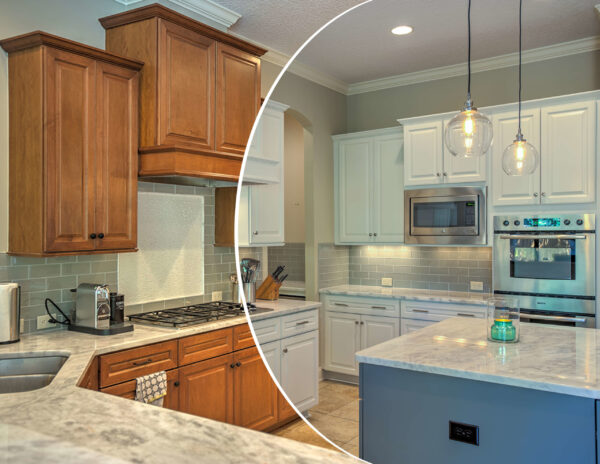
A no-obligation consultation includes a material assessment, a custom color and glaze consultation, and a detailed project estimate. For homeowners who want to see what is possible before committing, refinishing kitchen cabinets Denver CO showcases real transformations that demonstrate the difference a professional glaze finish makes. Your kitchen already has good bones. A custom glaze finish gives it the presence it deserves.