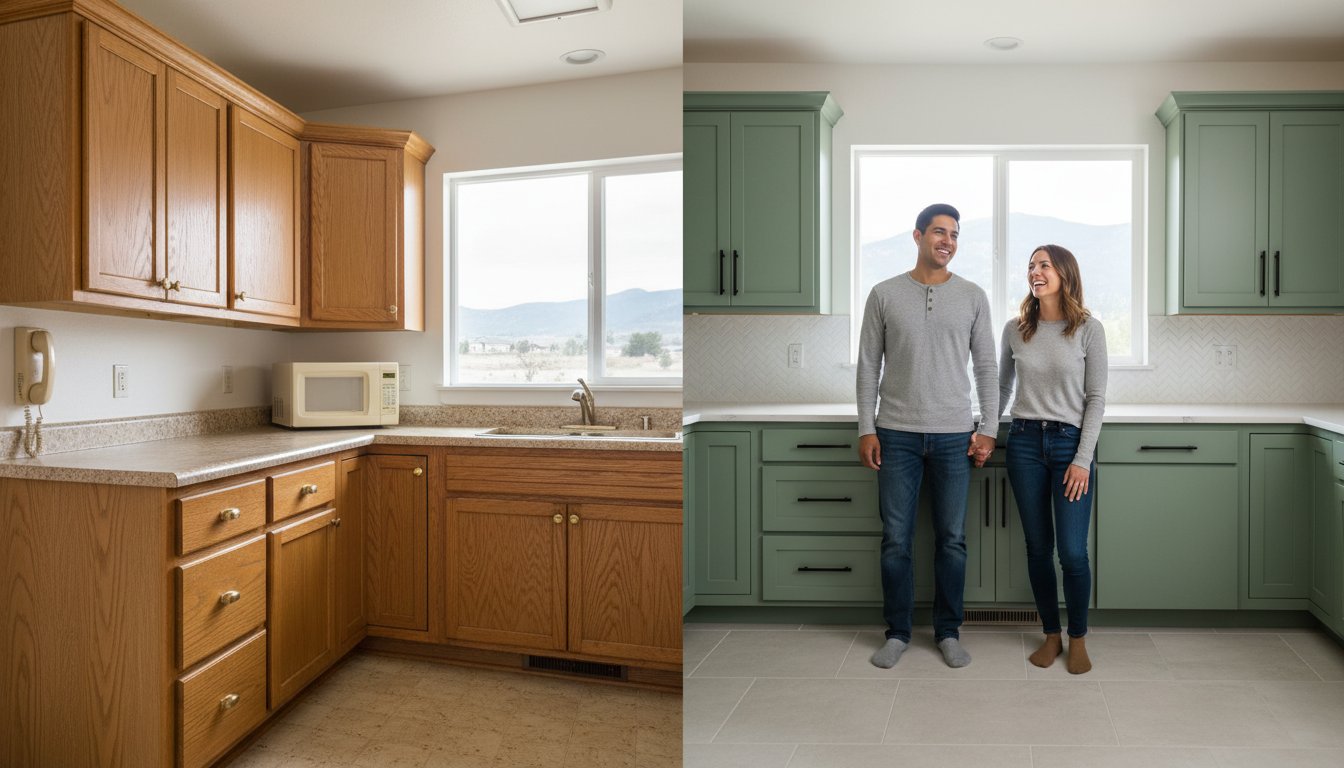
Finding the best cabinet painters in Denver, CO, who specialize in a sprayed factory finish is the single most effective way to modernize your kitchen without the six-figure price tag of a full gut renovation. This guide cuts through the marketing noise to give you a data-backed framework for evaluating cabinet refinishing specialists across the Denver metro area, including Castle Rock, Castle Pines, Highlands Ranch, and Parker. We will cover what separates a true sprayed factory finish from a standard paint job, what you should expect to pay in 2026, and the technical factors that make Denver's unique climate an unexpected advantage for cabinet coating durability.
Table of Contents
- Why Denver Homeowners Are Choosing a Factory Finish Over Full Replacement
- The "Factory Finish" Difference: Spray Application vs. Brush and Roll
- What to Look For in a Top-Tier Cabinet Painter (Denver Criteria)
- The Real Cost of Cabinet Painting in Denver (2026 Pricing Guide)
- Our Process: How We Deliver a Sprayed Factory Finish
- Frequently Asked Questions
- Serving the Denver Metro and Surrounding Areas
- Conclusion
Why Denver Homeowners Are Choosing a Factory Finish Over Full Replacement
The economics of kitchen renovation in the Denver market have shifted decisively in favor of refinishing. A full kitchen remodel in neighborhoods from Cherry Creek to Littleton now routinely exceeds $30,000 and can easily climb past $45,000 when you factor in custom cabinetry, countertops, and the inevitable surprises that come with tearing out walls. Professional cabinet refinishing, by contrast, costs approximately 30% of what a full replacement would run. That means a kitchen that might cost $40,000 to gut and rebuild could see a comparable aesthetic transformation for somewhere in the low five figures, with the existing cabinet boxes remaining in place.
The return on investment tells an equally compelling story. Cabinet painting can deliver an ROI of up to 80%, and a fresh factory finish has been shown to add $10,000 to $15,000 to a home's appraisal value. In Denver's competitive real estate market, that number carries real weight. Properties with updated, neutral cabinetry in sought-after neighborhoods like Washington Park and Cherry Hills have sold 15% faster than comparable homes still sporting dated wood tones. For homeowners planning to list in the next 12 to 24 months, cabinet refinishing is one of the highest-leverage pre-sale improvements available.
Beyond the financial case, there is a structural reality that most homeowners overlook. Approximately 85% of existing cabinet boxes are structurally sound enough to last another 25 years with a professional industrial coating. The boxes in your kitchen were likely built from plywood or solid wood that far exceeds the quality of what you would find in a mid-range replacement line today. Tearing them out means discarding material that still has decades of life left, while refinishing preserves that quality and simply updates the surface.
There is also an environmental dimension worth considering. A single kitchen cabinet refinishing project keeps roughly 1,200 pounds of high-quality wood and composite material out of Colorado landfills. For homeowners who prioritize sustainability, that figure transforms a cosmetic upgrade into a meaningful environmental choice.
The "Factory Finish" Difference: Spray Application vs. Brush and Roll
When cabinet painters talk about a factory finish, they are describing something specific: a surface so smooth and uniform that it looks like it came straight from a high-end cabinet manufacturer's production line. The only way to achieve that result is through professional spray application. Spray equipment atomizes the coating into a fine mist, depositing it in thin, even layers that self-level into a glass-like surface. Brush marks, roller stipple, and lap lines simply do not exist in a properly sprayed finish.
The durability gap between a sprayed industrial coating and a brushed-on latex paint is dramatic. Standard latex house paint, even when applied carefully with a brush, will typically begin showing signs of wear on cabinet surfaces within 12 months. The constant contact with hands, cooking oils, and cleaning products breaks down the film, leading to peeling, chipping, and a surface that traps grime. Industrial coatings used by cabinet specialists, including precatalyzed primers and conversion lacquers, form a chemically cured film that resists those same forces for years.
Denver's climate gives homeowners an advantage they rarely hear about. The city's average humidity hovers around 15%, which is exceptionally low compared to coastal or southern markets. Low humidity allows specialized coatings to cure into a rock-hard surface that resists grease and oils far better than the same product would in a humid environment. In places like Houston or Atlanta, ambient moisture can interfere with the curing process, leaving a finish that is slightly softer and more vulnerable to degradation over time. Denver's dry air effectively acts as a natural accelerator for the chemical cross-linking that gives industrial coatings their hardness.
The single most important factor in achieving a sprayed factory finish, however, is not the spray equipment itself. It is the preparation. Professional refinishers spend roughly 75% of their total project time on prep work: degreasing every surface to remove cooking oils that would repel paint, sanding to create a mechanical bond for the primer, masking off every adjacent surface with precision, and priming with products specifically engineered for cabinetry. A painter who rushes through prep will produce a finish that looks acceptable for a few months and then begins to fail. The difference between a specialist and a general house painter often comes down to how many hours they are willing to spend on work the homeowner never sees.
The Technical Edge: Primers and Tannin Blocking
The science behind cabinet painting starts with the primer. Many Denver-area homes feature oak or maple cabinets, and both woods contain tannins: natural compounds that can bleed through standard primers and create yellowish-brown stains in the finish coat, sometimes weeks or months after the job is complete. Pre-catalyzed primers are chemically engineered to block tannin migration, sealing the wood at a molecular level before the color coat ever touches the surface. Top-tier cabinet painters use specific product systems rather than whatever is on sale at the local paint store. Benjamin Moore Advance, Fine Paints of Europe ECO, and Hollandlac are names that signal a provider has invested in understanding coating chemistry. These are not products you will find on the shelf at a big-box home improvement store, and they require training to apply correctly.
What to Look For in a Top-Tier Cabinet Painter (Denver Criteria)
Identifying the best cabinet painters in Denver, CO, requires looking past the estimate and evaluating the business itself. The first filter is specialization. Cabinet refinishing is a distinct trade from wall painting, and the most reliable providers have been focused exclusively on cabinets for decades. Some of Denver's established names bring 20 to 45 years of specific cabinet experience to every project. A general house painter who paints cabinets on the side simply cannot match the depth of knowledge that comes from thousands of kitchen transformations.
Warranty terms reveal how much confidence a provider has in their own work. A 15-year no-peel warranty, offered by some Denver-area refinishers, sets the benchmark for what a factory finish should deliver. If a company offers a one-year warranty or no written guarantee at all, that tells you something about the materials and methods they are using.
Process transparency is another critical signal. The best providers walk you through a clear sequence: an initial consultation, thorough preparation, spray application in a controlled environment, careful reinstallation, and a final cleanup that leaves the kitchen ready to use. Some specialists offer off-site door finishing, picking up doors and drawer fronts on a Monday and returning them fully cured and ready to install by Friday. This model minimizes disruption to your household and ensures that the spray application happens in a dust-controlled shop rather than your kitchen.
Local reputation matters. Check Google ratings and read the actual review text, not just the star count. A 4.9 average from dozens of verified reviews carries more weight than a perfect 5.0 from a handful of friends and family. Some Denver cabinet painters have earned media credibility through features on HGTV, Property Brothers, Netflix, and Forbes, which provides an additional layer of third-party validation.
Red Flags to Avoid
Lowball estimates are the most common trap. A quote that comes in thousands below the market average almost always signals shortcuts: skipping the degreasing step, using latex wall paint instead of cabinet-grade coatings, or rushing through the sanding process. The result is a finish that looks passable at the walkthrough but begins peeling within a year, at which point the original painter is unreachable and the homeowner is paying a specialist to strip and redo the entire job.
For homes built before 1978, lead-safe practices are non-negotiable. Any reputable cabinet painter working in Denver's older neighborhoods must adhere to EPA lead-safe painting practices, which include containment, specialized cleaning, and verification procedures. A provider who does not mention lead safety when quoting a pre-1978 home is either unaware of the regulations or willing to ignore them, and neither scenario inspires confidence.
High-pressure sales tactics are another warning sign. Some companies still rely on lengthy in-home sales presentations designed to create urgency and close the deal on the spot. A growing number of Denver's top cabinet painters have moved to text-based quoting systems that let you submit photos and receive a preliminary estimate without a hard sell. That approach respects your time and signals that the company competes on quality rather than sales pressure.
The Real Cost of Cabinet Painting in Denver (2026 Pricing Guide)
Pricing transparency in the cabinet refinishing industry is notoriously poor, which is exactly why this section exists. Based on current market data for the Denver metro area in 2026, a professional sprayed factory finish on an average-sized kitchen typically falls in the range of $4,500 to $12,000. A smaller kitchen with a modest number of doors and drawers might land near the lower end, while a large kitchen with an island, extensive upper cabinetry, and a complex color change can push toward the upper end. Projects that involve additional built-ins, such as bookshelves or wet bars, may exceed that range.
Several factors drive the final quote. The number of doors and drawer fronts is the most obvious variable, but material type matters just as much. Oak, with its deep grain pattern, requires additional filling and sanding if the homeowner wants a smooth, grain-free finish. MDF and thermofoil surfaces demand different preparation protocols than solid wood. A color change from a dark stain to a light paint requires more coats and more meticulous coverage than refreshing an existing painted surface. Off-site finishing, while more convenient, adds logistical costs that on-site spraying does not.
The "too good to be true" price point is anything under $2,000 for a full kitchen. At that level, you are almost certainly dealing with a handyman using latex paint and minimal prep, or a DIY refinishing kit that will not hold up to daily kitchen use. The long-term cost of a failed finish is higher than paying for a professional job the first time, because stripping failed paint and starting over is more labor-intensive than working with the original factory surface.
Framing the cost as an investment puts the numbers in perspective. A professional spray finish takes 5 to 7 business days for a standard project, with more complex refinishing extending to 7 to 10 days. A full kitchen remodel, by contrast, can disrupt your home for three months or longer. The cost difference is measured in tens of thousands of dollars, and the time difference is measured in months of your life.
Our Process: How We Deliver a Sprayed Factory Finish
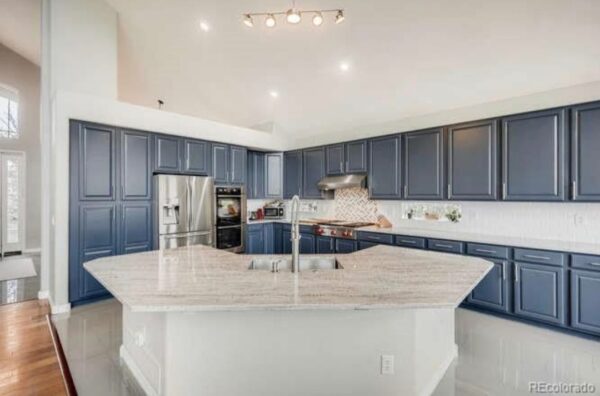
A transparent process builds trust before the first door comes off its hinges. The journey starts with an in-home consultation where we assess your cabinet condition, discuss color direction, and provide custom color matching against 2026 trends. Whites remain the dominant choice for their timeless appeal and light-reflecting qualities, but warm greys, navy blues, and soft neutrals are gaining ground among Denver homeowners who want personality without sacrificing resale value.
The industrial preparation phase is where the durability of your finish is truly determined. Every surface undergoes degreasing with specialized cleaners that dissolve cooking oils and hand oils that have accumulated over years of use. Sanding follows, creating a mechanical profile that gives the primer something to grip. Masking protects countertops, floors, appliances, and adjacent walls with surgical precision. This phase consumes the majority of the project timeline, and for good reason: no coating, no matter how expensive, can bond to a contaminated or improperly prepared surface.
The spray application itself happens either in a contained on-site environment or in a dedicated off-site spray booth, depending on the project scope. Professional HVLP or airless spray equipment atomizes the coating into a fine, consistent mist that self-levels into the signature factory-smooth surface. Multiple thin coats build depth and durability without the sags or drips that plague amateur applications.
Reinstallation and cleanup bring the project to a close. Doors and drawers are carefully rehung, hardware is reinstalled or replaced, and a final walkthrough ensures every detail meets the standard. The kitchen is left clean and functional, often within a week of the start date.
Frequently Asked Questions
What is the average cost to spray paint kitchen cabinets in Denver?
Most Denver homeowners invest between $4,500 and $12,000 for a professional sprayed factory finish on their kitchen cabinets, with the final figure depending on kitchen size, door count, material type, and the complexity of the color change.
Can you paint factory finish cabinets?
Yes. Previously factory-finished cabinets can be repainted successfully, but only with proper degreasing and sanding to ensure adhesion. This is a standard part of the professional preparation process and does not require stripping the original finish down to bare wood.
Is spray painting kitchen cabinets a good idea?
Spray painting is the only method that produces a truly smooth, glass-like finish free of brush marks and roller texture. When done with industrial coatings and proper preparation, a sprayed finish resists chipping and peeling far longer than any brushed alternative.
What is the best finish for painted kitchen cabinets?
For kitchens, a satin or semi-gloss sheen in a urethane-enhanced waterborne or precatalyzed lacquer offers the best balance of durability, cleanability, and appearance. These finishes resist moisture, grease, and frequent cleaning without showing wear the way flat or matte finishes would.
Serving the Denver Metro and Surrounding Areas
Our sprayed factory finish services cover the full Denver metro corridor, including Castle Rock, Castle Pines, Highlands Ranch, and Parker. Each of these communities shares Denver's low-humidity climate advantage, which means the same rock-hard cure that protects cabinets in the city applies equally to homes throughout the southern suburbs. Whether you are updating a kitchen in a Highlands Ranch family home or preparing a Castle Pines property for the spring market, the combination of industrial coatings and Colorado's dry air delivers a finish built to last. If you are researching cabinet refinishing options, you can explore more about how painting kitchen cabinets in Denver transforms kitchens across the metro area.
Conclusion
The best cabinet painters in Denver, CO, earn that distinction through preparation, product knowledge, and spray technology, not through the lowest bid. A true sprayed factory finish preserves the structural quality of your existing cabinets while delivering a surface that resists peeling, chipping, and wear for years. The economics are compelling: a fraction of the cost of replacement, an 80% ROI, and a transformation that takes days instead of months. If you are ready to see what a factory finish can do for your kitchen, reach out for a consultation. The process is straightforward, the timeline is measured in days, and the result is a kitchen that looks and feels brand new.