
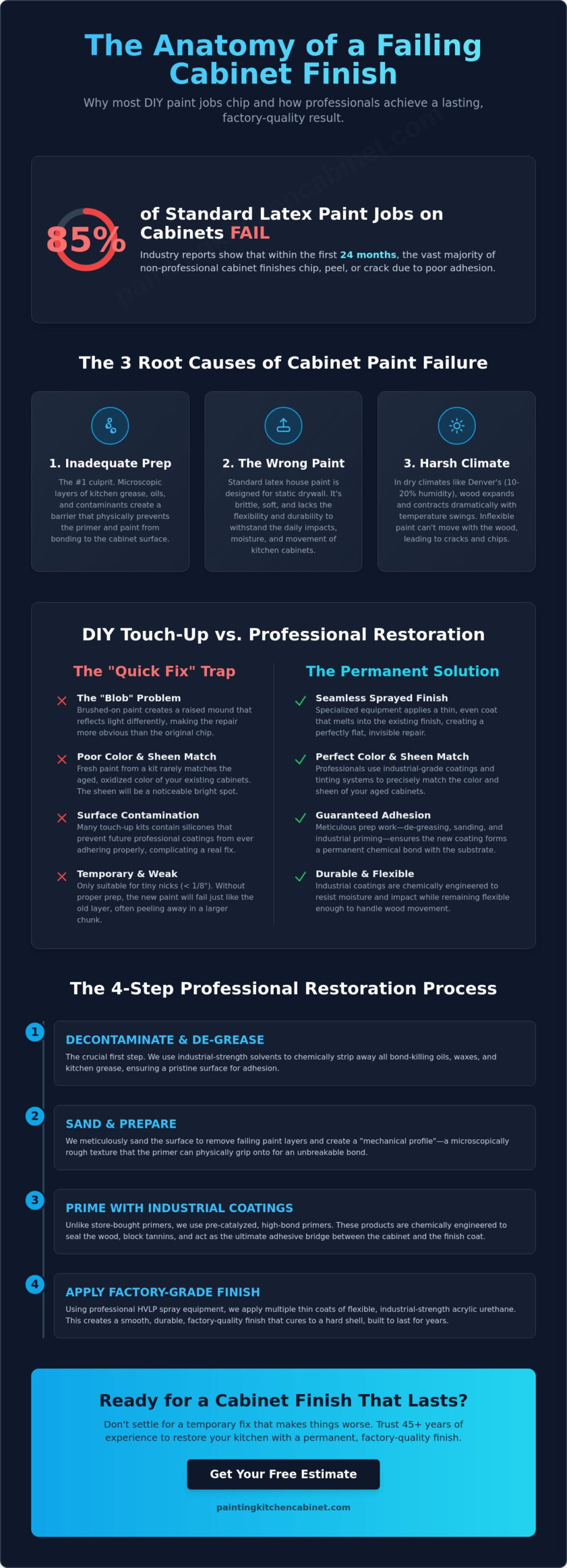
A cheap touch-up pen is often the fastest way to ruin your kitchen’s aesthetic. You’ve likely noticed those small, visible chips around your cabinet handles and felt the urge to just dab some paint on them. It’s frustrating when a high-traffic kitchen looks cheap because the finish is failing. You aren’t alone. Industry reports indicate that 85% of standard latex paint applications on cabinets fail within the first 24 months due to poor adhesion. This guide provides the exact professional steps for fixing chipped paint on cabinets while explaining why most DIY fixes don’t last.
Painting Kitchen Cabinets Denver has over 45 years of experience in the trade. We know that the secret isn’t in the paint; it’s in the preparation. We will show you how to handle minor repairs and why professional restoration is the only way to achieve a permanent, factory-quality finish. You’ll learn about the importance of industrial strength precatalyzed primers and the labor intensive sanding required to prevent future chipping. This article covers everything from basic spot repairs to the technical reasons why your current paint is peeling. We want to help you get a kitchen that looks new again.
Key Takeaways
- Identify the root cause of coating failure and why inadequate preparation is the primary reason cabinet paint chips and peels.
- Learn the professional sequence for fixing chipped paint on cabinets, including critical de-greasing and sanding steps to ensure a flat, lasting repair.
- Understand the “blob” problem and why brushed-on touch-ups can never truly blend with a seamless, factory-sprayed finish.
- Discover why standard house painters using cheap latex products often fail in Denver’s dry climate and high-traffic kitchen environments.
- Explore how industrial-strength coatings and a 45-year restoration process provide a durable, permanent finish that DIY methods cannot replicate.
Understanding Why Cabinet Paint Chips: The Root Cause
Chipping occurs when the bond between the coating and the substrate fails completely. This usually happens because of mechanical stress or poor adhesion at the surface level. When you are fixing chipped paint on cabinets, you have to look at why the paint let go in the first place. Most failures aren’t the fault of the paint itself but the person who applied it. Painting Kitchen Cabinets Denver sees this daily. The #1 culprit is inadequate prep work. If a painter fails to remove every trace of kitchen grease or uses the wrong primer, the finish will fail. There are many reasons for paint failure, but in a kitchen environment, it almost always comes down to what happened before the first coat was applied.
Environmental factors in Colorado play a massive role in Cabinet Refinishing durability. Denver’s low humidity, which often sits between 10% and 20%, makes wood extremely dry and brittle. When you combine this with temperature swings where the thermometer drops 40 degrees in three hours, the wood substrate expands and contracts violently. If the paint lacks the necessary elasticity, it can’t move with the wood. This leads to hairline cracks that eventually turn into large chips. Amateur house painters often use standard wall paint on cabinets. This is a recipe for disaster. Wall paint is designed to sit still on drywall, not to handle the constant movement and impact of kitchen doors and drawers.
The Role of Adhesion in Cabinet Longevity
Adhesion is the chemical and mechanical bond required to keep a finish permanent. Wood surfaces have pores that allow primer to “bite” into the material, while laminate surfaces are non-porous and require specialized high-bond primers. Sanding to the wood is often necessary for a permanent fix because it removes old, failing layers and creates a fresh profile for the new coating. Grease and oils from cooking are bond-killers. Even a microscopic layer of oil will destroy a paint bond over time, leading to peeling near handles and stoves.
Store-Bought Paint vs. Industrial Coatings
There’s a massive gap between flexible industrial acrylics and brittle consumer latex. Store-bought paints are often applied in thick layers by DIYers, which makes them more prone to impact damage. These paints stay “soft” for weeks and never achieve a true factory finish. We use precatalyzed primers and industrial-grade coatings that cure quickly and remain flexible enough to handle Colorado’s climate. Industrial strength in the context of kitchen durability means the coating is chemically engineered to resist moisture, grease, and physical impact without breaking its bond to the substrate.
- Preparation: The most vital factor in any cabinet project.
- Substrate: Knowing if you’re working with oak, maple, or MDF.
- Coating: Using industrial-strength materials instead of cheap house paint.
If you want a quote for professional Cabinet Refinishing, you can text us the number of doors and the number of drawers with pictures and we can get you an accurate price immediately. Our company is based on quality work at affordable prices, and we’ve been doing this for over 45 years. Don’t trust your kitchen to a painter who doesn’t understand the science of fixing chipped paint on cabinets the right way.
DIY Touch-Up vs. Professional Restoration
Fixing chipped paint on cabinets is a viable weekend project only when you are dealing with minor nicks under 1/8th of an inch. These small spots usually happen from a dropped pot or a vacuum cleaner bump. For these tiny areas, a steady hand can hide the damage for a short time. However, most homeowners quickly encounter the “Blob” problem. Factory finishes are applied using specialized spray equipment that creates a perfectly flat, uniform surface. When you use a brush to dab paint into a chip, the liquid surface tension creates a raised mound. This texture difference reflects light differently than the rest of the door, which often makes the repair look worse than the original chip.
The Limitations of Touch-Up Kits
Store-bought touch-up kits rarely deliver the results they promise on the packaging. Color matching at a paint store doesn’t account for how paint ages or how the sheen changes over several years. A kitchen that was painted five years ago has oxidized and shifted in color due to UV light and cooking oils. Applying fresh paint from a kit results in a bright, shiny spot that clashes with the surrounding area. Furthermore, many DIY kits contain silicones that can actually contaminate the surface. This makes it much harder for professional-grade coatings to bond if you decide to go for a professional cabinet refinishing later. We have seen many cases where amateur touch-ups voided manufacturer warranties because the chemicals used were incompatible with the factory topcoat.
Identifying Total Failure on Your Cabinets
If you notice chipping in high-moisture areas or around the handles, you aren’t just looking at a surface scratch. You are looking at a system failure. When paint peels away in large flakes, it means the primer has lost its bond with the wood. This is common when amateur house painters use cheap latex products instead of industrial-strength precatalyzed primers. When the foundation fails, fixing chipped paint on cabinets one spot at a time is a losing battle. Widespread chipping is a signal that the entire finish is compromised. In these instances, a patch won’t work because the surrounding paint will continue to lift. Your kitchen needs a complete cabinet restoration to remove the failing layers and apply a durable, factory-grade coating that can withstand daily use.
Patching a failing finish is a temporary band-aid that often leads to more frustration. If you want to see what a permanent, industrial-strength finish looks like for your kitchen, you can text us the number of doors and the number of drawers with pictures and we can get you an accurate price immediately.
The Right Way to Fix Minor Cabinet Chips (Step-by-Step)
Painting Kitchen Cabinets Denver understands that a factory finish is only as good as the surface beneath it. When you’re fixing chipped paint on cabinets, you aren’t just covering a mark; you’re restoring the structural integrity of the coating. Most failures in Cabinet Refinishing occur because the person doing the work ignored the physics of adhesion. With over 45 years of experience, we’ve seen that 90% of paint failures stem from poor cleaning or using the wrong materials. You must follow a professional process to ensure the repair doesn’t pop off in three weeks.
Preparation: The Most Vital Factor
Prep work is the most vital factor in any repair. You must remove every trace of grease, oil, and kitchen grime before touching a paintbrush. Use a professional-grade degreaser or TSP (Trisodium Phosphate) to scrub the area around the chip. If any residue remains, the new bond will fail immediately. Once the surface is dry, you need to feather-sand the “crater” edges. Use 320-grit sandpaper to smooth the sharp transition between the bare wood and the existing paint. This creates a ramp rather than a cliff, allowing the new finish to sit flush.
- Scrub: Use TSP to eliminate surface contaminants from cooking oils.
- Sand: Use 320-grit paper to feather the edges of the chip until smooth to the touch.
- Clean: Use a professional tack cloth to remove 100% of the sanding dust to prevent bumps.
Priming and Painting the Repair
When fixing chipped paint on cabinets, your choice of primer determines the lifespan of the fix. We use industrial strength precatalyzed primers because they bite into the existing finish. Amateur house painters often use cheap water-based primers that sit on top of the surface. This is a mistake. Apply the primer in a thin layer using a small artist brush or a specialized dabbing tool. Dabbing the paint into the center of the chip helps you avoid leaving visible brush marks or ridges that ruin the factory finish look.
Apply two or three thin layers rather than one thick coat. Thick coats become brittle and are prone to cracking during the natural expansion and contraction of the wood. Allow each layer to dry completely. A standard industrial coating requires a cure time of at least 24 hours before you should even think about cleaning the surface with a damp cloth. Patience is what separates a professional repair from a temporary fix. If you want an accurate price for a full professional refresh, you can text us the number of doors and the number of drawers with pictures and we can get you an accurate price immediately.
The Danger of Amateur Fixes: Why Cheap Latex Fails in Denver
Standard house painters often treat your kitchen like a bedroom wall. They use cheap latex paints that don’t belong on high-traffic wood surfaces. These products are too soft for the grease, oils, and constant handling a kitchen sees every day. In Colorado, our climate is a major factor that most amateurs ignore. The air here is extremely dry, with average relative humidity levels often dropping below 20 percent. This causes standard house paint to cure too fast, making it brittle and prone to snapping. When you are fixing chipped paint on cabinets, using these hardware store products only leads to more failure within 6 to 12 months. Our cabinet painting in Denver relies on industrial acrylics and precatalyzed primers that are engineered to handle low humidity without losing their bond.
The Joint Cracking Phenomenon
Wood is a living material that expands and contracts based on moisture levels. In Denver, seasonal shifts cause cabinet doors to move significantly at the joints. Amateur painters use standard painter’s caulk to fill these gaps. This is a massive mistake. Latex caulk is too rigid for cabinetry; it eventually dries out and pulls away, causing the paint to flake off in large chunks. Industrial strength coatings are different because they are designed to move with the wood fibers. We use professional cabinet fillers and industrial strength primers that bond deep into the grain. This prevents the common failure where paint snaps at the seam of the door frame. We have over 45 years of experience dealing with these specific wood movements, ensuring your finish doesn’t fail when the heater kicks on in the winter.
Why Spray Application is Non-Negotiable
A hand-painted cabinet door will never match the durability of a factory-sprayed finish. Brushes and rollers leave behind “orange peel” textures and micro-ridges. These high spots are the first places to wear down, making fixing chipped paint on cabinets a recurring nightmare. High-pressure spraying creates a uniform, impact-resistant surface that is significantly harder than anything a brush can apply. It is the difference between a DIY project and a professional finish that lasts 10 years or more. Our process is labor intensive because we focus on the prep work. This is the most vital factor in a lasting repair. If you want an accurate price for a factory finish, you can text us the number of doors and the number of drawers with pictures and we can get you a quote immediately.
Don’t settle for a temporary fix that will peel by next season. To get a professional result that stands up to Colorado’s climate, contact us for expert cabinet painting in Denver today.
Professional Cabinet Restoration: Getting That Factory Finish
Fixing chipped paint on cabinets requires more than a small brush and a bottle of touch-up paint. At Painting Kitchen Cabinets Denver, we use a 45-year process that transforms worn, damaged surfaces into a durable factory finish. We never use brushes or rollers because they leave behind textures and marks that ruin the professional look of your kitchen. Instead, we rely on industrial spray technology to provide a smooth, hard surface that stands up to daily use. This professional approach is the only way to ensure your kitchen looks new again without the high cost of a full replacement.
The Painting Kitchen Cabinet Denver Difference
Our process is labor intensive because we focus on the most vital factor: preparation. Most amateur house painters skip the hard work, but we spend hours on meticulous sanding and cleaning to remove grease and old finishes. We use industrial-strength acrylics and precatalyzed primers that bond to the wood. This specific combination of high-end materials and detailed prep work ensures your new finish never chips or peels again. We do things the right way because we take pride in our craftsmanship and our 45 years of experience in the trade.
We serve homeowners across the entire Denver metro area and surrounding Colorado cities. Our service areas include Arvada, Aurora, Boulder, Castle Rock, Centennial, Cherry Hills, Columbine, Commerce City, Denver, Englewood, Erie, Firestone, Fort Collins, Frederick, Golden, Greenwood Village, Highlands Ranch, Lafayette, Lakewood, Longmont, Louisville, Loveland, Northglenn, Parker, Superior, Thornton, Westminster, and Wheat Ridge. Whether you are in Highlands Ranch or Fort Collins, we bring the same level of mastery to every Cabinet Refinishing project we touch.
Ready to Fix Your Kitchen for Good?
If you’re tired of looking at damaged surfaces, fixing chipped paint on cabinets is a job for a specialist. You don’t have to wait days for a representative to visit your home just to get a price. We offer a modern, no-fuss shortcut for our customers. You can text us the number of doors and the number of drawers with pictures and we can get you an accurate price immediately. This direct communication reflects our honest, hardworking business style and our commitment to getting you the information you need fast.
Don’t settle for a temporary fix from a general painter who uses cheap latex products. Your kitchen is the heart of your home and deserves a finish that lasts for decades. You can hire a professional kitchen cabinet painter to restore your home and provide the high-quality results you expect. Contact Painting Kitchen Cabinets Denver today to start your transformation with a team that values quality work and affordable Cabinet Refinishing prices.
Get the Factory Finish Your Kitchen Deserves
Fixing chipped paint on cabinets requires more than a quick brush stroke or a hardware store touch-up kit. Lasting repairs depend on labor-intensive preparation and the use of industrial-strength acrylics that bond permanently to the wood. Most amateur fixes fail because cheap latex products cannot handle the heat and grease of a working kitchen. Our team at Painting Kitchen Cabinets Denver brings over 45 years of specialized experience to every job we take. We don’t use brushes or rollers because they leave texture and streaks; we only provide a smooth, factory-like finish that is guaranteed to last. You can skip the frustration of recurring chips by choosing professional restoration that prioritizes durability over shortcuts. To get started, text the number of doors and drawers with pictures to us for an accurate price immediately. We look forward to helping you transform your kitchen into a space you’re proud to show off again.
Frequently Asked Questions
Can I just paint over a chip in my cabinet?
You shouldn’t just dab paint over a chip because the new coating won’t bond properly and the indentation will remain visible. Proper fixing chipped paint on cabinets requires sanding the edges of the damage and using an industrial filler to level the surface. If you skip the vital prep work, the new paint will likely peel off in less than 30 days. We use precatalyzed primers to ensure the repair bonds permanently to the wood.
How much does it cost to fix chipped paint on cabinets in Denver?
Professional cabinet repair costs vary based on the total number of damaged doors and drawers in your kitchen. According to 2024 industry data for the Denver area, professional refinishing typically ranges from $1,800 to $4,500 depending on the kitchen size. For an accurate price on your specific project, you can text us the number of doors and the number of drawers with pictures and we can get you an accurate price immediately.
Why is the paint on my cabinets chipping around the handles?
Chipping around handles is almost always caused by skin oils and fingernail impact breaking down the finish over time. Statistics show that 90 percent of cabinet wear occurs in these high-touch zones. Amateur house painters often use cheap latex products that can’t stand up to these oils. We use industrial strength coatings that resist chemical breakdown, ensuring your factory finish stays intact even with heavy daily use.
What is the best paint to use for touching up kitchen cabinets?
The best paint for fixing chipped paint on cabinets is a precatalyzed lacquer or a high-performance conversion varnish that matches your original sheen. Using standard hardware store latex will result in a visible patch that won’t stick long-term. Professional Cabinet Refinishing requires industrial products that cure harder than DIY retail paints. These specialized coatings provide the durability needed to resist moisture and heat in a busy kitchen environment.
How do I stop my cabinets from chipping in the first place?
You stop cabinets from chipping by ensuring the initial preparation is done the right way with professional-grade bonding primers. Research indicates that 80 percent of coating failures are the result of poor cleaning and sanding before the paint is applied. Avoid using harsh ammonia-based cleaners which can bridge the finish and cause it to become brittle. Stick to mild soap and water to maintain the integrity of the industrial finish.
Is it better to touch up or completely refinish chipped cabinets?
It’s better to touch up if you only have one or two minor nicks, but widespread chipping requires a complete refinish. If more than 5 percent of your cabinet surfaces show damage, touch-ups will look blotchy and inconsistent. Painting Kitchen Cabinets Denver provides a full factory finish that looks uniform across the entire room. A complete refinish is a labor intensive process that offers a much higher return on investment than localized patches.
How long does a professional cabinet refinishing job last?
A professional cabinet refinishing job should last between 8 and 15 years when it’s done with the right materials. Our company has over 45 years of experience, and we’ve found that using industrial strength coatings is the only way to ensure longevity. Cheap house paint applied by amateurs often fails within 24 months. We focus on a meticulous prep process so your cabinets can withstand the rigors of a high-traffic home.
Can I use a touch-up pen for cabinet chips?
You can use a touch-up pen for tiny scratches smaller than 1 millimeter, but they won’t fix actual chips where the paint has flaked away. These pens don’t contain enough solids to fill the physical gap in the finish. Most pens are just thin dyes that don’t offer any protection to the underlying wood. For a lasting repair, you need to fill the void and apply a matching topcoat to seal the area against moisture.