Yes, kitchen cabinet painting is usually worth it in Castle Rock when the cabinet boxes are structurally stable, because it costs far less than replacement and a factory-style finish holds up in Colorado's dry, high-altitude climate. This guide is published by Cabinet, painting, and refinishing Denver CO. in Castle Rock CO, Castle Pines CO, Highlands Ranch CO, Parker CO, with a factory finish. The article covers 2026 pricing factors, the prep process, factory finish versus DIY, popular colors by neighborhood, and timeline.
Table of Contents
- What does kitchen cabinet painting cost in Castle Rock CO in 2026?
- Can you paint over oak cabinets in Castle Rock without sanding?
- What does a professional cabinet painting process look like from prep to cure?
- How does Cabinet, painting, and refinishing Denver CO. deliver a factory finish in Castle Rock?
- Is a factory finish better than DIY or a handyman cabinet paint job?
- Which cabinet colors are popular in The Meadows, Founders Village, Crystal Valley Ranch, and Red Hawk?
- How long does a kitchen cabinet painting project take in Castle Rock?
- Key Takeaways
- References
What does kitchen cabinet painting cost in Castle Rock CO in 2026?
No public source publishes a firm price for Castle Rock cabinet painting, so cost is driven by door count, box condition, finish type, and prep level. Kitchen Tune-Up Castle Rock, CertaPro Painters, and Imperial Painters all describe their cabinet painting services without listing a fixed price or price range. A written, itemized quote is the only reliable way to know what a specific kitchen will cost.
The number of doors and drawers is the first pricing factor. A kitchen with 30 doors and 12 drawers takes more labor and material than a smaller kitchen with 15 doors and 6 drawers. Whether the frames and boxes are painted also changes the total, because painting the cabinet face frames and interior boxes adds surface area and masking time.
Grain filling on oak is another cost driver. Oak has an open grain that shows through paint unless it is filled or heavily primed. Imperial Painters notes that many oak cabinets can be painted if surfaces are stable and properly cleaned, sanded, and primed before finishing. That extra prep step adds labor compared with painting smooth maple or painted cabinets.
Color changes also affect cost. Going from a dark stain to a light paint often requires more primer coats to block bleed-through. Hardware reinstallation adds time as well. CertaPro Painters states that its process includes removing cabinet doors and hardware before painting, then reinstalling the hardware and re-hanging the doors after painting is complete.
A factory-style finish typically costs more than a one-coat repaint because of the multi-step prep and spray process. The higher price reflects sanding, priming, controlled spray application, and curing time. Readers should get a written, itemized quote that separates prep, materials, and labor so the comparison between bids is clear.
Can you paint over oak cabinets in Castle Rock without sanding?
No, painting over oak cabinets without sanding is not a reliable approach in Castle Rock. Many oak cabinets can be painted if surfaces are stable and properly cleaned, sanded, and primed first, according to Imperial Painters. Skipping sanding and primer is the most common reason a cabinet finish fails, especially on oak grain that shows through paint.
Oak has a pronounced grain pattern that paint does not hide on its own. Sanding creates a surface the primer can grip, and primer fills and seals the grain so the topcoat sits flat. Without those steps, the paint can peel at the edges of doors and drawer fronts within months.
Certain conditions limit whether painting will hold up over time. Imperial Painters states that peeling layers, water damage, swelling, or unstable laminate can limit whether painting will hold up over time. Cabinets with those problems need repair or replacement before any paint is applied.
Some products are marketed as no-sanding or low-prep cabinet paints. Those products still require cleaning and deglossing, and they are not the same as a professional prep process. A deglosser removes surface gloss but does not smooth oak grain or repair damaged areas. For a finish that lasts in a working kitchen, sanding and priming remain necessary steps.
What does a professional cabinet painting process look like from prep to cure?
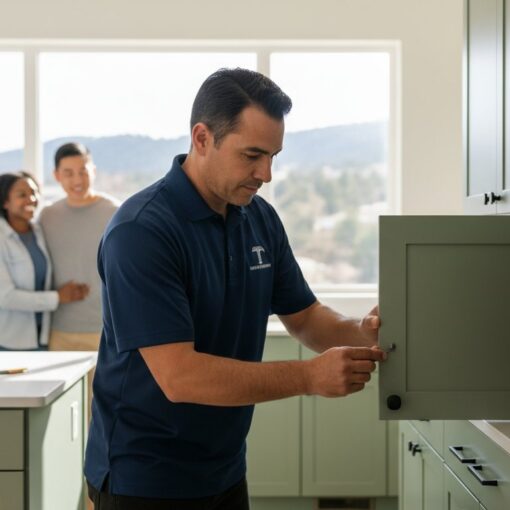
A professional cabinet painting process starts with labeling and removing doors, drawers, and hardware before any paint is applied. Imperial Painters describes a process that includes labeling doors, protecting nearby surfaces, preparing edges, and reinstalling hardware. CertaPro Painters states that it removes cabinet doors and hardware before painting and re-installs the hardware and re-hangs the doors after painting is complete.
Sanding is the next step. CertaPro Painters sands cabinet surfaces, some parts by hand and others with power equipment, to prep for a new paint or stain application. Sanding removes old gloss and smooths imperfections so primer and paint can bond. Nearby counters, floors, and appliances are protected before sanding begins.
Primer is applied after sanding. CertaPro Painters states that painting often includes primer steps to help keep the finish durable. Primer seals the wood, blocks stains, and gives the topcoat a uniform surface. In a working kitchen, primer is what keeps moisture and grease from breaking down the finish.
Doors and drawers are finished off-site or in a controlled area for a flatter, more even finish. CertaPro Painters applies paint or stain to mounted cabinets using hand rollers or brushes, while doors and drawer fronts can be sprayed in a controlled space. The finish then needs time to dry and cure before hardware is reinstalled and doors are re-hung.
How does Cabinet, painting, and refinishing Denver CO. deliver a factory finish in Castle Rock?
Cabinet, painting, and refinishing Denver CO. delivers a factory finish through an owner-operator approach built on 35-plus years of local experience serving Castle Rock, Castle Pines, Highlands Ranch, and Parker. The work is done by the owner, not a rotating crew, which keeps the process consistent from the first sanding pass to the final cured topcoat.
The factory-finish process uses controlled spray application, grain filling, and priming, followed by a cured topcoat rather than a brush-and-roll repaint. Spraying produces a smooth surface without brush marks or roller stipple. Grain filling on oak and other open-grain woods prevents the texture from telegraphing through the paint.
The specific services include cabinet painting, cabinet refinishing, and factory-finish cabinet coating for kitchens, bathroom vanities, and built-ins. Each service starts with the same preparation discipline: clean, sand, prime, spray, and cure. The difference is in how much surface correction and coating is needed for the existing cabinet condition.
A sprayed, cured finish resists chipping and moisture better than a hand-applied finish in Colorado's dry climate. Dry air can cause brush-applied paint to skin over too fast, leaving weak layers underneath. A controlled spray and cure process lets each coat bond fully before the next one goes on, which produces a harder final surface.
Is a factory finish better than DIY or a handyman cabinet paint job?
Yes, a factory finish is generally better than a DIY brush-and-roll job or a general handyman repaint for Castle Rock kitchens. The three options differ in prep depth, application method, and curing. DIY results often show brush marks, drips, and early peeling because prep and primer are skipped.
A DIY brush-and-roll job usually involves painting over existing cabinet surfaces with minimal sanding. The finish may look acceptable at first but can peel at high-touch areas within a year. Imperial Painters notes that many oak cabinets can be painted if surfaces are properly cleaned, sanded, and primed, which is exactly the step most DIY projects skip.
A handyman may paint cabinets but rarely has a spray booth, grain-filling materials, or a curing process. CertaPro Painters describes a professional sequence of removing doors and hardware, sanding by hand and power equipment, priming, painting, and reassembling after the finish dries and cures. A handyman repaint often compresses those steps into a shorter, less durable process.
A factory-style finish costs more upfront but typically lasts years longer, which changes the real cost per year. A repaint that fails in two years and needs redoing can cost more over a decade than one factory-style finish that lasts eight to twelve years. The value is in the prep and cure, not just the paint.
Which cabinet colors are popular in The Meadows, Founders Village, Crystal Valley Ranch, and Red Hawk?
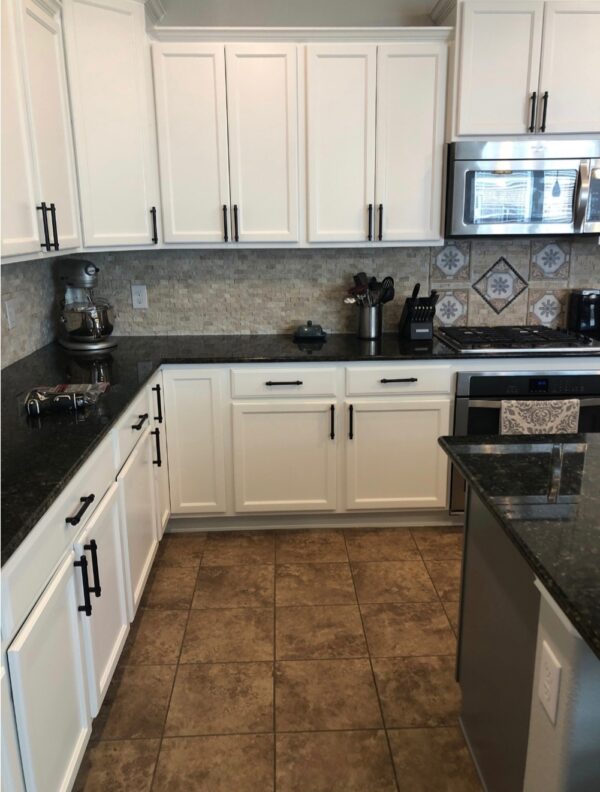
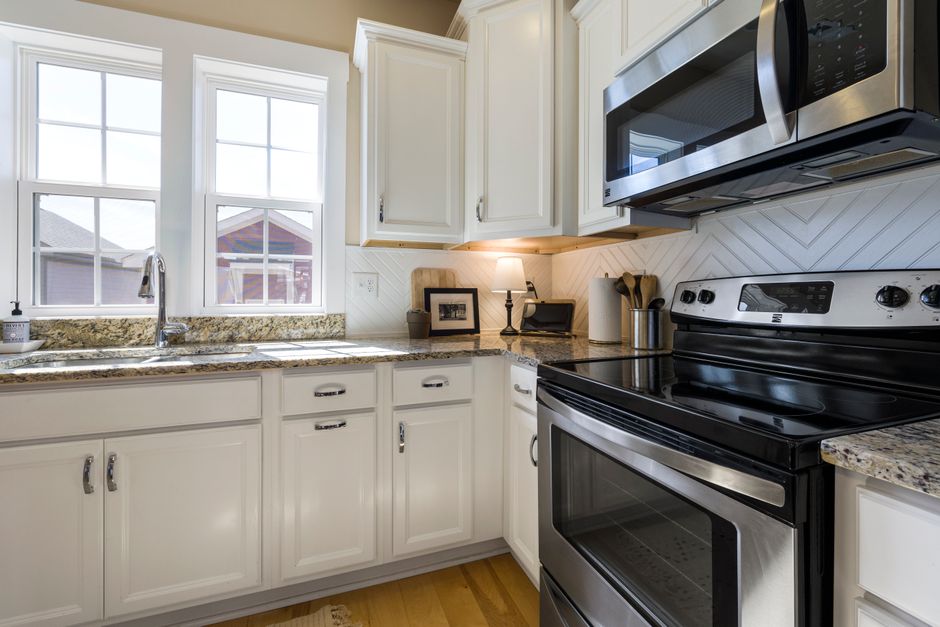
The dominant Castle Rock cabinet palette includes warm whites, greige, soft sage, and deep navy or charcoal islands. These colors work with the stone, tile, and flooring common in Douglas County homes. Warm whites and greige are the most frequent choices for full-kitchen cabinet painting because they keep open floor plans feeling bright.
Two-tone kitchens are common in newer builds in Crystal Valley Ranch and Red Hawk. Light uppers paired with darker lowers, often navy, charcoal, or a deep green, give the kitchen contrast without making the room feel heavy. The island is frequently painted the darker color while the perimeter cabinets stay light.
Natural light and open floor plans in The Meadows and Founders Village affect color choice. Homes with large windows and open sightlines can carry slightly deeper colors without feeling closed in. Homes with less direct light tend to favor warm whites and soft greige to reflect available light.
Testing large samples on actual doors in the room is the most reliable way to choose. Paint colors shift under different light and against different counters and backsplashes. A sample painted on a door and viewed at morning, noon, and evening gives a more accurate read than a small chip taped to a drawer.
How long does a kitchen cabinet painting project take in Castle Rock?
A realistic kitchen cabinet painting project takes several days for prep, spraying, drying, and reinstallation, not a single afternoon. The sequence of removing doors and hardware, sanding, priming, painting, and curing cannot be compressed into one day without sacrificing durability. CertaPro Painters describes a process that ends with reassembling cabinets and hardware after the paint or stain has had time to dry and cure.
Booking several weeks ahead is often helpful because cabinet projects involve preparation, drying time, and scheduling around household use, according to Imperial Painters. A kitchen is a daily-use space, and the project requires access to every cabinet surface. Planning ahead lets the work fit around the household rather than forcing the household around the work.
Heavy grain filling, door count, and color changes slow a project down. Oak cabinets with deep grain need more filling and sanding time. A kitchen with 40 doors takes longer than one with 20. Changing from dark stain to light paint adds primer coats and dry time between coats.
Humidity and temperature swings can also extend the timeline. Paint dries and cures best within a controlled temperature range, and Colorado's dry air can cause coatings to skin over if conditions are not managed. Homeowners should plan to temporarily empty cabinets and expect limited kitchen use for the duration of the project.
Key Takeaways
- Cabinet painting is usually worth it in Castle Rock when boxes are stable, because it costs far less than replacement.
- No public source publishes a fixed Castle Rock cabinet painting price; cost depends on door count, condition, finish type, and prep level.
- Many oak cabinets can be painted if they are cleaned, sanded, and primed first, but peeling, water damage, swelling, or unstable laminate can limit results.
- A professional process includes removing doors and hardware, sanding, priming, spraying, then reinstalling hardware after the finish cures.
- Cabinet, painting, and refinishing Denver CO. serves Castle Rock, Castle Pines, Highlands Ranch, and Parker with a factory-finish spray process.
- Popular Castle Rock cabinet colors include warm whites, greige, soft sage, and navy, with two-tone layouts common in newer neighborhoods.
- A typical cabinet painting project takes several days and is best booked several weeks ahead.
References
- Kitchen Tune-Up Castle Rock, CO Custom Cabinets, Refacing & Remodeling — date unknown
- CertaPro Painters Cabinet Painting and Refinishing — date unknown
- Imperial Painters Custom Cabinet Painting in Castle Rock, CO — date unknown