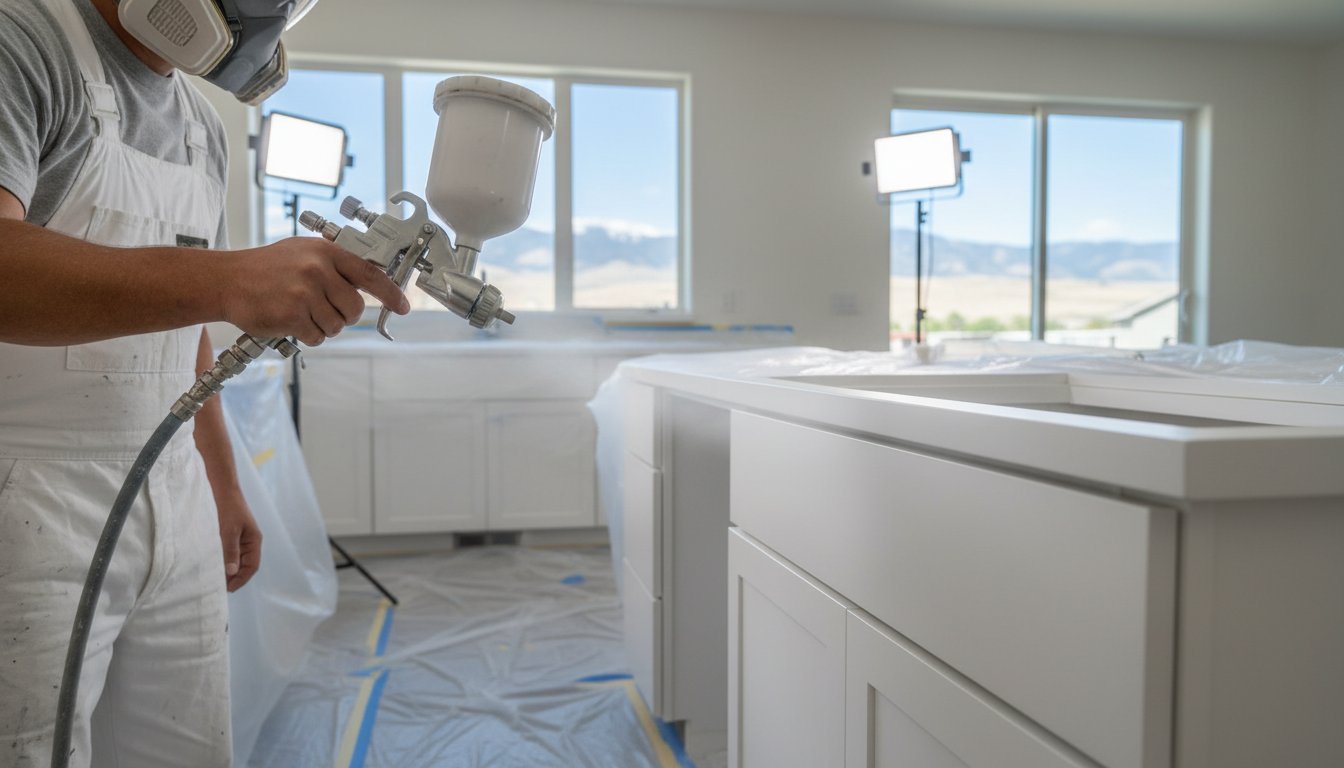
That gallon of "industrial" paint on the shelf at your local hardware store has more in common with standard wall paint than the high-performance coatings used in a professional cabinet spray booth. Most homeowners see that label and assume it can handle the grease and heat of a busy kitchen, but the reality is often a sticky, peeling mess within 12 months. You don’t want to spend $5,000 on a project only to have your cabinets chip every time a pot bumps the door. It’s a valid concern because most marketing is designed to sell cans, not to provide a permanent factory finish.
Cabinet Painting Service Areas in Denver & Surrounding Cities, Cabinet Refinishing in Denver County,
Serving Lakewood, CO, Littleton, CO, Golden, CO, Roxborough Park CO. Ken Carl Ranch CO, Washington Park Area,
Arvada, CO, Wheat Ridge, CO,
and Castle Pines CO. Englewood CO. Centennial CO.
Cabinet Painting in Arapahoe County, CO
Including Centennial, CO, Greenwood Village, CO,
Cherry Hills Village, CO,
and Aurora, CO.
Cabinet Painting in Adams County & Broomfield, CO
We know you want a durable surface that stands up to heavy daily use without the $25,000 cost of a full kitchen replacement. You’ll discover the critical differences between retail labels and the actual industrial strength paint for cabinets used by professionals to achieve a smooth, non-stick result. This guide breaks down the chemistry of precatalyzed primers and explains why professional application is the only way to avoid a DIY disaster. We will show you how to identify high-grade coatings and why our 45 years of experience proves that the right product is only as good as the meticulous prep work behind it.
Key Takeaways
-
Learn why real industrial strength paint for cabinets relies on high-solids and chemical cross-linking rather than just retail marketing labels to achieve a permanent bond.
-
Compare the performance of pre-catalyzed lacquers, urethane alkyds, and industrial acrylics to see which coating provides the best protection for your kitchen.
-
Understand why specialized spray application is mandatory for high-performance coatings that dry too fast for traditional brushes or rollers.
-
Discover how Denver’s low humidity and temperature swings affect paint curing and why local expertise is vital for a long-lasting finish.
-
Identify why 45 years of specialized experience and professional prep work are the only ways to guarantee a true factory finish in your home.
Table of Contents
-
The Application Myth: Why You Can’t Brush Industrial Strength Paint
-
The Professional Advantage: Industrial Results for Your Kitchen
What Is Real Industrial Strength Paint for Cabinets?
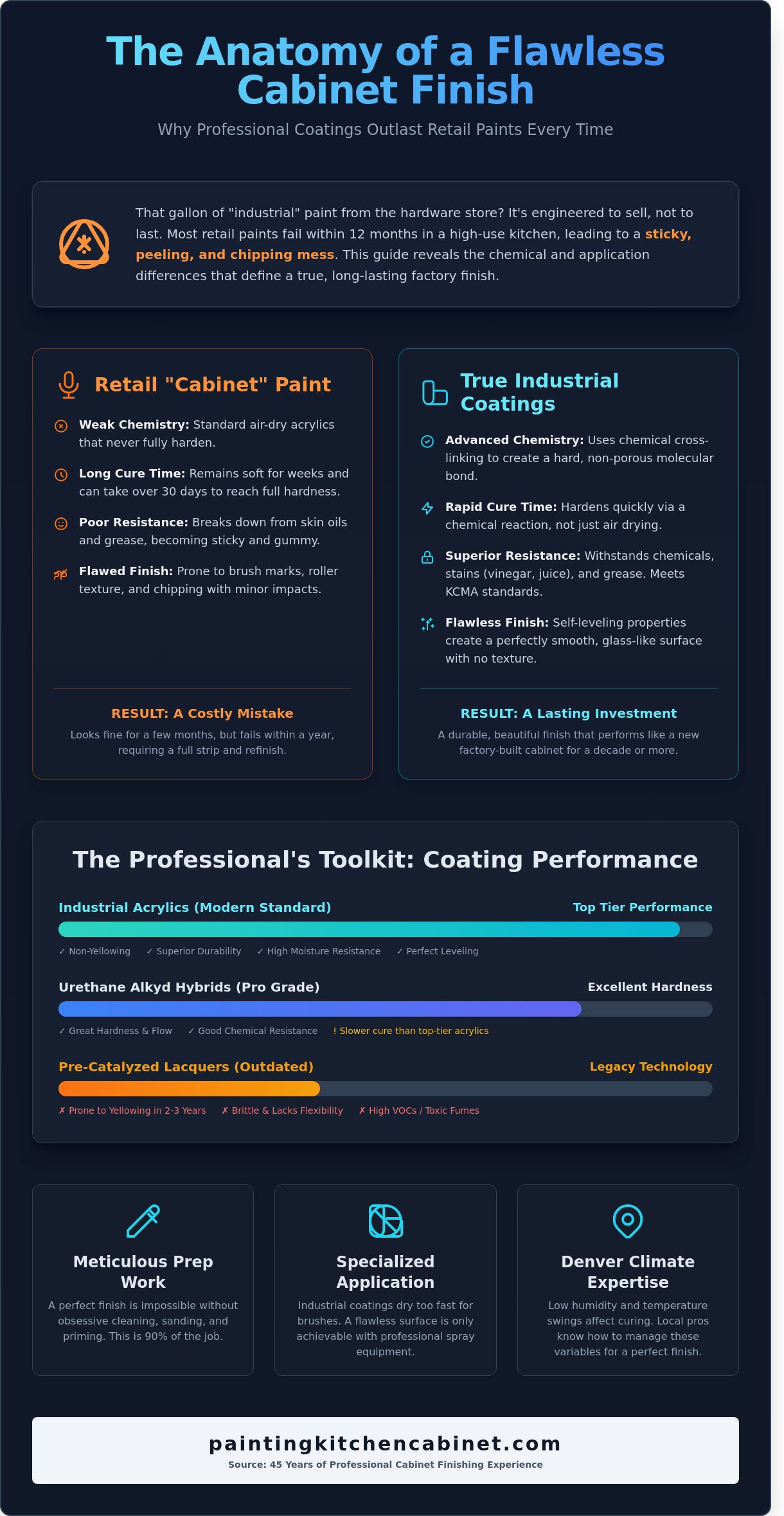
Real industrial strength paint for cabinets is not a product you find on the shelf at a local hardware store. These are high-solids, chemically cross-linking coatings designed for high-traffic environments. Most retail brands use "industrial" as a marketing term to sell standard trim enamels, but true professional grade products function differently. At Painting Kitchen Cabinets Denver, we focus on the technical performance of the finish. Understanding what coatings are and how they react to heat, moisture, and friction is the only way to achieve a durable factory finish. Retail paints are often air-dry acrylics that stay soft for weeks. Professional industrial coatings rely on a chemical reaction to harden quickly and provide a surface that resists impact.
The Chemistry of Durability
Chemical cross-linking technology creates a molecular bond that forms a much harder shell than standard latex. This process ensures the coating has high block resistance, which means the paint won’t stick to itself or peel away when doors and drawers are closed tightly. We use products with high-solids content to ensure maximum coverage and a smooth, thick film that covers wood grain effectively. Real industrial strength is defined as a coating that meets or exceeds KCMA (Kitchen Cabinet Manufacturers Association) standards for durability and finish. This standard requires the finish to withstand 24 hours of exposure to substances like vinegar, lemon juice, and fruit juices without staining or softening.
Why Wall Paint Fails on Cabinets
Standard wall paint is designed for flexibility, not hardness. When you use a typical latex or "cabinet-style" retail enamel, it remains soft enough to dent with a fingernail. Kitchens are high-friction environments where doors are opened dozens of times a day. Skin oils and kitchen grease are the primary enemies of cheap paint. Over time, the acids in human skin break down the resins in latex paint, turning the finish into a sticky, gummy mess around the handles. Industrial coatings offer superior chemical resistance to common household cleaners and grease. Our process at Painting Kitchen Cabinets Denver involves using these specialized materials because they don’t degrade when exposed to the daily rigors of a working kitchen. Amateur house painters often use cheap materials that look fine for a month but fail within the first year of use.
Comparing Professional Cabinet Coating Categories
Choosing the right industrial strength paint for cabinets determines if your kitchen looks like a DIY project or a professional factory finish. At Painting Kitchen Cabinets Denver, we focus on three main coating types: Pre-catalyzed Lacquer, Urethane Alkyd hybrids, and Industrial Acrylics. Each has different chemical properties. Pre-catalyzed lacquer was a wood shop standard for over 40 years, but it lacks the flexibility needed for modern kitchen environments. Industrial acrylics have replaced these older solvent-based systems because they offer superior durability without the toxic fumes. Our team has over 45 years of experience seeing how these coatings perform in real Colorado homes. Most amateur painters use standard house paint, but we only use high-performance coatings that meet the standards of professional industrial coating application to ensure your cabinets don’t chip or peel.
Industrial Acrylics vs. Traditional Lacquers
Traditional lacquers often yellow within 24 to 36 months, especially in sunny kitchens. Modern industrial acrylics are non-yellowing. This keeps your white cabinets bright for a decade. These coatings are designed for high-moisture areas like the space directly above a steaming dishwasher or around a kitchen sink. The secret to a factory-like result is the leveling process. Industrial acrylics are engineered to lay flat as they dry, which eliminates brush marks and orange peel texture. Painting Kitchen Cabinets Denver uses these specifically because they provide a hard, glass-like surface that resists grease and chemicals. If you want to see the difference in our finish, text us photos of your kitchen for a quick quote.
Waterborne Urethanes and Alkyd Hybrids
Retail stores sell hybrid paints to homeowners, but these are not true industrial products. A retail hybrid often requires 30 days to reach full hardness. In contrast, the industrial strength paint for cabinets we use reaches a critical hardness milestone within 24 hours. This fast dry time prevents dust from settling into the wet finish. True industrial coatings have lower VOC levels than old solvent products but maintain a higher resin content than retail hybrids. We don’t use cheap latex products because they remain soft and will stick to your cabinet frames in the summer heat. Our process ensures a durable Cabinet Refinishing job that stands up to daily use immediately after we finish the installation. We prioritize these high-performance waterborne industrial coatings because they are safer for your family and tougher than any retail alternative.
The Application Myth: Why You Can’t Brush Industrial Strength Paint
Many homeowners believe the secret to a durable kitchen lies solely in the can of paint. This is a mistake. The product is only 50% of the finish; the application method handles the rest. True industrial strength paint for cabinets is engineered for high-pressure atomization, not a synthetic bristle brush. Professional coatings are designed to dry rapidly to prevent dust nibs from settling in the finish. If you try to apply these products with a brush or roller, the paint will "drag" and leave permanent textures. You can’t achieve a smooth surface when the coating begins to set in under 15 minutes.
Amateur house painters often try to roll industrial products to save time on masking. This results in a heavy, uneven millage that looks cheap and fails early. Professional sprayers allow for a precise 4-mil thickness that provides maximum protection without looking caked on. At Painting Kitchen Cabinets Denver, we’ve seen countless DIY projects where the homeowner used expensive paint but ended up with a surface that feels like sandpaper because they lacked the right equipment.
Spray vs. Brush: The Battle for the Factory Finish
Brush marks are the primary sign of a low-quality cabinet job. When you use a brush, you’re physically pushing the paint into ridges. Industrial coatings lack the "leveling agents" found in slow-drying latex paints, so those ridges stay there forever. High-volume low-pressure (HVLP) sprayers break the paint into a fine mist. This mist lands softly on the wood and flows together to create a glass-like surface. Because these coatings are chemically dense, it’s vital to consider the health effects of paint fumes during the curing process. Professionals use specialized exhaust systems to manage these vapors, something a standard house painter simply isn’t equipped to do.
The ‘Labor Intensive’ Preparation Process
Even the highest quality industrial strength paint for cabinets will peel within 12 months if the prep work is ignored. We spend 70% of our project time on preparation because grease and oils from 20 years of cooking won’t just disappear with a wet rag. Our process includes:
-
Mechanical de-glossing to remove factory topcoats.
-
Meticulous cleaning with industrial-grade degreasers.
-
The application of pre-catalyzed primers that bond at a molecular level.
Painting Kitchen Cabinets Denver doesn’t take shortcuts. We know that if the substrate isn’t perfect, the final coat won’t be either. We’ve spent over 45 years refining a labor intensive cleaning and sanding phase that ensures our factory finish lasts for decades, not just a few seasons. If a contractor claims they can finish your kitchen in two days without sanding, they’re selling you a temporary fix, not a professional renovation.
Choosing Coatings for the Denver Climate
Denver presents a unique set of challenges that standard retail paints cannot handle. The average humidity in Colorado often hovers around 15 percent, which is significantly lower than the national average. This dry air causes moisture to leave the wood rapidly, leading to aggressive expansion and contraction. We use industrial strength paint for cabinets because it is engineered to remain flexible under these conditions. A standard DIY product will get brittle and flake off when the wood moves during a 40-degree temperature swing in a single October afternoon. Our 45 years of experience in the Mile High City has taught us that local expertise is the only way to ensure your kitchen doesn’t fail after one season.
High altitude also means your kitchen is exposed to roughly 20 percent more UV radiation than homes at sea level. This intense sunlight will yellow or fade cheap coatings within 24 months. We apply professional-grade coatings with built-in UV inhibitors to keep your factory finish looking bright. If you want an accurate price for a finish that lasts, text us the number of doors and drawers with pictures and we can help you immediately.
The Impact of High Altitude and Dry Air
Low humidity causes paint to evaporate at an accelerated rate. If a painter doesn’t manage the environment, the finish develops "dry spray," which feels like sandpaper to the touch. This happens when the paint particles dry before they even hit the cabinet surface. We maintain a strictly controlled environment during the spraying process. We adjust our thinning ratios and use specific retarders to slow down drying times, ensuring the coating flows out perfectly flat for that smooth factory look.
Preventing Cracks in White Painted Cabinets
White cabinets are the most popular choice in Denver, but they are also the most prone to showing cracks at the door joints. Standard latex caulking is a mistake made by amateur house painters; it shrinks and pulls away in our dry climate. We utilize specialized industrial acrylics and elastomeric materials that move with the wood. You can read more about our specific process in our guide on How We Prevent White Painted Cabinets From Cracking. Using the right industrial strength paint for cabinets ensures the bridge between the rail and the stile stays sealed, even when the furnace is running all winter long.
-
Professional coatings handle 40-degree daily temperature shifts.
-
UV inhibitors prevent yellowing from high-altitude sun exposure.
-
Controlled spraying techniques eliminate dry spray texture.
-
Industrial-grade caulking prevents joint separation in low humidity.
The Professional Advantage: Industrial Results for Your Kitchen
Hiring a specialist for your kitchen remodel beats the DIY route or hiring a general house painter every single time. Painting Kitchen Cabinet Denver provides a level of expertise that comes from over 45 years of experience in the trade. Since 1979, we have focused on one specific goal: delivering a high-quality finish that lasts for decades. Many homeowners try to apply industrial strength paint for cabinets themselves, but they lack the specialized spray booths and ventilation systems required for these heavy-duty coatings. We provide a 100% factory-finish guarantee because we use professional-grade industrial spray application techniques that no brush or roller can ever replicate. Our results are smooth, durable, and completely free of brush marks or texture.
Beyond the Can: Our Meticulous Process
Our "no shortcuts" approach is what sets us apart from amateur contractors. We understand that prep work is the most vital factor in cabinet restoration. While others might use cheap latex caulking or standard big-box store primers, we strictly use high-solids precatalyzed primers and industrial coatings. Our process is labor intensive. We degrease, sand, and repair every surface before a single drop of paint is applied. This ensures your cabinets won’t chip or peel under heavy daily use. This 45-year legacy in the Denver metro area means we have seen every wood type and kitchen layout. We know exactly how to handle oak, maple, or MDF to ensure the industrial strength paint for cabinets bonds perfectly to the surface.
Get Your Immediate Cabinet Painting Quote
We value your time and offer a no-fuss way to get your project started. You don’t have to wait days for a salesperson to visit your home. You can text us the number of doors and the number of drawers along with a few pictures of your current kitchen. We will provide you with an accurate price immediately. Our service area covers the entire Denver metro area and surrounding Colorado cities. We frequently work in Aurora, Fort Collins, Lakewood, Thornton, Arvada, and Westminster. We also serve clients in Centennial, Boulder, Greeley, and Longmont. Contact Painting Kitchen Cabinet Denver today to get a professional transformation that stands the test of time.
Get the Durable Factory Finish Your Denver Kitchen Deserves
Don’t settle for hardware store products that fail in the dry Colorado climate. Real industrial strength paint for cabinets requires specialized spray equipment and high-performance acrylics to achieve a lasting bond. We’ve spent over 45 years perfecting this process. Our team focuses on labor-intensive preparation and factory-grade coatings that amateur house painters simply don’t use. A brushed or rolled finish will never match the durability or look of a professional spray application. It’s the difference between a temporary fix and a permanent upgrade.
Painting Kitchen Cabinets Denver guarantees a smooth, factory-like finish that won’t peel or chip under daily use. We use exclusive industrial-strength spray-applied acrylics to ensure your kitchen looks new for years. You can skip the frustration of DIY kits and get results backed by 45 years of specialized trade experience. We never brush or roll our finishes because your cabinets deserve the highest quality possible. We’re ready to transform your space with the professional standards we’ve maintained since 1979.
Text us your door and drawer count for an immediate quote!
We look forward to giving your home the high-quality finish it deserves.
Frequently Asked Questions
What is the most durable paint for kitchen cabinets?
Pre-catalyzed lacquers and post-catalyzed conversion varnishes are the most durable coatings available for kitchen cabinets. These industrial products provide a chemical bond that resists moisture and grease far better than any consumer-grade paint found in retail stores. At Painting Kitchen Cabinets Denver, we’ve found these finishes last 15 to 20 years under normal kitchen use. Amateur house painters often use water-based latex which usually fails within 24 months.
Is industrial paint safe for home use in a kitchen?
Industrial strength paint for cabinets is completely safe for home use once the curing process is finished. While these products have higher VOC levels during application, they off-gas quickly within 48 hours when applied in a controlled environment with proper ventilation. We use specialized exhaust systems to ensure 99 percent of fumes are removed from your home. Once dry, the finish is non-toxic and meets KCMA standards for safety in food preparation areas.
Can I buy professional-grade industrial cabinet paint at Home Depot?
You can’t buy true professional-grade industrial cabinet paint at big-box retailers like Home Depot or Lowe’s. These stores sell consumer-grade DIY products that lack the chemical hardeners found in industrial coatings. Professional suppliers require a business license and specialized training to purchase 2-component polyurethanes or conversion varnishes. Using retail paint often results in a sticky finish that peels within 12 months of application.
How long does industrial strength cabinet paint take to cure?
Industrial coatings dry to the touch in 15 to 30 minutes, but a full chemical cure takes 7 to 30 days depending on humidity. You can use your kitchen carefully after 24 hours. We advise homeowners to avoid scrubbing the surface or using harsh chemicals for the first 3 weeks. This timeframe ensures the cross-linking process reaches 100 percent hardness, creating that rock-hard factory finish we guarantee for every client.
Why do professional painters prefer spraying over rolling for cabinets?
Spraying is the only way to achieve a true factory finish with zero brush marks or roller stipple. An HVLP or airless sprayer applies the coating at 1,500 to 3,000 PSI, which atomizes the paint for a perfectly smooth surface. Rolling adds 20 percent more texture to the wood, and that texture traps dirt and grease over time. Our 45 years of experience shows that sprayed finishes are easier to clean and look professional.
Will industrial paint prevent my cabinets from chipping around the handles?
Using industrial strength paint for cabinets significantly reduces chipping around handles because it bonds to the wood at a molecular level. Most chipping happens because DIY paints don’t adhere to the oils left by human hands. We use pre-catalyzed primers that bite into the substrate, creating a surface that is 5 times more impact-resistant than standard house paint. Proper prep work ensures the finish stays intact for over a decade.
What is the difference between cabinet refinishing and just painting them?
Cabinet refinishing is a multi-step industrial process that involves deep cleaning, mechanical sanding, and applying specialized coatings, while painting is often just a cosmetic topcoat. Refinishing removes 100 percent of old grease and contaminants to ensure the new finish doesn’t peel. We spend 70 percent of our time on prep work because that’s what determines the lifespan of the project. Simply painting cabinets without this labor-intensive prep leads to failure within 1 year.
How do I clean cabinets that have been finished with industrial-strength acrylics?
Clean your finished cabinets using a simple mixture of 95 percent warm water and 5 percent mild dish soap with a soft microfiber cloth. Avoid using abrasive sponges or cleaners containing ammonia or bleach, as these can dull the 20 to 30 percent sheen level over time. Wiping down spills within 10 minutes prevents any potential staining. This maintenance routine keeps your industrial finish looking like new for 15 years or more.