
The most expensive kitchen renovation you’ll ever pay for is the one you have to do twice because the paint started peeling within the first 180 days. Many homeowners assume any professional with a brush can handle their kitchen, but learning how to choose a cabinet painter is actually about finding a specialist who understands industrial strength coatings. You’ve likely felt the anxiety of seeing wide price gaps between quotes or worrying about a messy contractor turning your home into a construction zone for weeks. It’s common to feel overwhelmed when you just want a durable, factory finish that won’t chip the moment a pot hits the baseboard.
We agree that your kitchen deserves a finish that looks like it came straight from the manufacturer, not a DIY project. This guide will teach you how to distinguish a master refinisher from an amateur house painter so you can secure a clear ROI on your renovation. With over 45 years of experience in the trade, we know that labor intensive preparation is the most vital factor in a long lasting job. We’ll examine the specific equipment, precatalyzed primers, and technical processes required to turn your existing cabinets into a high quality focal point that lasts for years.
Key Takeaways
- Distinguish between a general house painter and a specialized refinisher to ensure you get a smooth, durable factory finish without brush marks.
- Identify the five non-negotiable prep work steps that are vital for preventing common issues like peeling, cracking, and premature wear.
- Learn how to choose a cabinet painter by vetting local Denver credentials and prioritizing a proven portfolio of kitchen projects over generic reviews.
- Recognize red flags like “one-day” shortcuts and cheap latex materials that compromise the integrity and longevity of your kitchen cabinets.
- Use a professional decision framework to ensure your project delivers the industrial-strength results and long-term value your home deserves.
Cabinet Painter vs. General House Painter: Understanding the Difference
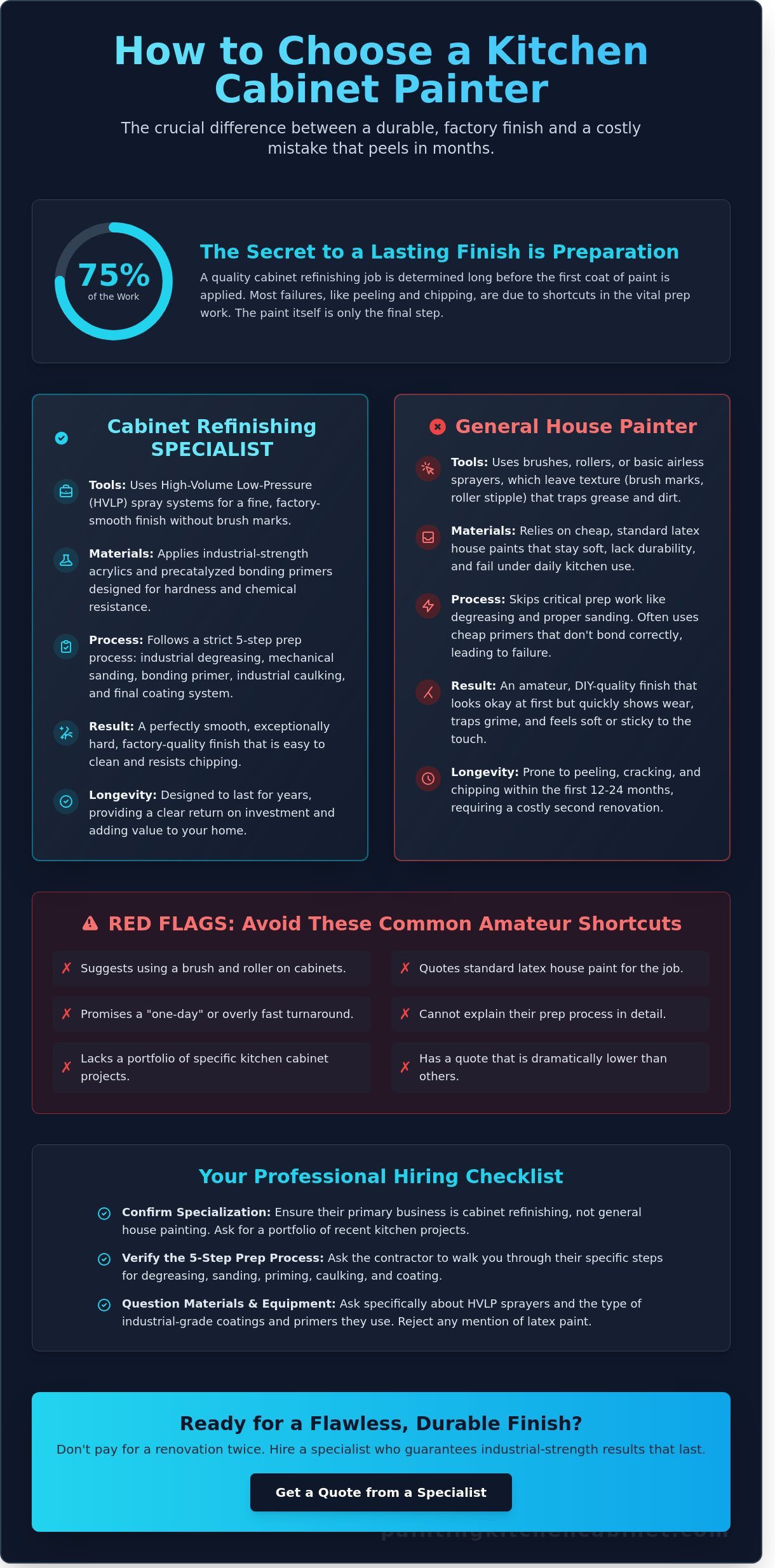
Many homeowners assume any contractor with a ladder and a brush can handle a kitchen remodel. This is a costly mistake. Cabinet refinishing is a highly specialized trade that is completely separate from interior wall painting. You aren’t just looking for someone to change a color; you are looking for a finishing specialist. This distinction is the most critical factor when you are learning how to choose a cabinet painter for your home.
A professional finish requires 45 years of experience to master the industrial spray equipment used in our shop. We don’t aim for “good enough.” We deliver a factory finish. This means a surface that is perfectly smooth, exceptionally hard, and entirely free of brush marks or roller stipple. It feels like the finish on a new car or high-end furniture. Achieving this requires a deep knowledge of chemistry and application techniques that a general house painter simply doesn’t possess.
Why a brush and roll application is a red flag
If a contractor suggests using a brush and roller on your cabinet frames or doors, they are an amateur house painter, not a specialist. Brushing creates a physical texture on the wood. Over 12 to 24 months, those tiny ridges and valleys trap kitchen grease, dust, and cooking oils. Once that grime is embedded in the texture, it’s nearly impossible to scrub away without damaging the paint. Amateur painters also use standard latex house paints. These coatings stay soft for weeks and lack the chemical resistance needed to withstand daily kitchen use. By understanding paint composition, you can see that industrial coatings are designed for hardness and durability, whereas wall paint is designed for flexibility and breathability. Shortcuts on prep work and using the wrong materials will lead to peeling within the first year.
The specialized tools of the trade
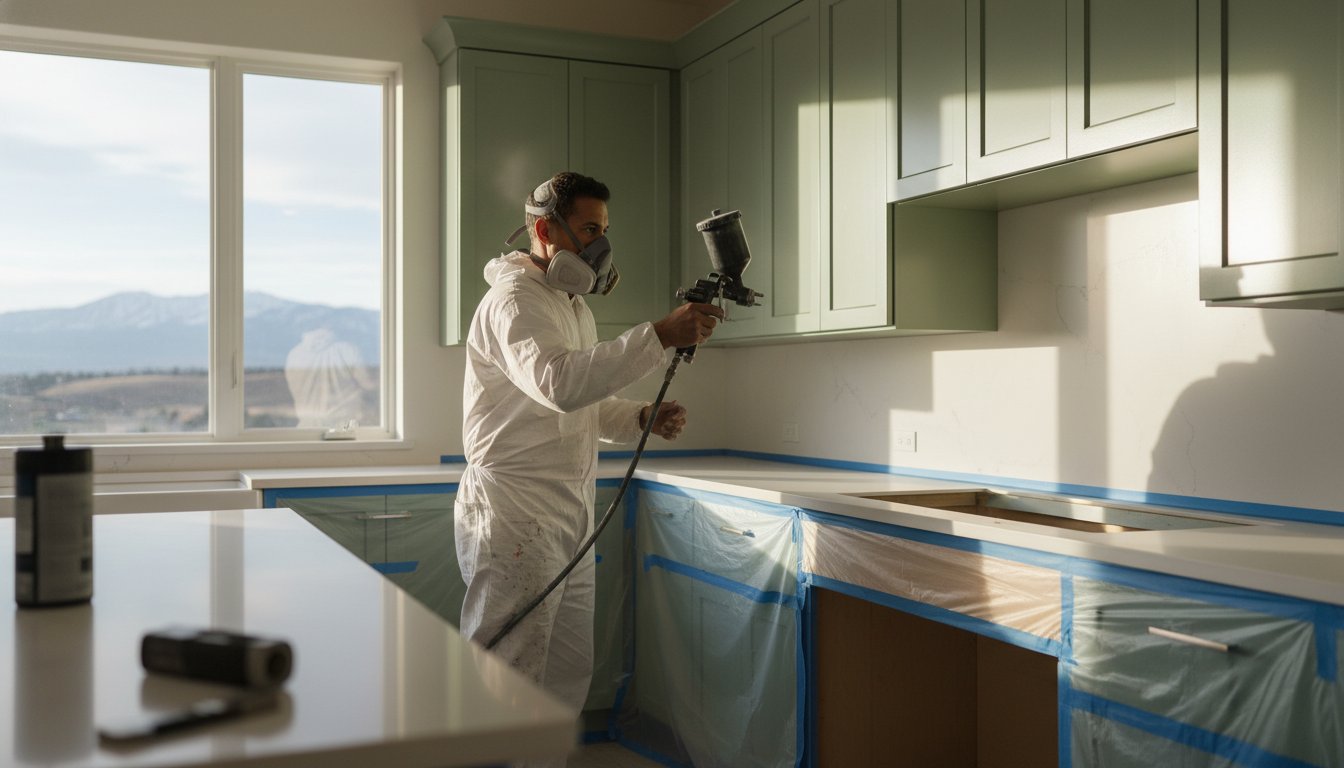
The equipment used by a finishing specialist is what sets them apart from the competition. While a house painter might use an airless sprayer for a fence or siding, we use High-Volume Low-Pressure (HVLP) systems for cabinets. This equipment allows for precision control and a fine atomization of the coating. To get these results, we follow a strict process:
- Controlled Environments: We spray doors and drawers in a dedicated shop to avoid dust and debris.
- Industrial Masking: Onsite frames are sealed in a plastic booth to protect the rest of your home.
- Professional Coatings: We use industrial-strength acrylics and precatalyzed primers that general painters don’t stock.
When you decide how to choose a cabinet painter, ask specifically about their spray setup. If they can’t explain the difference between their equipment and a standard house sprayer, they won’t deliver the factory finish you expect. Our process is labor intensive, but it’s the only way to ensure the job is done the right way.
Evaluating the Cabinet Painting Process: The “Prep Work” Standard
When you are learning how to choose a cabinet painter, you have to realize that 75 percent of a quality job happens before a single drop of color is applied. Most homeowners think the paint is the most important part. It isn’t. Preparation is the most vital factor in preventing peeling and cracking over time. In a high-use kitchen, grease and oils from cooking build up on every surface. If a painter doesn’t use industrial degreasers to clean every inch, the new finish will fail within 12 months. We see this constantly when we are called to fix DIY projects or cheap jobs done by amateur house painters. You should always consult consumer advice from the FTC to ensure you are hiring a legitimate contractor who follows these professional standards. Painting Kitchen Cabinets Denver has seen every shortcut in the book, and we know that a factory finish requires a strict, 5-step non-negotiable process: degreasing, mechanical sanding, bonding primer application, industrial-grade caulking, and the final coating system.
The labor-intensive reality of professional prep
Professional Cabinet Refinishing is a labor-intensive trade. We start with a mechanical sanding process to remove the old finish without damaging the underlying wood grain. This creates a “profile” for the new material to grab onto. We never use cheap hardware store primers. We use precatalyzed primers for maximum adhesion because they create a chemical bond with the wood. Another critical step is caulking cabinets with industrial-grade materials. Amateur painters use cheap latex caulking that shrinks and cracks within a few seasons. We use high-solids materials that move with the wood, ensuring your Cabinet Refinishing looks solid for years, not months.
The coating system: Beyond hardware store paint
The chemistry of industrial-strength acrylics is what separates a professional job from a house painter’s work. We don’t use latex paint. Industrial coatings offer superior block resistance, which means your cabinet doors don’t stick to the frames when you close them. This is a common failure in low-quality jobs. You also have to verify the cure time. While our coatings are dry to the touch quickly, a full chemical cure usually takes 24 to 48 hours before you should resume heavy kitchen use. This durability is why we have over 45 years of experience in the Denver area. If you want to see the difference in our process, you can text us the number of doors and drawers with pictures and we can get you an accurate price immediately.
Homeowner Checklist for Initial Estimates:
- Does the contractor specify the use of industrial degreasers or just “wiping them down”?
- Will they perform mechanical sanding on all surfaces, including the frames?
- Are they using precatalyzed primers or standard water-based primers?
- Do they use industrial-grade caulking for all seams and joints?
- What is the specific brand of industrial coating being used?
Choosing the right professional means finding someone who respects the preparation phase. If a painter tells you they can finish the whole project in two days without sanding, they are not providing a factory finish. They are giving you a temporary fix that will likely peel. Real Cabinet Refinishing takes time, the right chemicals, and a lot of hard work.
Vetting Local Credentials in the Denver Metro Area
Verifying a contractor’s local standing is the first step in learning how to choose a cabinet painter who won’t disappear halfway through the job. You must confirm they hold a valid Colorado business license through the Secretary of State. Request a current certificate of insurance that specifically includes general liability and workers’ compensation. This is vital because cabinet refinishing is labor intensive work that involves moving heavy doors and using industrial equipment inside your home. Without proper insurance, the homeowner is liable for any accidents that occur during the process.
The Denver climate presents unique challenges for any painting project. Our local low humidity, which often drops below 15%, significantly impacts the curing process of industrial coatings. A painter from out of state might not understand how fast precatalyzed primers dry in our thin air. We focus on the entire metro area, serving homeowners from Aurora and Littleton to Highlands Ranch and Centennial. When you review a portfolio of kitchen cabinets denver projects, you are looking for local results that have survived Colorado’s dry winters and hot summers without cracking or peeling.
Asking for specific cabinet references
Don’t just look at a review from a project finished yesterday. Ask for a reference from a kitchen completed at least 2 or 3 years ago. This is the only way to see if the adhesion is truly permanent. When you examine “before and after” photos, zoom in on the hinges and the inside edges of the door frames. Paint on the hinges or “bridging” between the wood and the hardware are signs of amateur work. You should also ask if the owner is involved in the day-to-day labor. At Painting Kitchen Cabinets Denver, we believe owner-supervised work is the only way to guarantee a factory finish. Large crews of subcontractors often cut corners on the vital prep work.
Reviewing the contract and warranty
A legitimate contract must be specific. Red flags include vague terms like “prep” or “paint.” A professional agreement will list the use of industrial strength cleaners, sanding protocols, and specific precatalyzed primers. The warranty should specifically cover peeling, cracking, or adhesion failure. One way to test a company’s professionalism is the “immediate quote” test. You can text us the number of doors and the number of drawers with pictures and we can get you an accurate price immediately. If a contractor can’t give you a straight price based on your door count, they probably don’t have enough experience with how to choose a cabinet painter standards for the Denver market. We have over 45 years of experience, so we know exactly what the labor and materials will cost for your specific kitchen size.
Red Flags: Common Shortcuts Amateurs Take
When you are researching how to choose a cabinet painter, you must watch out for “one-day” miracles. Professional Cabinet Refinishing is a labor intensive process that cannot be finished in 24 hours. Industrial strength coatings require specific flash times and curing windows between coats. If a contractor promises to finish a 30-door kitchen in a single day, they are skipping the vital prep work that prevents peeling. Painting Kitchen Cabinets Denver involves a methodical approach that amateurs simply cannot replicate with speed alone.
Another major warning sign is the use of cheap latex caulking. Many house painters use standard painter’s caulk in cabinet joints. This material often shrinks by 20 to 25 percent as it dries, which causes visible cracks in the finish within 6 to 12 months. A professional uses industrial grade fillers that bond with the wood and resist the expansion and contraction of Colorado’s climate. If you see a painter applying thick beads of hardware store caulk, your finish will not last.
The myth of “no-sand” solutions
Liquid deglossers are rarely enough to create a lasting bond on factory-sealed cabinets. Amateurs use these “no-sand” chemicals to save hours of labor, but they fail to create the mechanical tooth needed for primer to stick. We use 220-grit sanding to ensure every surface is ready for our precatalyzed primers. Skipping the sanding phase is the number one reason cabinet paint fails. You can tell a contractor is cutting corners if they don’t have dust extraction equipment or if they claim their “special” paint sticks to anything without preparation.
Skipping the grain filler on oak cabinets
Oak cabinets present a specific challenge because of their deep, open grain. An amateur will spray paint directly over the wood, leaving a “pitted” look that looks like orange peel. To achieve a true factory finish, you must use a high-build grain filler. This process fills the deep pores of the wood to create a flat, smooth surface. When deciding how to choose a cabinet painter, ask to see a sample of their work on oak. A pro gives you the choice between a natural wood look and a smooth finish; an amateur just leaves the holes behind because they don’t want to do the work.
The “smell test” is your final defense against low-quality work. We use low-VOC industrial finishes that are safe for your home. If the house smells like heavy lacquer thinner for three days, the contractor is likely using toxic, outdated materials that are not meant for residential interiors. Finally, look at the hardware. Painting over hinges or screw heads is a sign of a lazy contractor. We remove every door, drawer front, and piece of hardware to ensure a clean, professional result every time.
If you want a quote from a team with over 45 years of experience, text us the number of doors and the number of drawers with pictures and we can get you an accurate price immediately.
How to Hire a Kitchen Cabinet Painter: Finalizing Your Decision
Deciding how to choose a cabinet painter comes down to a strict framework: Process, Product, and Professionalism. You aren’t just buying a color change. You are investing in a chemical bond that must withstand heat, moisture, and daily physical contact. Amateur house painters often use cheap latex caulking and wall paint that peels within 12 months. A professional uses industrial strength precatalyzed primers and finishes designed for wood surfaces. This service is a direct investment in your home value. Real estate data shows that kitchen updates can provide a return on investment of 60% to 80%, making a factory-like finish one of the smartest upgrades a homeowner can make.
When you compare quotes, look past the bottom-line price. A lower bid often means the contractor is skipping labor intensive prep work or using inferior materials. Ensure every quote includes these specific steps:
- Total degreasing and cleaning of all surfaces.
- Mechanical sanding to ensure proper adhesion.
- Use of high-solid, industrial-grade primers.
- Spray application in a controlled environment for doors and drawers.
Finalizing your choice means looking for a contractor who is transparent about their methods. Once you select a pro, the final steps involve scheduling your start date, completing a color consultation to match your flooring and countertops, and following a kitchen preparation guide to clear out your workspace.
The “Text for Quote” advantage
We provide a modern, no-fuss method to get your project started. You can text us the number of doors and the number of drawers with pictures and we can get you an accurate price immediately. This system reflects our 45 years of experience; we know exactly how much labor and material every job requires. Immediate, accurate pricing is the hallmark of a pro who doesn’t need to “guess” at your expense. It eliminates the high-pressure sales visit and gives you the facts you need to make a decision quickly.
Getting started with Painting Kitchen Cabinets Denver
Painting Kitchen Cabinets Denver has over 45 years of experience serving the entire Denver metro area, from Fort Collins to Castle Rock. Our process is built on the belief that prep work is the most vital factor in a successful job. We don’t cut corners and we don’t use house paint on your cabinets. To begin your cabinet refinishing project, contact us to see our physical samples and witness the durability of an industrial finish. Hiring a kitchen cabinet painter with our level of expertise ensures your kitchen looks brand new for years. Transform your kitchen with a factory-like finish today.
Get the Factory Finish Your Kitchen Deserves
Choosing the right professional determines whether your kitchen looks brand new or simply painted over. You now understand that a general house painter using cheap latex caulking cannot match the durability of a specialist. True quality comes from a labor intensive process that prioritizes prep work and uses industrial-strength acrylics rather than standard wall paint. When you evaluate how to choose a cabinet painter, look for a team that avoids common amateur shortcuts and guarantees a factory-like finish through 100% spray application.
At Painting Kitchen Cabinets Denver, we bring over 45 years of specialized experience to every project in the Denver Metro area. We don’t just change the color of your cabinets; we provide a finish that stands up to daily wear and tear. You can skip the guesswork and get started on your renovation today. Text us photos of your kitchen for an immediate, accurate quote! We look forward to transforming your space into the kitchen you’ve always wanted.
Frequently Asked Questions
How can I tell the difference between a cabinet painter and a house painter?
A cabinet painter uses industrial strength coatings and specialized spray equipment while a house painter typically uses standard latex paint and brushes meant for walls. Painting Kitchen Cabinets Denver focuses on a factory finish that resists kitchen grease and heat. House painters often lack the 45 years of experience required to handle the labor intensive sanding and deglossing phases. This difference ensures your doors don’t peel within 12 months.
Is it better to spray or brush kitchen cabinets?
Spraying is the superior method because it eliminates brush marks and creates a perfectly smooth factory finish. We use high volume low pressure systems to apply precatalyzed primers and industrial finishes. Brushing or rolling leaves texture and ridges that trap dirt. A sprayed finish provides a 100 percent uniform surface that looks like it came straight from the manufacturer.
What questions should I ask a cabinet painting company before hiring them?
You should ask what specific industrial coatings they use and if they have a dedicated shop for spraying doors. Learning how to choose a cabinet painter means asking if they use precatalyzed primers or cheap hardware store paint. Ask for a detailed list of their 8 step preparation process. A professional will explain their dust containment and ventilation setup without any hesitation.
Why is prep work considered the most important part of cabinet painting?
Prep work is the most vital factor because it determines if the paint will actually bond to the wood surface. We spend 3 days on cleaning, degreasing, and sanding before any paint touches the cabinets. Without removing 100 percent of the oils and old finish, the new coating will bubble or chip. Proper preparation is what separates a professional job from an amateur failure.
How long should a professional cabinet paint job actually last?
A professional cabinet paint job should last between 10 and 15 years when using industrial strength coatings. This lifespan depends on the use of precatalyzed primers and rigorous prep work. Standard house paint often fails in under 2 years in high moisture areas like kitchens. Our process ensures the finish remains durable against daily cleaning and heat for over a decade.
Can I get an accurate quote for cabinet painting without an in-home visit?
You can get an accurate price immediately by texting us the number of doors and drawers along with clear photos of your kitchen. This modern approach saves time and provides a firm quote based on the actual scope of work. We’ve used this method for over 5 years to give homeowners fast and reliable pricing. It eliminates the need for 2 hour sales appointments in your home.
What kind of paint is best for kitchen cabinets to ensure a factory finish?
The best products for a factory finish are industrial strength precatalyzed primers and waterborne alkyd urethanes. These coatings dry harder than standard latex paint and provide a chemical resistant surface. We avoid cheap retail paints because they don’t level out properly. Using these professional grade materials is a key part of how to choose a cabinet painter who delivers lasting results.
Does a professional cabinet painter also handle repairs and caulking?
A professional cabinet painter handles all necessary repairs including filling old hinge holes and caulking gaps between the cabinets and walls. We use high grade wood fillers and industrial caulking that won’t shrink or crack over time. Amateur house painters often use cheap latex caulking that fails within 6 months. We ensure every seam is sealed correctly before applying the final factory finish.