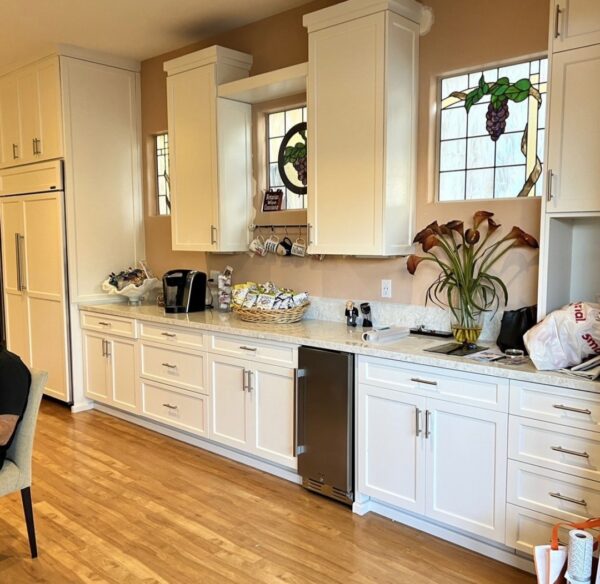
If you live in Castle Rock, Colorado, and you have been staring at tired, dated kitchen cabinets, you have probably heard the term "factory finish" thrown around by contractors and neighbors. A factory finish kitchen cabinet in Castle Rock, Colorado is not a myth or a marketing gimmick. It is a specific, technical standard of smoothness and durability that you can achieve without tearing out your existing cabinetry. For homeowners in Castle Pines, Parker, and Highlands Ranch, understanding what this finish actually is, and why it matters more at 6,200 feet of elevation than it does at sea level, is the difference between a kitchen that looks flawless for a decade and one that shows brush marks by spring.
Table of Contents
- What "Factory Finish" Really Means for Your Kitchen Cabinets
- Why Castle Rock's Climate Demands a Factory Finish
- Factory Finish vs. Cabinet Replacement: Cost and Time Comparison
- The Factory Finish Process: Step-by-Step
- Paint vs. Stain vs. Glaze: Choosing Your Finish Type
- DIY vs. Professional Factory Finish: Why the Difference Matters
- Choosing the Right Factory Finish Provider in the Denver Metro Area
- Maintaining Your Factory Finish: Care Guidelines for Colorado Homes
- Frequently Asked Questions About Factory Finish Cabinets
- Get Your Factory Finish Kitchen Cabinet Quote in Castle Rock, CO
What "Factory Finish" Really Means for Your Kitchen Cabinets
A factory finish is not simply a coat of paint applied carefully. It is a spray-applied, cured coating system that produces a smooth, uniform surface indistinguishable from what you would expect on a brand-new cabinet shipped from a manufacturing plant. The highest benchmark for this smoothness is called a Level 5 finish. That standard means zero brush marks, zero roller stipple, and consistent film thickness across every door, drawer face, and frame.
The difference comes down to application method. When a painter uses a brush or roller, the physical contact of the tool creates a thickness variance of 15 to 20 percent across the surface. That variance is invisible on day one, but as the coating cures and settles, those micro-ridges become visible as sheen shifts and texture flaws. A true factory finish relies on HVLP spray systems. HVLP stands for high volume, low pressure. These systems atomize the paint into a fine mist that lands evenly and levels out before it begins to dry. The result is a surface that feels like glass.
There is one more component that separates a real factory finish from a garage job: environment. True factory finishing requires controlled conditions. A dedicated spray booth with managed temperature, humidity, and dust filtration prevents airborne particles from embedding in the wet coating. Spraying doors in a garage or, worse, inside the kitchen itself, invites contamination and uneven curing.
Why Castle Rock’s Climate Demands a Factory Finish
Castle Rock sits at roughly 6,200 feet above sea level. The air here is dry, often with single-digit humidity for long stretches of the year. That dry, high-altitude environment creates a specific problem for paint application. When paint is brushed or rolled onto a surface, the solvents and water in the coating evaporate rapidly. In Castle Rock, that evaporation happens so fast that the paint can "skin" over before it has a chance to level out. The result is a texture known as orange peel, along with magnified brush marks and uneven sheen.
Hand-painted cabinets in this climate often show visible flaws within six months, not years. Sheen shifts, micro-cracking, and rough texture appear quickly because the coating never cured evenly in the first place. A factory spray application mitigates these issues. The atomized particles are fine enough to level before the dry air can lock them in place. Controlled curing environments prevent the flash-off problems that plague open-air painting in Douglas County. The same conditions apply across the Denver metro microclimates. Castle Pines, Parker, and Highlands Ranch share this high, dry profile. A finish that works in coastal humidity will fail here.
Factory Finish vs. Cabinet Replacement: Cost and Time Comparison
The financial case for refinishing over replacement is straightforward. Cabinet painting and refinishing saves homeowners 50 to 70 percent compared to full cabinet replacement. Some providers cite savings as high as 70 to 80 percent depending on the scope of the project and the condition of the existing boxes. If a full replacement quote lands at $30,000, a factory finish refinishing project might come in at $10,000 to $15,000.
Time is the second major advantage. Most professional cabinet painting projects are completed in approximately one week. A full replacement, by contrast, typically runs three to six weeks once you factor in demolition, delivery delays, and contractor scheduling. During that time, the kitchen is largely unusable. Refinishing keeps the kitchen functional for most of the process. There is no demolition dust throughout the home, no dumpster in the driveway, and no weeks of eating takeout.
Most professional projects also include upgrading all doors and drawers to soft-close hardware as a standard enhancement. That is a feature many older Castle Rock homes lack, and it changes the daily feel of the kitchen. For homeowners preparing to sell, a factory finish refinishing delivers a strong pre-sale return without the permit process or renovation timeline that a full replacement requires.
The Factory Finish Process: Step-by-Step
Assessment and Preparation
The process begins with an evaluation of the cabinet material. Oak, maple, cherry, and birch each respond differently to refinishing. Oak has open grain that may require additional filling for a smooth painted finish. Maple is dense and takes paint well. Cherry can bleed through lighter colors if not properly primed. Birch falls somewhere in between. A skilled provider adjusts the preparation process based on the species.
During this phase, the provider may also recommend a full overlay spacing conversion. This technical upgrade adjusts door spacing to give cabinets a more custom, high-end look. Hardware is removed and labeled with a system that ensures accurate reinstallation.
The Spray Application
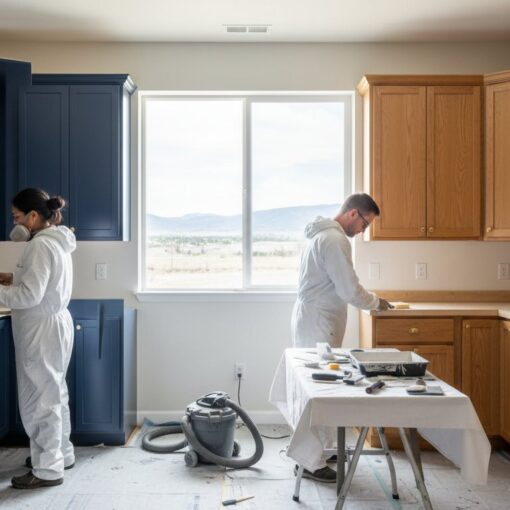
Doors and drawer fronts are removed and transported to a dedicated spray facility. This is a critical quality differentiator. The best providers never spray in the garage or kitchen. A dedicated shop allows for controlled temperature, humidity, and dust levels. HVLP spray technology delivers the Level 5 finish standard with zero brush marks. Advanced curing methods, including nano-curing and UV curing technologies, allow for rapid drying and, in some cases, same-day cabinet use.
Reinstallation and Detailing
Once the finish has cured, the doors and drawer fronts return to the home for reinstallation. The best providers are owner-installed operations, meaning the person who quoted the project is the person doing the work. No subcontracted crews. Soft-close mechanisms are installed on all doors and drawers. A final walkthrough verifies finish quality, coverage, and hardware function before the project is considered complete.
Paint vs. Stain vs. Glaze: Choosing Your Finish Type
Paint is the most popular choice for Castle Rock homeowners who want a modern, uniform look. White Shaker styles dominate, with Benjamin Moore Chantilly Lace and Simply White leading the pack. Paint hides wood grain and creates a clean, bright canvas.
Stain preserves and highlights natural wood grain. It is ideal for oak and cherry cabinets where the homeowner wants the wood character to remain visible. Stain requires more surface preparation to ensure even absorption, but the result is warm and timeless.
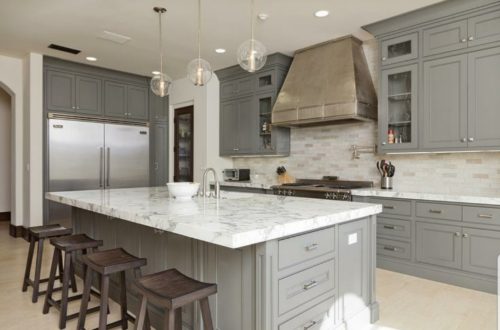
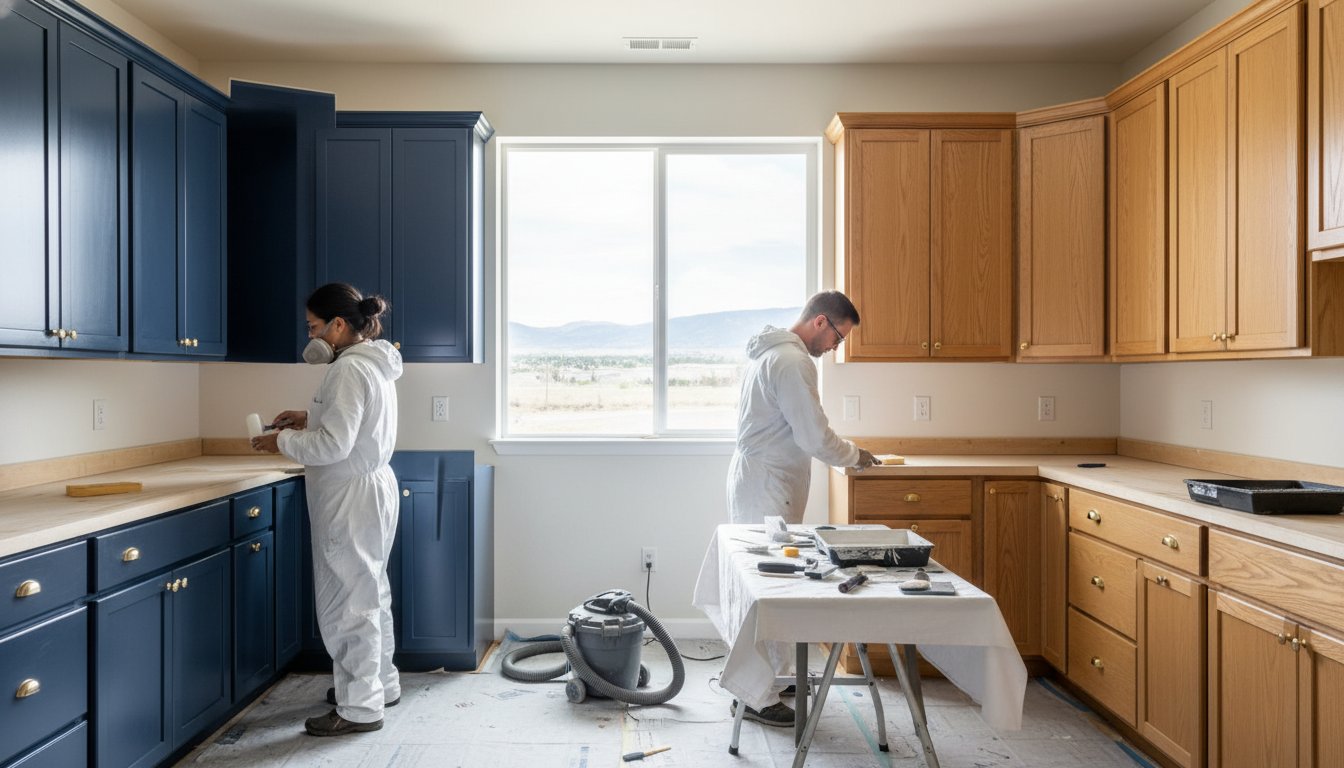
Glaze adds depth and dimension to painted cabinets. A charcoal glaze over a white or blue base creates shadow lines and visual interest. For 2026, white Shaker remains the dominant choice, but blue accents in Newportbury Blue and Champion Cobalt are gaining traction, often paired with charcoal glazes.
For durability, water-based acrylic-polyurethane blends like Benjamin Moore Scuff-X offer exceptional scuff resistance for high-traffic kitchens. These products resist the daily wear of pots, pans, and busy households better than standard latex paints.
DIY vs. Professional Factory Finish: Why the Difference Matters
The appeal of a DIY cabinet painting project is easy to understand. The cost of brushes, rollers, and a weekend of labor seems low. But the reality is different. DIY spray kits and brush methods cannot achieve the Level 5 finish standard. A quality HVLP spray system alone costs $500 or more, and that is before you factor in the learning curve. One bad pass with a sprayer means sanding everything down and starting over.
Brush application creates that 15 to 20 percent thickness variance, which becomes visible as the finish cures and settles. Professional shops control temperature, humidity, and dust, factors that determine whether a finish cures smooth or develops orange peel. There is also the matter of accountability. Professional providers stand behind their work. A DIY mistake means additional material costs and more of your time. When you factor in materials, equipment, time, and the cost of fixing flawed results, professional finishing often wins on value.
Choosing the Right Factory Finish Provider in the Denver Metro Area
The first question to ask any provider is where they spray. Shop spraying in a dedicated facility delivers more consistent results than on-site spraying. If a company tells you they will spray in your garage, keep looking.
Experience matters. Look for companies with 20 or more years in the industry and thousands of completed projects. Longevity signals reliability. Review before-and-after galleries. Quality providers showcase 100 or more transformation photos. Look for oak-to-white conversions, cherry-to-blue updates, and 90s ribbed-to-Shaker transformations. These are the projects that demonstrate real skill.
Confirm owner involvement. Owner-installed projects ensure accountability and consistent quality. Ask about products. Benjamin Moore Scuff-X and comparable water-based acrylic-polyurethanes indicate a commitment to durability. Finally, verify service area coverage. The provider should serve Castle Rock, Castle Pines, Parker, Highlands Ranch, Aurora, and the surrounding Denver metro communities. If you are comparing options for painting kitchen cabinets in Denver, the same standards apply across the metro area.
Maintaining Your Factory Finish: Care Guidelines for Colorado Homes
A factory finish is durable, but it still benefits from proper care. Clean cabinet surfaces with mild soap and water. Avoid abrasive pads and harsh chemical cleaners that can dull the finish over time. Even with a factory finish, Colorado's dry air means occasional conditioning of wood components may be needed.
Request a small amount of matched paint at installation for future minor repairs. Soft-close mechanisms may need occasional adjustment. Check hinges and slides annually. Avoid steam cleaners, solvent-based degreasers, and prolonged direct sunlight on cabinet faces. These simple habits will keep your finish looking new for years.
Frequently Asked Questions About Factory Finish Cabinets
How long does a factory finish last on kitchen cabinets?
Professional spray-applied finishes with quality products like Scuff-X typically last 10 to 15 years before needing a refresh, depending on usage and care.
Can any cabinet be refinished, or are some materials unsuitable?
Most wood cabinets, including oak, maple, cherry, and birch, are excellent candidates. Laminate and thermofoil require different approaches and may not achieve the same result.
What is the most durable finish for kitchen cabinets?
Water-based acrylic-polyurethane blends and conversion varnishes offer the best durability-to-appearance ratio for residential kitchens.
Is a glossy or matte finish better for kitchen cabinets?
Satin and semi-gloss sheens balance durability with ease of cleaning. High-gloss shows fingerprints, while matte is harder to clean and less forgiving of imperfections.
How much does factory finish cabinet painting cost in Castle Rock?
Costs vary by cabinet count, material, and finish type. Most providers offer free on-site estimates. Expect pricing to reflect the 50 to 70 percent savings versus replacement.
Get Your Factory Finish Kitchen Cabinet Quote in Castle Rock, CO
A factory finish kitchen cabinet in Castle Rock, Colorado is the smartest way to transform your kitchen without the cost and disruption of replacement. With local expertise, climate-appropriate spray techniques, and 2026 color trends in white, blue, and charcoal, your kitchen can look brand new in about a week. If you are ready to explore cabinet refinishing in Denver and the surrounding communities, contact a local provider for a free consultation and on-site assessment. Service areas include Castle Rock, Castle Pines, Parker, Highlands Ranch, and the greater Denver metro.