Yes, you can paint over factory-finished cabinets, but the durability of the result depends entirely on the preparation process and the quality of the coating system used. Homeowners in Parker, CO, can achieve a factory-quality result through professional refinishing methods that cure or harden the finish, rather than relying on standard paint application alone. The right process transforms a dated kitchen without the cost of full replacement.
Table of Contents
- What preparation is required before painting over a factory finish?
- How do you achieve a true factory-quality finish on kitchen cabinets?
- How much does professional cabinet painting cost in Parker, CO, compared to replacement?
- How long does a professional cabinet painting project take?
- What cabinet colors are currently outdated, and what should Parker homeowners choose instead?
- Can a factory finish be applied to cabinets that stay in place, or must they be removed?
- How durable is a professionally painted cabinet finish over multiple years of use?
- Which surfaces and cabinet types can be professionally painted or refinished?
- Key Takeaways
- References
What preparation is required before painting over a factory finish?
Yes, preparation is required, and it is the single most important factor in whether the new finish will adhere and last. Factory-finished cabinets have a smooth, non-porous surface that resists adhesion, so cleaning and degreasing are mandatory first steps. Years of cooking residue, oils, and hand contact create a film that paint cannot bond to. Professional services begin by removing that contamination completely before any coating is applied.
Sanding or de-glossing the existing factory finish is required to create a mechanical bond for the new primer and paint layers. According to Parker Precision Painting Company, the process includes cleaning, degreasing, sanding, priming, spray application of two to three coats with light sanding between coats, and a protective topcoat. Fine Line Painting also lists sanding as a core step in its cabinet painting process.
A specialized primer is needed to block tannins and prevent bleed-through, especially when painting over stained wood. Fine Line Painting states it can paint over stained wood using specialized primers that block tannins and prevent bleed-through. Without this step, the natural oils and colorants in wood can migrate through the new paint and create discoloration.
Professional processes eliminate the dust and mess of traditional sanding by using chemical de-glossers or advanced abrasion systems. N-Hance of Denver notes that its refinishing process does not require sanding, which eliminates dust and minimizes mess. This is a meaningful advantage for households that want to avoid airborne particles during the project.
How do you achieve a true factory-quality finish on kitchen cabinets?
A true factory-quality finish is achieved through spray application equipment, such as HVLP sprayers, which create a smooth, even coat that brushing cannot match. Parker Precision Painting Company uses HVLP, or high-volume low-pressure, spray equipment to apply paint. This method atomizes the coating into a fine mist that levels out on the cabinet surface, eliminating brush marks and roller texture.
Multiple thin coats, typically two to three, with light sanding between coats build a durable, level surface. Parker Precision Painting Company applies two to three coats with light sanding between each layer. Fine Line Painting also applies two or more coats as part of its standard process. The layering approach creates depth and hardness that a single heavy coat cannot provide.

The key differentiator is the curing process. Proprietary systems like N-Hance's Lightspeed® Nano technology instantly cure the finish, creating a hardened surface that resists scratches, scuffs, and wear. According to N-Hance of Denver, the Lightspeed® Nano system instantly cures the finish for a durable, factory-quality result. This curing step is what separates a professional factory-grade finish from a standard air-dried paint job.
Professional cabinet makers use cabinet-grade paints and topcoats from brands like Sherwin-Williams and Benjamin Moore, which are formulated for durability. Both Parker Precision Painting Company and Fine Line Painting state they use Sherwin-Williams and Benjamin Moore cabinet paint systems. These products are engineered for high-traffic surfaces and resist chipping, yellowing, and moisture damage better than standard wall paint.
How much does professional cabinet painting cost in Parker, CO, compared to replacement?
Professional cabinet painting in Parker, CO, costs significantly less than replacement. Full kitchen cabinet replacement in Parker typically costs between $15,000 and $50,000, including new cabinetry, installation, and hardware, according to Parker Precision Painting Company. That range reflects the wide variation in kitchen size, cabinet quality, and hardware selection.
Professional cabinet painting delivers the same visual transformation for 20 to 30 cents on the dollar, saving homeowners up to 70% versus replacement. Parker Precision Painting Company states that most kitchen cabinet painting projects range from $1,500 to $4,500, depending on cabinet count and complexity. The final number depends on the number of doors, drawer fronts, and the condition of the existing surfaces.
Cabinet refinishing services are available at a fraction of the cost of replacement or refacing, making it a budget-conscious renovation choice. N-Hance of Denver states its service is available at a fraction of the cost of cabinet replacement or refacing. For Parker homeowners who want a new look without a five-figure renovation budget, painting is the most cost-effective path.
How long does a professional cabinet painting project take?
Most professional cabinet painting projects in Parker are completed in 3 to 5 days, depending on the number of cabinets and drying times. Both Parker Precision Painting Company and Fine Line Painting report that most projects fall within the 3 to 5 day window. The exact timeline depends on kitchen size, cabinet count, and the number of coats required.
Refinishing processes that use instant-cure technology can be completed in just a few days, without the extended downtime of traditional paint drying. N-Hance of Denver states its process takes only a few days and uses the Lightspeed® Nano system to instantly cure the finish. This reduces the disruption to daily kitchen use compared to methods that require long drying periods between coats.
The process includes cleaning, priming, spray application of multiple coats, and reassembly, all performed on-site. Fine Line Painting's process includes consultation, labeling and disassembly, cleaning and degreasing, sanding, priming, painting with two or more coats, and reassembly and inspection. Homeowners should remove all contents from cabinets before work begins to expedite the process.
What cabinet colors are currently outdated, and what should Parker homeowners choose instead?
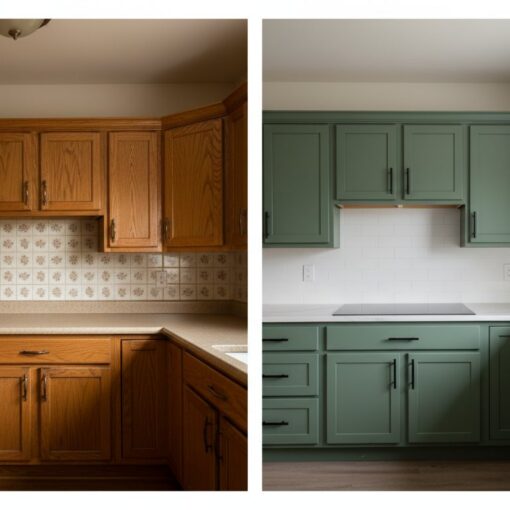
All-white kitchens are losing favor as homeowners seek warmer, more layered palettes. The shift away from stark white reflects a broader move toward spaces that feel lived-in and textured rather than clinical. Honey oak and stark high-gloss finishes are widely considered dated in the Parker market, according to Parker Precision Painting Company. These finishes were common in homes built in the 1990s and early 2000s and now read as outdated to many buyers.
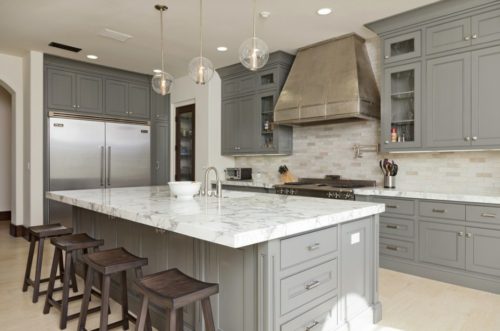
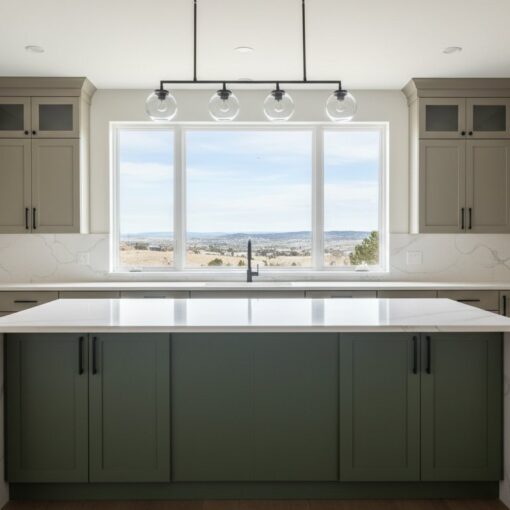
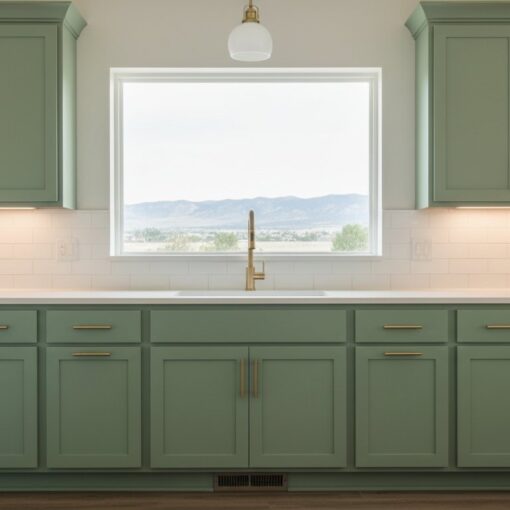
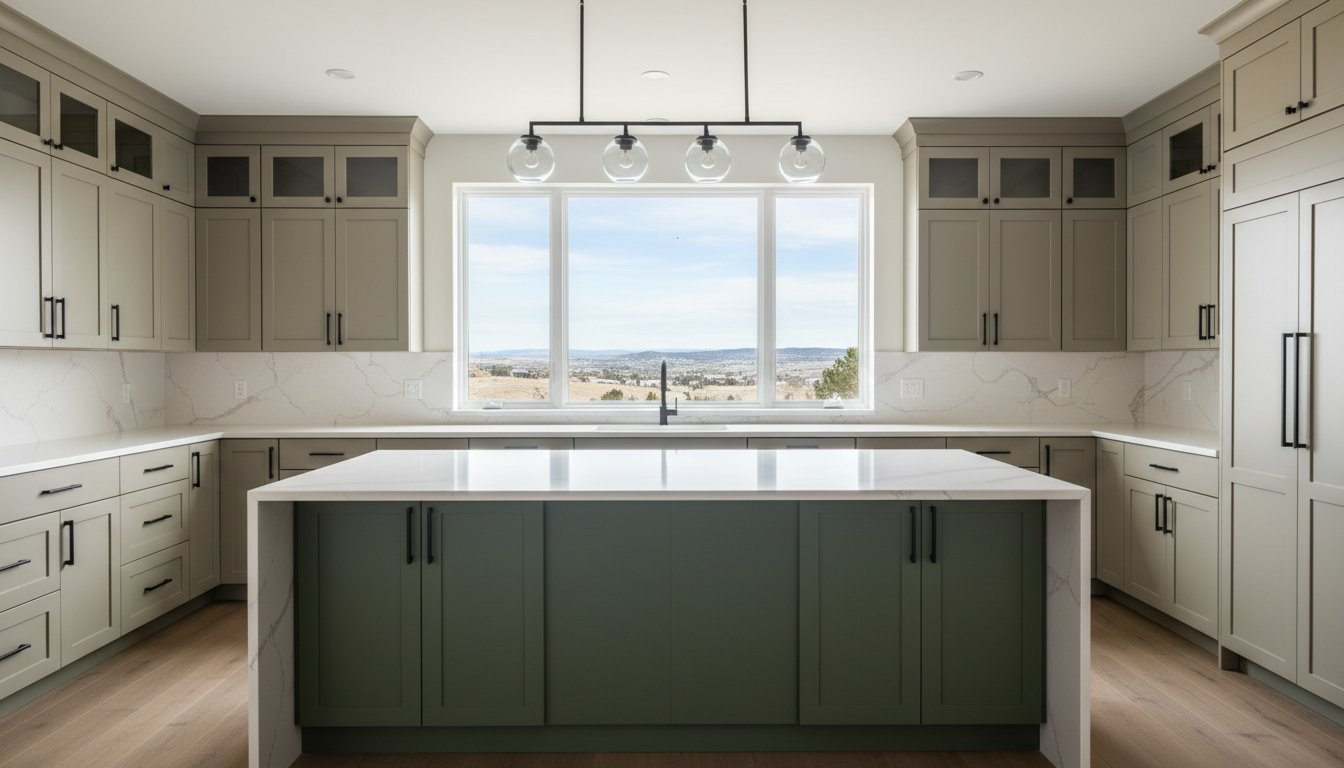
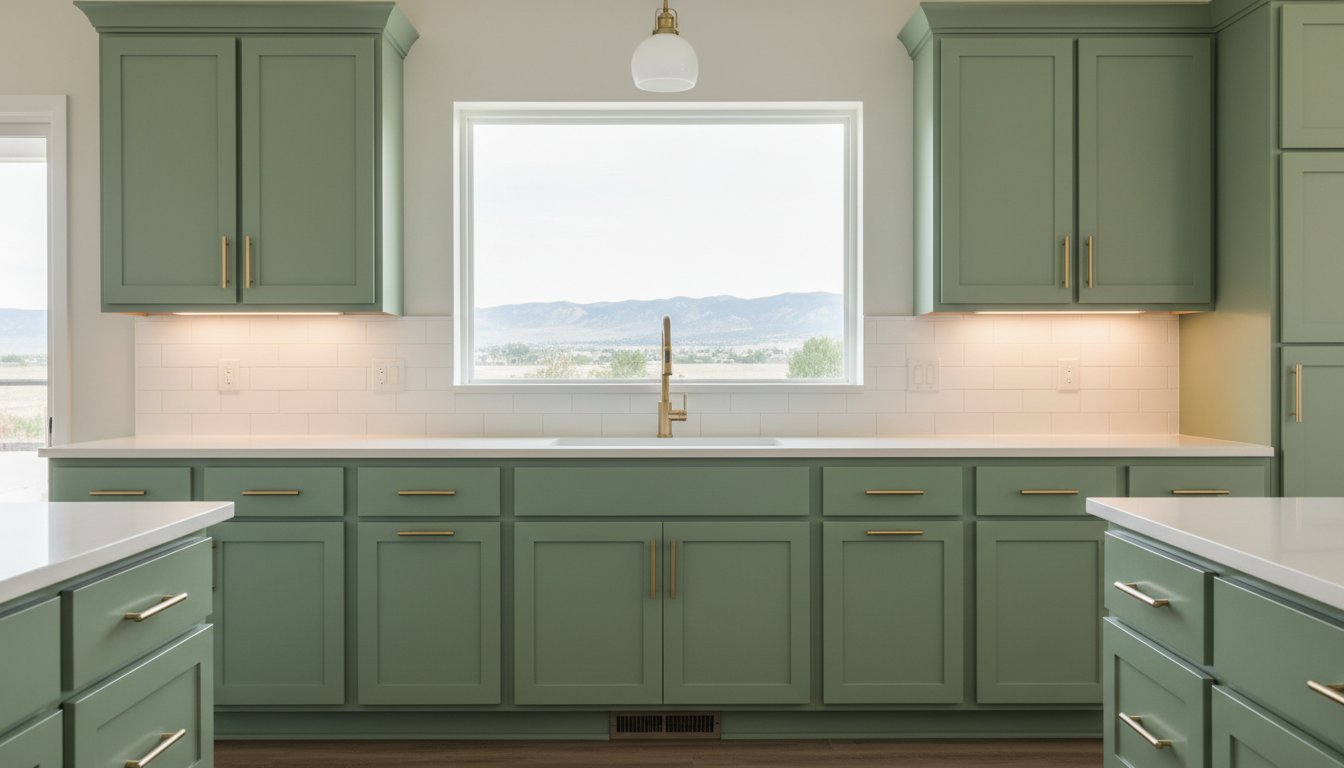
Popular choices in Parker kitchens include crisp white, soft gray, deep navy, sage green, and warm greige two-tone combinations. Parker Precision Painting Company identifies these as the colors most requested by Parker homeowners. Two-tone combinations, such as a deep navy island paired with soft gray perimeter cabinets, add visual interest without overwhelming the space.
A professional consultation can help homeowners select a color that aligns with current trends and their home's architectural style. Updated kitchens are one of the top factors buyers consider in Parker's real estate market, from zip code 80134 to 80138, according to Parker Precision Painting Company. The right color choice can support resale value while creating a kitchen that feels current.
Can a factory finish be applied to cabinets that stay in place, or must they be removed?
Yes, a factory-quality finish can be applied to cabinets that stay in place. Cabinet refinishing with a factory-quality finish takes place directly in the home, eliminating the need to remove cabinets or send doors to an off-site facility. N-Hance of Denver states that its cabinet refinishing takes place directly in the home, eliminating the need to remove cabinets. This reduces project complexity and keeps the kitchen functional during the work.
Cabinet, painting, and refinishing Denver CO. in Castle Rock CO., Castle Pines CO., Highlands Ranch CO., Parker CO. with a factory finish uses a process that eliminates dust and minimizes mess, making it safe for families and the environment. The brand serves the Parker area and surrounding communities with factory-grade coating systems designed for in-home application. The on-site approach avoids the risk of damage during transport and the delays associated with off-site finishing.
Eco-friendly refinishing reduces the release of VOCs, which is safer for both the household and the environment compared to traditional paint stripping. N-Hance of Denver states its process is eco-friendly and reduces the release of VOCs. This is a meaningful consideration for households with children, pets, or anyone sensitive to chemical odors.
The process is suitable for hardwood, MDF, laminate, and thermofoil cabinet doors and boxes, covering a wide range of cabinet constructions. Parker Precision Painting Company states it handles hardwood, MDF, laminate, and thermofoil cabinet doors and boxes. This versatility means most Parker homes can be refinished in place regardless of the original cabinet material.
How durable is a professionally painted cabinet finish over multiple years of use?
A professionally painted cabinet finish is designed to hold up over multiple years of use. Professional cabinet finishes resist scratches, scuffs, and wear, making them suitable for high-traffic kitchens. N-Hance of Denver states its finish resists scratches, scuffs, and wear. This durability is the result of the coating system, not just the paint itself.
The durability of the finish is tied to the curing method. Instant-cure nano technology creates a cross-linked surface that is harder than air-dried paint. N-Hance's Lightspeed® Nano system instantly cures the finish, creating a hardened surface that performs differently from paint that simply dries over time. The curing process locks the molecular structure into a more resistant state.
Using moisture-resistant primers and cabinet-grade topcoats is essential for bathroom vanities and other high-humidity areas. Parker Precision Painting Company states it uses moisture-resistant primers and cabinet-grade topcoats for bathroom vanities. These products prevent swelling, peeling, and mildew growth in damp environments.
While painted cabinets hold up well over years of use, the need for touch-ups or repainting depends on the original surface condition and the quality of the prep work. Cabinets that were heavily damaged or poorly prepared before painting may show wear sooner. A properly prepared and cured finish can last for many years with normal cleaning and care.
Which surfaces and cabinet types can be professionally painted or refinished?
Professional cabinet painting and refinishing works on a wide range of surfaces and cabinet types. Professional services handle hardwood, MDF, laminate, and thermofoil cabinet doors and boxes, according to Parker Precision Painting Company. Each material requires specific preparation techniques, but all can accept a durable new finish when the correct process is followed.
Beyond kitchen cabinets, services extend to bathroom vanities, laundry room storage, built-in shelves or bookcases, fireplace surrounds, mudroom cubbies and lockers, and garage storage systems. Fine Line Painting lists these as the surfaces it regularly paints. This breadth means a single refinishing project can create a cohesive look across multiple rooms.
Painting over stained wood is possible using specialized primers that block tannins and prevent bleed-through. Fine Line Painting states it can paint over stained wood using these primers. This allows homeowners to move from a dated wood stain to a modern painted finish without replacing the cabinets entirely.
Finish options include matte, satin, semi-gloss, or gloss, allowing homeowners to match their preferred aesthetic. Fine Line Painting offers all four finish levels. Satin and semi-gloss are common choices for kitchen cabinets because they balance appearance with cleanability.
Key Takeaways
- Factory-finished cabinets can be painted, but the surface must be cleaned, de-glossed, and primed to ensure adhesion.
- A factory-quality finish is achieved through HVLP spray application, multiple thin coats, and a protective topcoat.
- N-Hance's Lightspeed® Nano technology instantly cures the finish, creating a scratch- and scuff-resistant surface.
- Cabinet replacement in Parker costs between $15,000 and $50,000, while professional painting ranges from $1,500 to $4,500.
- Professional cabinet painting can save Parker homeowners up to 70% compared to full replacement.
- Most cabinet painting projects in Parker are completed in 3 to 5 days.
- Popular Parker color trends include crisp white, soft gray, deep navy, sage green, and warm greige two-tone combinations.