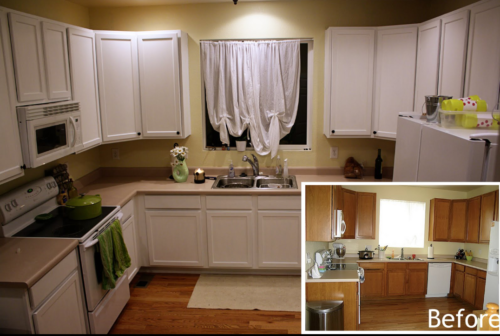

What if the most durable finish for your kitchen was also the safest for your family? Many homeowners believe they must choose between industrial-strength protection and a healthy home environment, but modern chemistry has changed the game. It’s frustrating to deal with the fear that eco-friendly options will peel or that a standard project will leave your house smelling like a chemical plant for weeks. At Painting Kitchen Cabinet Denver, we’ve spent over 45 years proving that you don’t have to sacrifice performance for safety. Using high-performance low voc paint for kitchen cabinets allows us to deliver a hard, resilient surface that stands up to daily use while keeping your indoor air clean.
In this guide, you’ll discover how we achieve a flawless factory finish using advanced waterborne alkyds and urethanes. We’ll break down the technical differences between Low-VOC and Zero-VOC coatings, highlight the top professional brands used by experts, and explain why our meticulous spray application is the secret to a long-lasting result. You’ll learn why traditional oil-based paints are a thing of the past and how our specialized process ensures your cabinets remain beautiful and chip-free for years to come.
Key Takeaways
- Learn how modern waterborne acrylics provide industrial-strength durability without the toxic off-gassing associated with traditional oil-based paints.
- Discover why thorough preparation, including sanding and de-glossing, is the most vital factor in ensuring your new finish doesn’t chip or peel.
- Identify the top-performing brands of low voc paint for kitchen cabinets that deliver a hard, factory-like finish while keeping your indoor air safe.
- Understand the importance of professional spray application and industrial primers to achieve a smooth, long-lasting surface that resists daily kitchen wear.
- See how experienced cabinet refinishing specialists use specialized coatings to provide a high-quality result that is both eco-friendly and extremely durable.
What is Low VOC Paint for Kitchen Cabinets and Why Does It Matter?
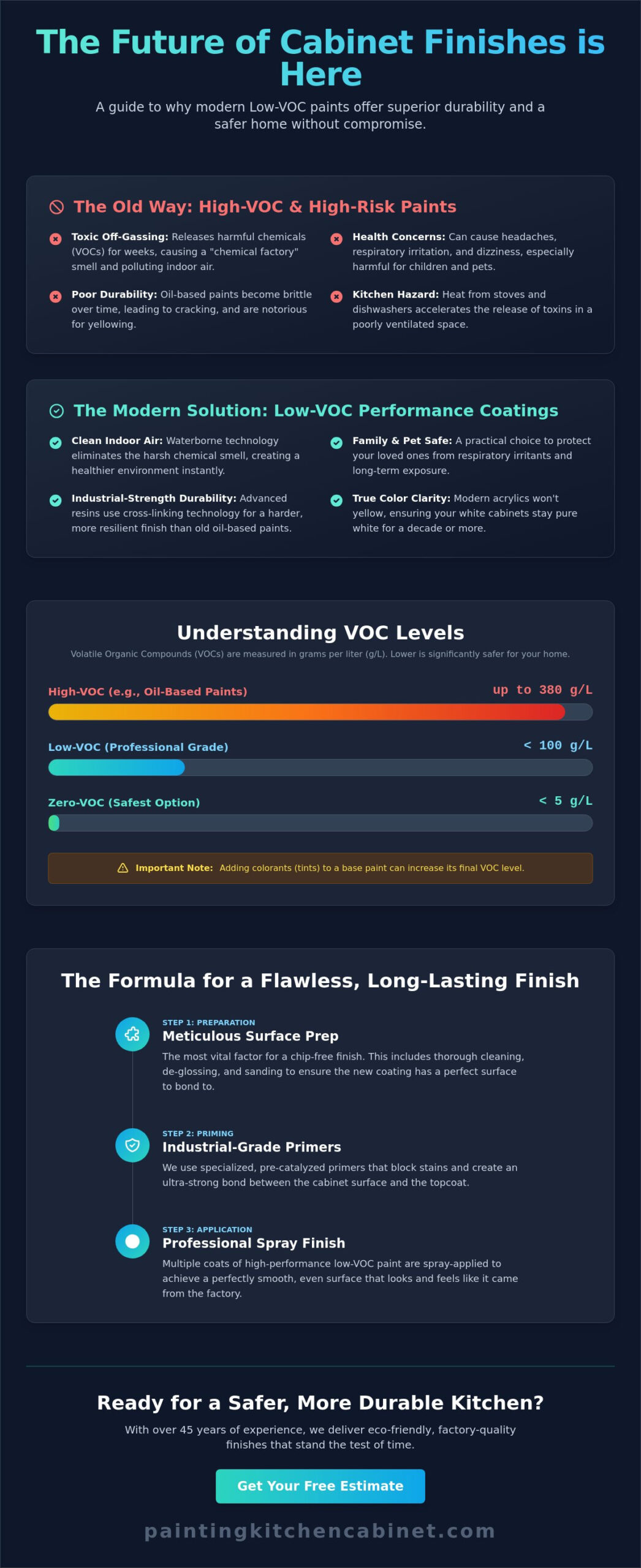
Volatile Organic Compounds (VOCs) are chemicals that turn into gases at room temperature, and they are the primary reason your house smells like a chemical factory after a standard paint job. These Volatile Organic Compounds (VOCs) are released through a process called off-gassing, which can continue for years after the coating is dry. In a kitchen, this problem is magnified. Your kitchen is a high-risk zone because heat from ovens, dishwashers, and stovetops accelerates the release of these toxins. Since many kitchens lack industrial-grade ventilation, these gases get trapped where your family eats and breathes. Choosing low voc paint for kitchen cabinets is a practical decision to improve your indoor air quality, which is often two to five times more polluted than outdoor air.
The health benefits are immediate and measurable. High levels of VOCs cause respiratory irritation, headaches, and dizziness. By using modern, eco-friendly coatings, we eliminate the toxic “new paint smell” and create a safer environment for children and pets. In 2026, regulatory standards are tighter than ever. While the EPA sets a national limit of 380 grams per liter (g/L) for non-flat coatings, professional-grade products now aim much lower to meet strict regional requirements. This shift isn’t just about being “green”; it’s about using superior chemistry that doesn’t rely on harmful solvents to achieve a hard finish.
The Difference Between Low-VOC and Zero-VOC
Technical thresholds matter when you’re looking for the right product. A coating is generally classified as low-VOC if it contains fewer than 100 g/L for non-flat finishes. Zero-VOC products are even cleaner, containing fewer than 5 g/L. It’s a common mistake to assume “Zero” means absolutely nothing is there, but it represents the safest possible level for sensitive individuals. You should also watch out for tinting. Even if the base paint is zero-VOC, adding certain colorants can push those levels back up. We use high-performance systems that maintain low emission levels even after the color is mixed.
Why Traditional Oil-Based Paints are Fading Away
The days of using smelly, oil-based enamels are over. Those old-school products are notorious for yellowing over time and becoming brittle, which leads to cracking. Environmental regulations in Colorado are pushing the industry toward cleaner, waterborne technologies that outperform oil in every category. Modern low voc paint for kitchen cabinets uses advanced resins that provide industrial durability without the weeks of lingering chemical odors. VOCs are carbon-based chemicals that evaporate easily, and reducing them is the most effective way to ensure home renovation safety without sacrificing a high-quality factory finish.
Performance vs. Safety: Can Low-VOC Coatings Deliver a Factory Finish?
Many homeowners think they have to choose between a durable kitchen and their family’s health. This is a false choice. Modern low voc paint for kitchen cabinets is engineered with advanced resins that often exceed the hardness of traditional oil-based enamels. While old-school solvent paints rely on harsh chemicals to cure, high-performance waterborne coatings use cross-linking technology to create a dense, industrial-strength film. This film is specifically designed to minimize the impact on indoor air quality without sacrificing the scrub resistance your kitchen requires.
We use pre-catalyzed primers and industrial topcoats that provide a true factory finish. These aren’t the cheap latex paints you find at big-box stores. These coatings are resistant to grease, steam, and the frequent cleaning that happens in a busy home. Unlike oil-based paints that turn yellow after a few years, these modern acrylics maintain perfect color clarity. Your white cabinets will stay white for a decade or more. The result is a surface that feels as smooth as glass and stands up to the daily abuse of a high-traffic kitchen.
Comparing Solvent-Based vs. Waterborne Acrylics
Solvent-based paints have a massive downside: the smell. They off-gas for weeks and require respirators for everyone in the house. Waterborne acrylics dry to the touch in about 30 to 60 minutes and have almost no odor. This makes them the clear winner for inhabited home renovations. You don’t have to move out of your house for a week just to get new-looking cabinets. For more on how we achieve this look, check out our Cabinet Refinishing: The Expert’s Guide to a Factory-Finish Look.
Meeting KCMA Durability Standards
Professional-grade low voc paint for kitchen cabinets must pass rigorous testing by the Kitchen Cabinet Manufacturers Association (KCMA). These tests involve exposing the finish to 120-degree heat, freezing cold, and common household chemicals like vinegar and lemon juice for 24 hours. Our coatings pass these tests easily. We also prioritize “block resistance.” This is a technical term for a coating’s ability to not stick to itself. Without it, your cabinet doors would stick to the frames every time you closed them. If you want a finish that lasts, you can text us pictures of your kitchen for an accurate price on a professional industrial-grade application.
Top Professional Low-VOC Paint Brands for Cabinets
Choosing the right product is what separates a professional factory finish from a failed project. Many niche blogs recommend brands like AFM Safecoat or linseed oil paints, but these often lack the industrial strength needed to withstand daily kitchen use. We rely on proven coatings from major manufacturers who have spent millions on research and development. According to the U.S. Environmental Protection Agency on VOCs, these compounds are ubiquitous in traditional building materials, making the choice of a high-performance, low-emission coating critical for your home.
Sherwin-Williams Emerald Urethane Trim Enamel is a staple in our shop. It’s a water-based urethane modified alkyd that provides the hardness of a floor enamel with very low VOC levels. Benjamin Moore Advance is another heavy hitter. It’s a waterborne alkyd that flows out like old-school oil paint but cleans up with water. For clients who want the absolute latest in coatings technology, we look toward Envirolak. This Canadian brand specializes in industrial wood coatings that offer a near-zero VOC profile without sacrificing the durability we demand. These products don’t just meet standards; they set them.
If you’re looking for the absolute gold standard, we use Italian finishes like Renner or Milesi. These are high-end waterborne coatings used in custom cabinetry shops across Europe. They offer incredible clarity and a feel that you simply can’t get with standard retail paint. Using low voc paint for kitchen cabinets doesn’t mean you’re settling for a “softer” product. In many cases, these European finishes are significantly more durable than anything found on a hardware store shelf. They resist chemicals and physical wear better than the toxic solvents of the past.
Why We Choose Industrial-Strength Acrylics
We never use standard house paint or “cheap latex” on your cabinets. Wall paint is designed to be flexible and breathable, which is the opposite of what a cabinet needs. Cabinets require a hard, non-porous surface that can handle thousands of opening and closing cycles. We use specialized, precatalyzed primers that create a permanent chemical bond with the wood. This ensures the finish won’t peel when it’s exposed to the heat and moisture of a Denver kitchen. Our process is labor intensive because that’s the only way to guarantee a result that lasts.
Color Selection and Low-VOC Pigments
Achieving deep, rich colors used to require high-solvent tints, but that’s no longer the case. Modern tinting systems allow us to mix thousands of colors while keeping the VOC content well below the 50 g/L threshold. The sheen you choose also plays a role in the final look. While satin is the most popular choice for a factory finish, we also offer matte and high-gloss options. For a deeper look at how we achieve these results, read our Cabinet Painting: The Professional’s Guide to a Flawless, Factory Finish.
The Secret to Low-VOC Success: Prep Work and Spray Application
Prep work is the most vital factor in any cabinet project. You can buy the most expensive low voc paint for kitchen cabinets in the world, but if the surface isn’t prepared correctly, the finish will fail. Most amateur house painters skip the hard parts because they are labor intensive. We don’t. Our process starts with a deep cleaning using industrial-strength degreasers to remove years of cooking oils and skin proteins. If these contaminants remain, the paint simply won’t bond. We follow this with mechanical sanding to create a “profile” on the wood, ensuring the primer has something to grab onto.
The application method is just as important as the preparation. Brushing and rolling are for walls, not for cabinetry. A brush leaves visible tracks, and a roller creates a textured “orange peel” look that screams amateur work. To achieve a true factory finish, we use professional spray equipment. This allows us to handle the unique viscosity of modern waterborne coatings. These eco-friendly paints are often thicker than old-school solvents, requiring high-end sprayers to achieve proper atomization without over-thinning the product. Over-thinning is a common mistake that ruins the durability of the coating.
Our Meticulous Preparation Process
We take a systematic approach to every kitchen in the Denver metro area. First, we remove all doors and drawer fronts. These are transported to our controlled shop environment. This allows us to spray in a dust-free zone, which is impossible to achieve in a standard home. We use specialized pre-catalyzed primers. These primers are designed to block tannins and prevent “bleed-through,” especially on woods like oak or cherry. Without this step, yellow or brown spots will eventually ruin your light-colored cabinets. If you want to see how this looks in your home, text us the number of doors and drawers with pictures and we can get you an accurate price immediately.
Achieving the ‘Factory Look’ via Spray
The science of atomization is what creates that glass-smooth surface. Our sprayers break the paint into a fine mist that settles evenly across the wood. This eliminates the risk of drips, runs, or uneven textures. Because low voc paint for kitchen cabinets dries quickly, often within 30 to 60 minutes, the environment must be perfectly clean. We ensure a dust-free setting for the final topcoat to prevent any imperfections from being trapped in the finish. This level of detail is why our results look like they came straight from a high-end furniture factory, not a hardware store shelf. Our 45 years of experience ensures we do it the right way every time.
Hiring Denver’s Low-VOC Cabinet Specialists
Experience is the difference between a project that looks good for a month and one that lasts for decades. We have over 45 years of experience serving the Denver metro area and surrounding Colorado cities. During that time, we’ve perfected the use of industrial-strength coatings in our unique high-altitude environment. Colorado’s dry climate can be tricky for low-VOC products because they dry much faster here than in humid regions. If a painter doesn’t understand how to manage these specific dry times, you’ll end up with visible lap marks and an uneven surface. Our commitment to using the safest, highest-quality industrial acrylics ensures your home stays healthy while your cabinets gain a durable, factory finish.
Choosing a local expert is essential because the Front Range presents specific challenges for paint adhesion. The thin air and low humidity mean that the “open time” of the paint—the window where it can be leveled out—is much shorter. We use specialized equipment and techniques to ensure the low voc paint for kitchen cabinets lays down perfectly flat before it sets. This isn’t something an amateur house painter can achieve with a brush and a bucket of retail-grade paint. We focus on the physical labor and technical precision required to make your kitchen look like it just came off the showroom floor.
Why Experience Matters in Eco-Friendly Painting
Amateur house painters often treat low voc paint for kitchen cabinets like standard wall paint. They don’t respect the necessary cure times or the meticulous preparation required for a permanent bond. We’ve spent nearly half a century refining our process to avoid these common failures. We know exactly how these coatings behave on different wood species found in Colorado homes, from grainy oak to smooth maple. For a deeper look at our professional standards, read our guide on Expert Cabinet Painting in Denver: Get a Flawless, Factory Finish. We take pride in doing the job right the first time so you don’t have to pay someone else to fix it later.
Get Your Accurate Price Immediately
We value your time and believe in direct, no-fuss communication. You don’t need to schedule a lengthy in-home sales presentation just to get a number. As part of our straightforward approach, you can text us the number of doors and the number of drawers with pictures and we can get you an accurate price immediately. This practical shortcut is how we’ve modernized our traditional, family-owned operation. We serve the entire Front Range, including Denver, Boulder, Castle Rock, Aurora, and Highlands Ranch. If you want the best low-emission coatings applied by seasoned experts who understand the “most vital factor” is prep work, we are ready to work. Text us today to get started on your kitchen restoration.
Transform Your Kitchen with Professional Low-VOC Coatings
Choosing low voc paint for kitchen cabinets is no longer a compromise between indoor air quality and long-term durability. Modern waterborne alkyds and industrial-strength acrylics provide a hard, scrub-resistant surface that handles the heat and activity of a busy home. The secret to a lasting result isn’t just the paint; it’s the labor-intensive prep work and specialized spray-only application that creates a true factory finish. We never use brushes or rollers because your cabinets deserve a smooth, professional look without visible tracks or textures.
With over 45 years of expert experience across the Denver metro area, we understand how to make these eco-friendly coatings perform in Colorado’s dry climate. Our process ensures a permanent bond and a finish that won’t yellow or chip. If you’re ready to upgrade your kitchen without the toxic fumes, we are ready to help. Text us your cabinet door count and photos for an immediate, accurate quote! It’s time to get the beautiful, safe kitchen you’ve been planning.
Frequently Asked Questions
Is low-VOC paint as durable as traditional oil-based paint?
Modern industrial-strength acrylics are actually more durable than traditional oil-based paints because they don’t become brittle as they age. These coatings use advanced cross-linking resins to create a flexible yet rock-hard surface. This technology allows the finish to expand and contract with the wood, which prevents the chipping and cracking often seen with older solvent products.
How long does low-VOC cabinet paint take to fully cure?
Most industrial coatings are dry to the touch within 60 minutes but require 30 days to reach full industrial hardness. You can resume light use of your kitchen after 48 hours. It’s vital to avoid scrubbing the surface or using heavy chemical cleaners during this 30-day window to ensure the finish doesn’t mar or lose its sheen.
Can I stay in my home while you are painting my kitchen cabinets?
You can absolutely stay in your home during the entire process. Since we use low voc paint for kitchen cabinets and spray all doors and drawers in our controlled shop, there are no toxic fumes in your living space. The minimal work done on-site involves masking and spraying the frames with high-efficiency equipment that limits overspray and eliminates lingering odors.
Does low-VOC paint still have a smell during application?
These paints have a very mild, water-based scent that dissipates almost immediately after the coating is dry. Unlike traditional oils that off-gas for 14 days or more, the low-emission profile of modern acrylics means you won’t experience headaches or respiratory irritation. Most homeowners find the scent less noticeable than common household dish soap.
What is the best low-VOC paint brand for a professional factory finish?
We recommend industrial-grade products like Sherwin-Williams Emerald Urethane or Benjamin Moore Advance for a true factory finish. These specific brands are engineered for woodwork and trim rather than walls. They provide the necessary block resistance to prevent doors from sticking to frames, which is a common failure seen with cheaper retail paints.
How do I clean my cabinets after they have been painted with low-VOC acrylics?
Clean your cabinets using a soft microfiber cloth and a mixture of mild dish soap and warm water. You must avoid abrasive sponges or harsh chemical cleaners like bleach and ammonia. These substances can break down the protective topcoat and dull the sheen of your industrial acrylic finish over time.
Is low-VOC paint the same as non-toxic or natural paint?
Low-VOC paint is a high-performance industrial coating regulated to contain fewer than 50 grams per liter of volatile compounds. Natural or non-toxic paints are often made from plant oils or minerals and typically lack the resin hardness required for kitchen cabinetry. We choose low-VOC industrial acrylics because they provide the best balance of safety and extreme durability.
Will low-VOC paint prevent my white cabinets from cracking or yellowing?
Modern waterborne acrylic coatings are chemically stable and won’t yellow over time like traditional oil-based paints. Yellowing is a chemical reaction found in solvents that doesn’t occur in these newer formulas. Cracking is usually a result of wood movement or poor preparation, which is why our 45 years of experience in prep work is essential for a lasting look.